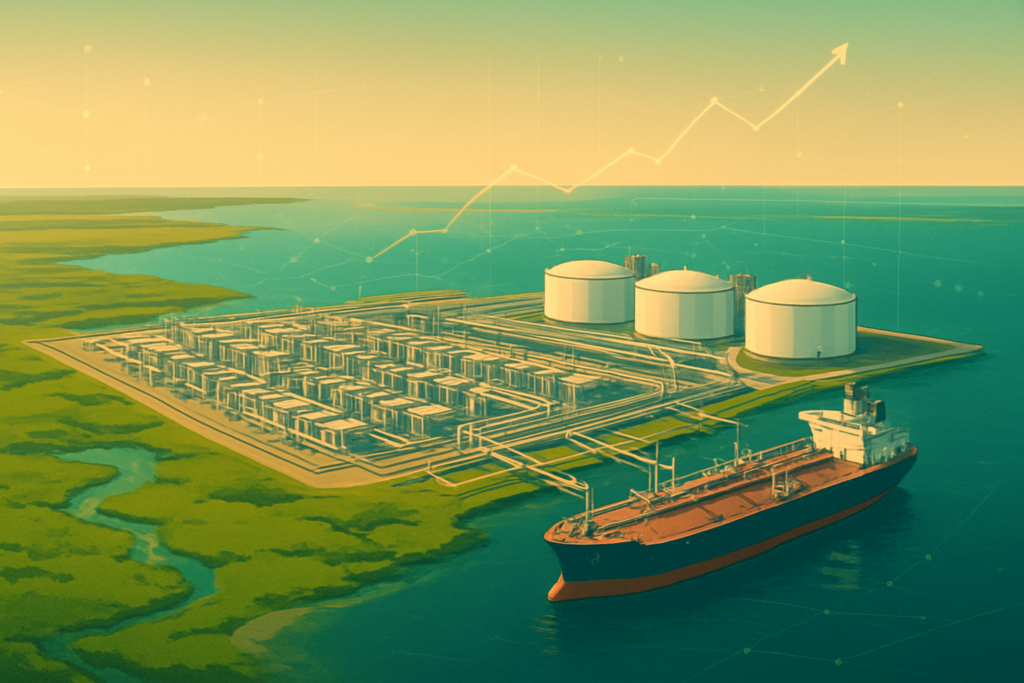
As of March 30, 2026, the global energy landscape is defined by a frantic race for security, and no company has disrupted this race more than Venture Global (NYSE: VG). Once a scrappy private challenger to established energy giants, Venture Global’s transition to a public entity on the New York Stock Exchange in early 2025 marked a watershed moment for the liquefied natural gas (LNG) sector. By leveraging a radical "modular" construction model and an aggressive commercial strategy that has both captivated investors and infuriated long-term partners, the company has ascended to become the second-largest LNG exporter in the United States. Today, Venture Global stands at the center of a geopolitical tug-of-war, serving as a critical bridge for European and Asian energy needs while navigating a complex web of high-stakes litigation and massive debt obligations.
Historical Background
Venture Global was founded in 2013 by two outsiders to the traditional oil and gas establishment: Michael Sabel, a former investment banker, and Robert Pender, an energy finance attorney. At the time, the U.S. shale revolution was in its infancy, and the concept of exporting LNG was dominated by multi-billion-dollar "stick-built" projects that often took a decade to complete.
Sabel and Pender’s vision was to treat LNG plants like manufactured products rather than custom construction projects. Between 2013 and 2018, the duo raised hundreds of millions in private capital and formed a strategic alliance with Baker Hughes (NASDAQ: BKR). This partnership allowed Venture Global to utilize mid-scale, factory-built liquefaction modules that could be shipped to the site and plugged in, significantly reducing lead times. The company’s first project, Calcasieu Pass, broke ground in 2019, setting the stage for what would become the fastest-ever transition from a greenfield site to a global exporter.
Business Model
The Venture Global business model is built on two pillars: Speed-to-Market and Commercial Optionality.
- Revenue Streams: The company generates revenue through 20-year Sale and Purchase Agreements (SPAs) with global utilities and energy majors. However, unlike its peer Cheniere Energy (NYSE: LNG), which prioritizes the stability of "take-or-pay" contracts, Venture Global retains a larger portion of its capacity (estimated at 20-30%) for the "spot market." This allows the company to capture massive windfalls during periods of high global demand and price spikes.
- Modular Scalability: By using standardized 0.626 MTPA (million tonnes per annum) modular trains, the company can bring capacity online incrementally. This "train-by-train" commissioning allows them to start producing and selling LNG while the rest of the facility is still under construction.
- Customer Base: Its portfolio includes diversified global players such as Shell (NYSE: SHEL), BP (NYSE: BP), ExxonMobil (NYSE: XOM), and state-backed entities like China’s CNOOC and Germany’s SEFE.
Stock Performance Overview
Since its IPO on January 24, 2025, Venture Global’s stock has been a bellwether for energy market volatility.
- 1-Year Performance: The stock debuted at $25.00 per share but faced a tumultuous first year. After a late-2025 dip to a 52-week low of $5.72—driven by an arbitration loss to BP—the stock has staged a resilient recovery in Q1 2026. As of today, it trades between $16.50 and $18.00, representing a ~180% bounce from its lows but still trading below its IPO price.
- 5-Year & 10-Year Horizons: On a 5-year basis (including its private valuation growth), the company has seen an exponential rise from a $2 billion private valuation in 2021 to a current market capitalization of approximately $12.5 billion. Investors who entered during the early private rounds have seen returns exceeding 500%, though post-IPO retail investors are still waiting for the stock to reclaim its initial offering price.
Financial Performance
Venture Global’s 2025 fiscal year was a study in contradictions: record-breaking revenue paired with staggering debt.
- Earnings: The company reported $13.8 billion in revenue for FY 2025, a staggering 177% increase year-over-year as its Calcasieu Pass facility reached full commercial operation.
- Margins: EBITDA margins remain high at approximately 42%, bolstered by the company's ability to sell "commissioning cargoes" at high spot prices throughout 2024 and early 2025.
- Debt Profile: The primary concern for analysts is the company’s $95.4 billion in total project debt. With a debt-to-equity ratio of 5.18, Venture Global is significantly more leveraged than the industry average, necessitating consistent cash flow from its expanding project pipeline to service its interest payments.
Leadership and Management
Executive Co-Chairmen Michael Sabel and Robert Pender continue to lead the firm with a "move fast and break things" philosophy that is rare in the conservative energy sector. Sabel, acting as CEO, is known for his aggressive negotiation style and willingness to engage in protracted legal battles to protect the company's "commissioning" margins.
The board was recently strengthened in late 2025 with the addition of several former Department of Energy officials and infrastructure veterans to improve governance and repair the company’s reputation with European regulators. Strategy remains focused on reaching 100 MTPA of total capacity by 2029, which would potentially make Venture Global the largest independent LNG company in the world.
Products, Services, and Innovations
Beyond its core LNG liquefaction, Venture Global has positioned itself as an innovator in "Green LNG."
- Modular Trains: Its partnership with Baker Hughes remains its "secret sauce," allowing for rapid deployment and higher efficiency than traditional massive-train designs.
- Carbon Capture and Sequestration (CCS): The company is currently developing one of the largest CCS projects in the U.S. at its Calcasieu Pass and Plaquemines sites. The goal is to capture and store 500,000 tons of CO2 per year, allowing the company to market its gas as "lower-carbon LNG" to meet strict EU methane regulations.
- Sequential Commissioning: A proprietary operational process that allows them to export gas for up to two years before a plant is "officially" completed—a practice that remains the subject of intense legal scrutiny.
Competitive Landscape
Venture Global occupies a unique space between the established "Big Oil" exporters and the smaller, pure-play developers.
- Cheniere Energy (NYSE: LNG): The primary rival. Cheniere is the "utility-style" alternative, offering lower risk and more stable dividends.
- QatarEnergy: A formidable state-backed competitor. While Qatar has lower production costs, Venture Global offers geographical diversification and shorter shipping routes to Europe.
- The "Second Wave" Developers: Companies like Sempra Infrastructure (NYSE: SRE) and Tellurian (OTC: TELL) compete for the same pool of global capital, but Venture Global’s speed in reaching FID (Final Investment Decision) has given it a significant head start.
Industry and Market Trends
The global LNG market in early 2026 is at a crossroads. After the scarcity-driven spikes of 2022-2024, a massive "supply wave" is beginning to hit the market.
- Buyer’s Market Looming: Analysts project that between 2026 and 2028, global LNG supply will increase by 25%. This could compress margins and lower spot prices, testing Venture Global’s strategy of keeping uncontracted capacity.
- Energy Security: Geopolitical tensions in the Middle East and the continued absence of Russian pipeline gas in Europe have made U.S. LNG a "strategic asset" rather than just a commodity.
- Price Decoupling: We are seeing an increasing trend of LNG prices decoupling from Brent crude oil, moving instead toward a global gas-to-gas benchmark, which benefits agile exporters like VG.
Risks and Challenges
Venture Global is perhaps the most "litigated" company in the energy sector, which remains its primary risk.
- Legal/Arbitration Risk: The ongoing disputes with Shell and BP over delayed contract deliveries are a major overhang. While the company settled with Italy’s Edison in March 2026, the potential for multi-billion dollar damages in other arbitrations remains a "black swan" risk for shareholders.
- Execution Risk: With the CP2 LNG project currently under construction, any delay in its 2027 start date would put immense pressure on the company’s ability to service its debt.
- Environmental Pressure: Despite its CCS initiatives, the company faces constant pressure from environmental groups and strict new methane-intensity standards in its primary export market, the European Union.
Opportunities and Catalysts
- CP2 Full Approval: In late 2025, the Department of Energy finalized the non-FTA export authorization for the CP2 project, removing a massive regulatory hurdle. Full construction is now underway.
- Plaquemines Phase 2: The commissioning of the second phase of the Plaquemines facility in late 2026 is expected to double the company’s current cash flow.
- M&A Potential: As the market consolidates, Venture Global is frequently cited as a potential acquisition target for a super-major like Chevron (NYSE: CVX) or ExxonMobil, who may want to quickly add 40+ MTPA of U.S. capacity to their portfolios.
Investor Sentiment and Analyst Coverage
Wall Street remains divided on Venture Global.
- Bulls (e.g., Goldman Sachs, Morgan Stanley): Highlight the "extraordinary cash-generation machine" and the company's ability to capitalize on market dislocations. Morgan Stanley recently upgraded the stock to Overweight with a target of $22.00.
- Bears (e.g., JPMorgan): Point to the "reputational damage" from contract disputes and the high leverage. JPMorgan maintains a Neutral rating, citing the high cost of debt.
- Retail Sentiment: On platforms like X and Reddit, VG is often discussed as a "geopolitical play," with retail investors betting on sharp price movements tied to global energy crises.
Regulatory, Policy, and Geopolitical Factors
The regulatory environment for Venture Global has shifted dramatically over the past two years. The "DOE Pause" of 2024, which temporarily froze new LNG export approvals, was reversed in early 2025 by the incoming administration. This policy "U-turn" was the primary catalyst for the CP2 project’s survival.
Furthermore, the U.S.-EU Energy Task Force has designated Venture Global’s facilities as "critical infrastructure" for European energy independence. However, this support comes with strings attached: the company must comply with the 2025 Global Methane Pledge, requiring rigorous satellite monitoring and reporting of emissions across its entire supply chain.
Conclusion
Venture Global (NYSE: VG) is a high-octane bet on the future of global energy. By March 2026, it has proven that its modular technology can scale faster than any competitor in history, but its aggressive commercial tactics have left it with both massive profits and a trail of legal battles. For investors, the company offers a unique combination of extreme growth potential and significant downside risk.
As the Plaquemines facility ramps up and the CP2 project takes shape, the next 18 months will be a "prove-it" period for Michael Sabel and his team. If they can settle their remaining legal disputes and maintain their construction timelines, Venture Global may well become the undisputed king of the second wave of U.S. LNG. For now, it remains a high-stakes, high-reward play in an increasingly volatile world.
This content is intended for informational purposes only and is not financial advice.