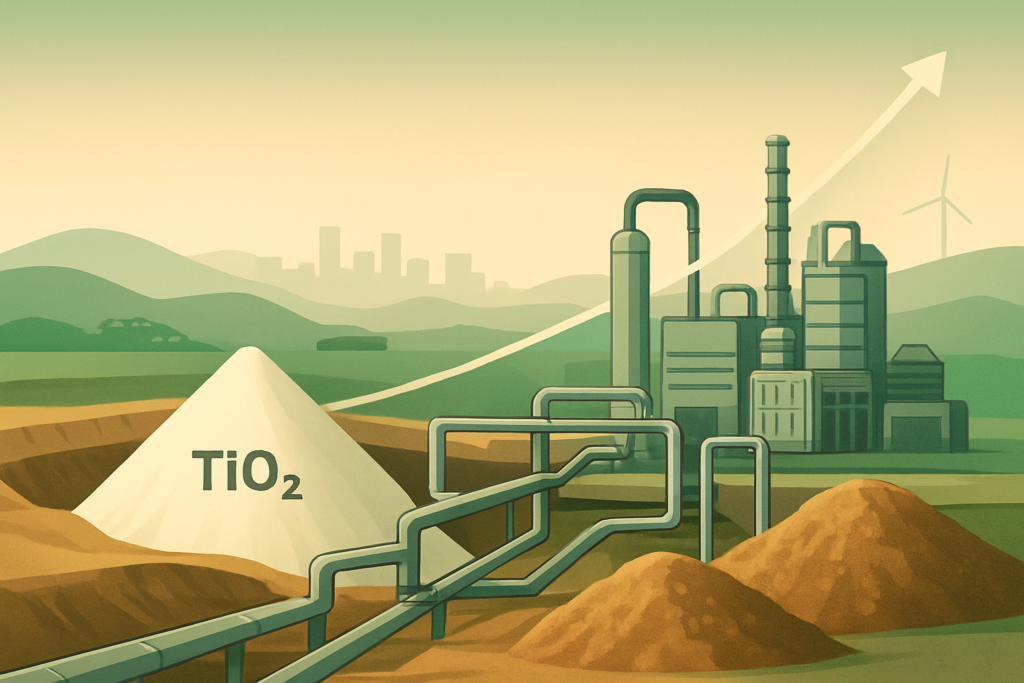
As of March 25, 2026, the global chemical and mining industries are at a critical crossroads, and few companies embody this tension more than Tronox Holdings plc (NYSE: TROX). As a premier vertically integrated producer of titanium dioxide (TiO2) pigment and zircon, Tronox sits at the base of the global industrial supply chain. Its products provide the essential whiteness and opacity for everything from the paint on suburban homes to the plastics in consumer electronics.
Currently, Tronox is in the spotlight as it attempts to engineer a high-stakes turnaround. After weathering a brutal multi-year industry downturn characterized by "destocking" and high energy costs, the company is pivoting toward a leaner operating model and an ambitious expansion into the rare earth minerals market. With a stock price recovering from recent lows but still shadowed by significant debt, Tronox represents a classic cyclical play for investors betting on a global manufacturing rebound and the strategic value of Western-sourced critical minerals.
Historical Background
The story of Tronox is one of resilience and aggressive consolidation. The company was born in March 2006 as a spin-off from the Kerr-McGee Corporation, intended to house the parent company’s chemical assets and, controversially, its legacy environmental liabilities. This heavy debt and liability load forced Tronox into Chapter 11 bankruptcy in 2009. However, the company emerged in 2011 with a restructured balance sheet and a new strategic mandate: vertical integration.
The 2012 acquisition of Exxaro’s mineral sands business was a watershed moment, transforming Tronox from a pure-play chemical processor into a mining powerhouse that could supply its own feedstock. This was followed by the landmark $1.67 billion acquisition of the TiO2 business of Cristal in 2019. That deal not only made Tronox one of the world’s top three producers but also prompted its re-domiciliation to the United Kingdom, cementing its status as a truly global enterprise with assets spanning Australia, South Africa, Europe, and the Americas.
Business Model
Tronox operates a "mine-to-pigment" business model, which is its primary competitive advantage. By mining its own titanium-bearing mineral sands (ilmenite and rutile), the company achieves roughly 85% ore self-sufficiency. This vertical integration buffers Tronox against the volatile price swings of raw materials that often squeeze the margins of non-integrated competitors.
The company’s revenue is divided into three primary streams:
- Titanium Dioxide (TiO2): Accounting for roughly 75-80% of revenue, this white pigment is indispensable for the coatings, plastics, and paper industries.
- Zircon: Representing 10-15% of revenue, zircon is a high-value co-product used in ceramics, refractories, and foundry applications.
- Feedstock and Other Products: This includes high-purity pig iron and monazite, a mineral containing rare earth elements that is becoming a cornerstone of the company’s future growth strategy.
Its customer base includes industrial titans such as Sherwin-Williams (NYSE: SHW) and PPG Industries (NYSE: PPG), making Tronox a bellwether for the global housing and construction sectors.
Stock Performance Overview
As of the close on March 24, 2026, TROX was trading at approximately $8.46 per share. This represents a 15% recovery over the past year, as the market began to price in the end of the destocking cycle. However, the longer-term view remains sobering for multi-year holders.
- 1-Year Performance: The stock has climbed from a 52-week low of approximately $2.86, driven by improved volumes and cost-cutting news.
- 5-Year Performance: Down roughly 47% from its October 2021 peak of over $21.57. The decline reflects the impact of the 2023-2025 cyclical trough and the burden of its high-leverage balance sheet.
- 10-Year Performance: Tronox has historically been a "feast or famine" stock. It experienced massive bull runs in 2017 and 2021, but remains prone to sharp corrections during industrial slowdowns.
Financial Performance
Tronox’s fiscal year 2025 was a year of "pruning." The company reported revenue of $2.90 billion, a 6% decline year-over-year. The bottom line showed a net loss of $470 million, though this was heavily impacted by $233 million in restructuring charges related to the strategic closure of its Botlek and Fuzhou plants.
The company’s Adjusted EBITDA for 2025 stood at $336 million with a margin of 11.6%. The most pressing concern for analysts remains the debt profile; total debt sits at $3.2 billion, resulting in a net leverage ratio of 9.0x. Management has stated that 2026 will be the "year of the balance sheet," with a focus on generating positive free cash flow through reduced capital expenditures and working capital management to pay down this high-interest burden.
Leadership and Management
John Romano took the helm as CEO in April 2024, tasked with navigating the company through one of its most difficult post-bankruptcy periods. Under his leadership, the strategy has shifted from expansion to optimization. The current executive team is focused on a "cash-first" approach, aiming to extract $125 million to $175 million in annual run-rate savings by the end of 2026.
Governance is overseen by an independent-heavy board led by Chair Ilan Kaufthal. While the strategy to close high-cost facilities has been praised by analysts for its long-term logic, management faces scrutiny regarding the timing of the rare earth pivot while the core TiO2 business remains highly leveraged.
Products, Services, and Innovations
Tronox continues to lead in product quality through its TiONA® and TiKON brands. Its innovation pipeline is currently centered on sustainability and high-performance applications. The CristalACTiV range is a notable innovation; these specialty TiO2 products act as environmental catalysts that can degrade nitrogen oxides (NOx) and other air pollutants in urban environments.
The most significant innovation, however, is not a pigment but a process. Tronox is developing a "cracking and leaching" facility in Australia to process monazite into rare earth carbonate. This move transforms a former waste product from its mining operations into a critical component for the permanent magnets used in electric vehicle motors and wind turbines.
Competitive Landscape
The TiO2 market is an oligopoly, but one fraught with intense competition. Tronox’s primary rivals include:
- The Chemours Company (NYSE: CC): The global market leader, known for high-quality chloride-process TiO2.
- Kronos Worldwide (NYSE: KRO): A significant competitor with a strong footprint in Europe and North America.
- LB Group (SHE: 002601): A massive Chinese producer that has historically used low-cost sulfate-base production to flood international markets.
Tronox’s competitive edge lies in its vertical integration, which provides a lower cost floor than non-integrated players, particularly when mining costs or logistics for ore are high.
Industry and Market Trends
A defining trend for 2026 is the rise of regional protectionism. The European Union, India, Brazil, and Saudi Arabia have all implemented anti-dumping duties against Chinese TiO2. This creates a "protected" market for Western producers like Tronox, allowing them to recapture market share and improve pricing power in regions where they were previously being undercut by Chinese exports.
Additionally, the trend toward "friend-shoring" of critical minerals has put a spotlight on Tronox's mining assets in Australia and South Africa. As Western governments seek to reduce reliance on Chinese rare earth supply chains, Tronox’s monazite assets have become strategically vital.
Risks and Challenges
Despite the recovery narrative, the risks are substantial:
- High Leverage: At 9.0x leverage, Tronox is vulnerable to any macro shocks that might delay the 2026 industrial recovery.
- Cyclicality: The company’s fortunes are tied to interest rates and housing starts. If central banks are forced to maintain high rates longer than expected, the construction-driven demand for TiO2 could stall.
- Environmental Liabilities: As a legacy chemical producer, Tronox is constantly managing remediation costs for historic sites, which can result in unexpected cash outflows.
Opportunities and Catalysts
- Rare Earth Re-Rating: If Tronox can prove the commercial viability of its midstream rare earth carbonate production, the stock could be re-rated as a "green energy" materials play rather than a commodity chemical stock.
- Operational Tailwinds: The closure of the high-cost Botlek facility is expected to permanently lower the company’s cost basis, improving EBITDA margins even if prices remain flat.
- U.S./Australia Strategic Funding: Tronox is in discussions for up to $600 million in conditional government financing for its rare earth projects, which would de-risk its capital-heavy expansion.
Investor Sentiment and Analyst Coverage
Wall Street sentiment on Tronox is currently a "wait and see." Most analysts maintain a "Hold" rating, with price targets ranging between $6.40 and $8.60. While there is optimism about the cyclical recovery, credit agencies like S&P Global have highlighted the company’s "CCC+" credit rating as a point of concern.
Recent insider activity has also given some investors pause. In March 2026, SEC filings showed small-scale share sales by CEO John Romano and other executives. While these were likely part of scheduled tax-planning or diversification, they occurred just as the stock was attempting to break out of its multi-year range.
Regulatory, Policy, and Geopolitical Factors
Tronox is a major beneficiary of current geopolitical shifts. The company’s rare earth project is a prime candidate for support under the U.S. Inflation Reduction Act and Australia's Critical Minerals Strategy. On the trade front, the aforementioned anti-dumping duties are the single most important regulatory catalyst for Tronox’s earnings recovery in 2026.
However, the company must also navigate tightening environmental regulations in Europe and North America regarding chemical emissions and mining land rehabilitation. Compliance with these evolving ESG standards is no longer optional but a prerequisite for institutional investment.
Conclusion
Tronox Holdings plc is a company in the midst of a profound transformation. On one hand, it is a traditional cyclical chemical producer fighting high debt and a volatile macro environment. On the other, it is a strategically vital mining entity evolving into a key player in the rare earth supply chain.
For investors, the bull case for TROX rests on the successful execution of its rare earth strategy and the continued protection of Western markets through anti-dumping duties. The bear case is anchored in the company's high leverage and the inherent unpredictability of global industrial demand. As we move further into 2026, Tronox remains a high-beta bet on the resilience of the global manufacturing sector and the strategic shift toward mineral independence.
This content is intended for informational purposes only and is not financial advice.