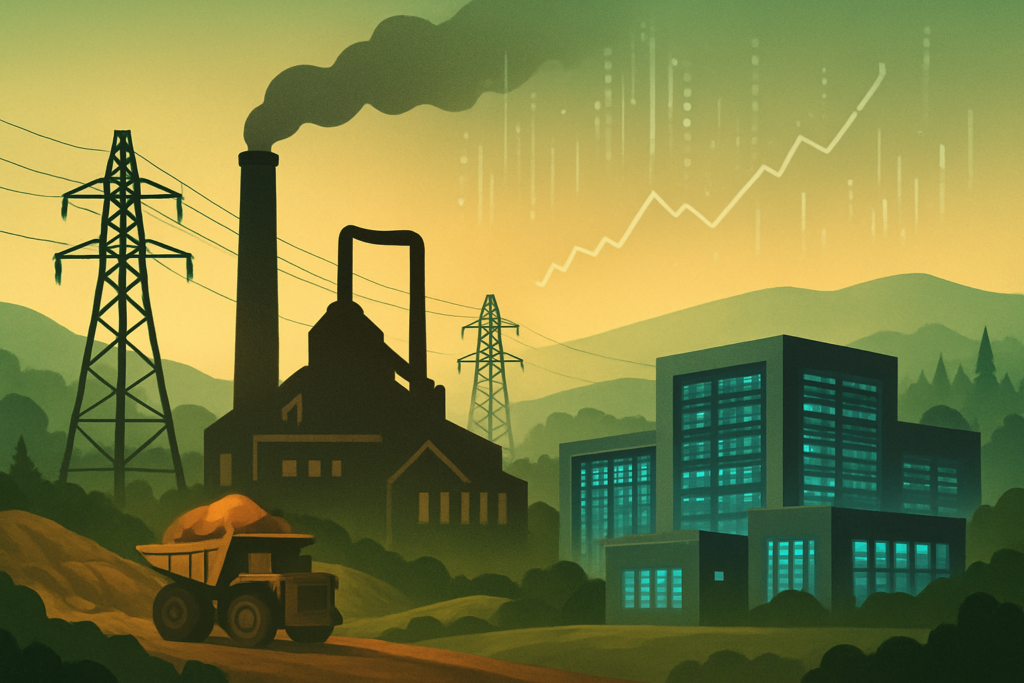
As of March 13, 2026, the industrial landscape is witnessing an extraordinary convergence of old-world manufacturing and new-world digital infrastructure. At the center of this transformation is Alcoa Corp. (NYSE: AA), a titan of the global aluminum industry that has recently transitioned from a cyclical recovery story into a high-stakes strategic pivot.
Alcoa is currently in the spotlight following a significant rating upgrade by JPMorgan in early March 2026, shifting the firm from "Underweight" back to "Neutral." This move comes as the company capitalizes on a dual-tailwind environment: a dramatic surge in global aluminum prices—driven by geopolitical supply shocks and the green energy transition—and a groundbreaking initiative to monetize its legacy industrial footprint. By selling and repurposing its idled smelter sites for AI-driven data center development, Alcoa is unlocking hundreds of millions of dollars in "hidden" real estate value, positioning itself as a critical, albeit unconventional, beneficiary of the artificial intelligence boom.
Historical Background
Founded in 1888 by Charles Martin Hall, the Pittsburgh Reduction Company—later renamed the Aluminum Company of America (Alcoa)—pioneered the electrolytic process for extracting aluminum from bauxite. For over a century, the company was the undisputed leader of the integrated aluminum market, controlling everything from mining to finished aerospace components.
A pivotal transformation occurred in November 2016, when the "old" Alcoa split into two independent, publicly traded entities: Arconic Inc., focused on value-added engineering and finished products, and the "new" Alcoa Corp., which retained the upstream bauxite, alumina, and aluminum smelting operations. This split was designed to allow Alcoa to operate as a lean, pure-play commodity producer. In August 2024, Alcoa further consolidated its power by acquiring Alumina Limited for $2.8 billion, gaining 100% control of the Alcoa World Alumina and Chemicals (AWAC) joint venture and simplifying its corporate structure for the modern era.
Business Model
Alcoa operates a vertically integrated model across three primary segments:
- Bauxite: Alcoa owns or has interests in some of the world’s largest and lowest-cost bauxite mines, primarily in Australia, Brazil, Guinea, and Saudi Arabia.
- Alumina: The company refines bauxite into alumina (aluminum oxide). Following the 2024 Alumina Limited acquisition, Alcoa is now the world’s largest third-party seller of alumina, providing a significant competitive advantage in price discovery.
- Aluminum: The smelting segment produces primary aluminum in various forms (ingot, billet, slab). This segment is the most sensitive to global LME (London Metal Exchange) price fluctuations and energy costs.
Alcoa’s customer base spans the transportation (EVs), packaging, building and construction, and electrical industries. Increasingly, the company is marketing "green" aluminum through its Sustana line, targeting premium buyers focused on low-carbon supply chains.
Stock Performance Overview
Alcoa’s stock (NYSE: AA) has historically been a "high-beta" play on global industrial growth.
- 1-Year Performance: Over the past twelve months, the stock has been highly volatile. After peaking near $65 in early January 2026, it saw a 15% correction in February following analyst concerns over valuation and a projected aluminum surplus. However, it has rallied 8% in the first two weeks of March 2026 following the JPMorgan upgrade.
- 5-Year Performance: Since 2021, the stock has tracked the post-pandemic commodity super-cycle. It reached highs during the 2022 energy crisis, dipped in 2023-2024 amid high interest rates, and began a structural recovery in 2025 as the data center monetization strategy gained traction.
- 10-Year Performance: Looking back to its 2016 inception as a standalone entity, Alcoa has outperformed many of its pure-play mining peers by maintaining a leaner balance sheet and aggressively closing high-cost, older assets.
Financial Performance
In its most recent quarterly filing (Q4 2025), Alcoa reported a significant return to profitability. Revenue for the full year 2025 reached $11.8 billion, a 12% increase year-over-year.
- Margins: Adjusted EBITDA margins expanded to 18%, driven by the integration of Alumina Limited and the realization of $645 million in annual savings from CEO Bill Oplinger’s 2024 profitability program.
- Debt & Liquidity: Alcoa maintains a strong liquidity position with over $1.2 billion in cash and a manageable debt-to-capital ratio. The company’s 2025 sale of its 25.1% stake in the Ma’aden joint venture for $1.1 billion significantly de-leveraged the balance sheet.
- Valuation: Trading at an EV/EBITDA multiple of roughly 5.8x, Alcoa remains attractively valued compared to its 10-year historical average, particularly given the potential for non-core asset sales.
Leadership and Management
William "Bill" F. Oplinger, who took the helm as CEO in September 2023, has been credited with Alcoa’s "industrial-to-infrastructure" pivot. A former CFO and COO, Oplinger is viewed by Wall Street as a pragmatic operator who prioritizes "portfolio discipline" over vanity production volumes.
Alongside CFO Molly Beerman, the management team has shifted the company’s narrative from merely surviving commodity cycles to actively shaping them. Their focus on the "Ten Sites" strategy—monetizing idled smelters for data centers—has been a hallmark of their tenure, moving Alcoa away from being a "price taker" in the real estate market.
Products, Services, and Innovations
Alcoa’s competitive edge increasingly lies in its R&D and sustainability initiatives:
- ELYSIS: A joint venture with Rio Tinto (NYSE: RIO) and Apple, ELYSIS uses a revolutionary carbon-free smelting process that emits pure oxygen instead of CO2. While still in the commercialization phase, it represents the future of "zero-carbon" aluminum.
- Sustana Line: This product family includes EcoLum (low-carbon aluminum) and EcoDura (recycled content), which command a premium price in the European and North American markets.
- Infrastructure Repurposing: Perhaps Alcoa’s most innovative "service" in 2026 is its internal division dedicated to brownfield redevelopment, transforming massive industrial power envelopes into turnkey solutions for hyperscale data center providers like Microsoft (NASDAQ: MSFT) and Amazon (NASDAQ: AMZN).
Competitive Landscape
Alcoa remains one of the "Big Three" in the Western world, alongside Rio Tinto and Hydro (Norway).
- Strengths: Total vertical integration post-2024; dominant position in Tier-1 bauxite; strategic North American and European smelter locations.
- Weaknesses: Higher exposure to fluctuating energy costs compared to hydro-heavy peers like Hydro; regulatory pressure in Western Australia regarding bauxite mining permits.
- Global Rivals: China’s Chalco and Hongqiao Group remain the volume leaders, but their dominance is increasingly challenged by Western "green" premiums and Section 232 tariffs.
Industry and Market Trends
As of March 2026, two primary trends are defining the aluminum market:
- The Energy-Power Nexus: Aluminum production is famously energy-intensive (the "solidified electricity" of metals). As AI demand causes power prices to spike, Alcoa’s existing high-voltage grid connections at idled sites have become more valuable than the metal they once produced.
- Aluminum Scarcity: LME aluminum prices have surged past $3,400 per metric ton in early 2026. This is largely due to production caps in China and the unexpected closure of the Strait of Hormuz in February 2026, which blocked roughly 9% of global supply from Middle Eastern producers.
Risks and Challenges
Despite the current optimism, Alcoa faces significant hurdles:
- Cyclicality: Aluminum is a deeply cyclical commodity. A global recession or a sudden resolution to Middle Eastern trade tensions could send prices back below $2,500/ton.
- Operational Risk: Environmental challenges in Western Australia continue to threaten bauxite supply stability.
- Energy Costs: For its active smelters, Alcoa remains vulnerable to spikes in natural gas and electricity prices, particularly at its European operations.
- Execution Risk: The data center land sale strategy is complex; delays in zoning or power-grid upgrades at sites like Wenatchee, Washington, could dampen investor enthusiasm.
Opportunities and Catalysts
The primary catalyst for 2026 is the "Ten Sites" monetization plan.
- Data Center Sales: Alcoa is targeting $500 million to $1 billion in proceeds from selling 10 prioritized sites. The first major transaction is expected to close in June 2026.
- Microsoft and the Wenatchee Site: Speculation is mounting regarding a massive deal at Alcoa’s Wenatchee site in Washington, which sits adjacent to existing Microsoft data center expansions. A confirmed sale here could be a multi-hundred-million-dollar event.
- Green Premium: As the EU Carbon Border Adjustment Mechanism (CBAM) fully kicks in, Alcoa’s low-carbon aluminum will likely fetch an even higher premium over high-carbon Chinese alternatives.
Investor Sentiment and Analyst Coverage
Investor sentiment has done a 180-degree turn in the first quarter of 2026.
- JPMorgan Upgrade: Analyst Bill Peterson’s upgrade to "Neutral" on March 5, 2026, was a watershed moment. Peterson noted that while he was previously concerned about valuation, the "sustained strength in aluminum prices and the clarity on data center land monetization" provide a floor for the stock.
- Institutional Moves: Data shows several large hedge funds increased their positions in AA during Q4 2025, viewing the company as a "sleeper AI play" via its infrastructure assets.
- Retail Chatter: On retail platforms, Alcoa is increasingly discussed as a "real asset" hedge against inflation, combining commodity upside with technology-driven real estate value.
Regulatory, Policy, and Geopolitical Factors
The geopolitical environment in March 2026 is fraught but beneficial for Alcoa.
- Trade Policy: The U.S. government has maintained 50% tariffs on several categories of aluminum imports, protecting domestic producers like Alcoa from subsidized foreign competition.
- Climate Policy: Stricter EPA regulations and the push for domestic "critical mineral" supply chains have made Alcoa’s North American assets strategically vital to U.S. national security.
- Geopolitics: The ongoing instability in the Middle East has disrupted the flow of aluminum from the UAE and Bahrain, forcing global buyers to look toward Alcoa’s Atlantic-based supply chain.
Conclusion
In March 2026, Alcoa Corp. stands at a unique crossroads. No longer just a 138-year-old metals company, it is evolving into a strategic steward of industrial power infrastructure. The JPMorgan upgrade to Neutral reflects a growing consensus that the company’s risks are now balanced by its extraordinary asset-monetization potential.
For investors, Alcoa represents a dual-track opportunity: a play on the rising price of a critical green-transition metal and a "hidden" real estate developer for the AI era. While the cyclical nature of aluminum will always remain a risk, the company’s strong leadership under Bill Oplinger and its aggressive pivot toward high-value infrastructure make it one of the most compelling stories in the basic materials sector today. Investors should watch the June 2026 deadline for the first data center site sale as the next major indicator of whether this "new" Alcoa can truly deliver on its promise.
This content is intended for informational purposes only and is not financial advice. All data and projections are as of March 13, 2026.