
Single-Dose EPI-321 Demonstrated a Positive Safety Profile and Increased Lean Muscle Volume Across the First Three Evaluable Patients at Six Months
EPI-321 is the First Investigational Therapy Designed to Silence DUX4, the Genetic Driver of FSHD
Epicrispr Biotechnologies, a clinical-stage company pioneering epigenetic therapies, today announced new interim data from its ongoing open-label Phase 1/2 first-in-human study of EPI-321 in facioscapulohumeral muscular dystrophy (FSHD), demonstrating the first reported clinical evidence that a therapy increased muscle volume in patients with FSHD, potentially providing a disease modifying benefit.
This press release features multimedia. View the full release here: https://www.businesswire.com/news/home/20260626528684/en/
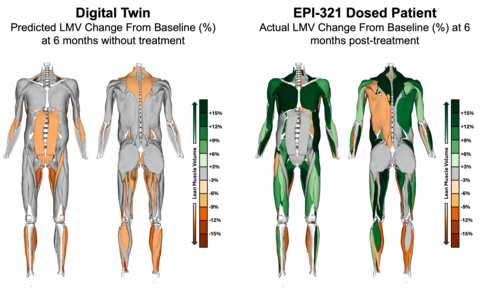
Image caption: MRI images of Lean Muscle Volume (LMV) change from baseline at 6 months for the predicted digital twin without treatment (left) and actual EPI-321 treated patient (right) 6-months post dosing. Images show LMV was predicted to decline due to natural FSHD disease progression (orange colored muscles), but LMV was observed to increase (green muscles) following EPI-321 treatment. Images are from one participant in the study, however the increase in LMV seen here was observed across all n=3 patients 6-months post dosing. Images from Springbok Analytics.
As of the May 12, 2026 data cutoff, nine patients had been treated across two dose cohorts EPI-321 demonstrated a positive safety profile, with no serious adverse events reported to date: six patients were treated with a single IV infusion at the target dose of 2×10¹³ vg/kg (Cohort 1), and three patients treated with a single IV infusion at 4×10¹³ vg/kg (Cohort 2).
Among the first three evaluable patients in Cohort 1, all demonstrated gains in lean muscle volume at six months compared to baseline. Patients achieved an average increase of approximately 370 mL of lean muscle volume, equivalent to approximately 0.8 pounds of muscle mass, with individual gains ranging from approximately 0.5 to 1.3 pounds, and some muscles gaining 15% in lean muscle volume.
The findings represent a potential milestone for FSHD, a progressive neuromuscular disease characterized by ongoing muscle degeneration and weakness. Historically, patients in FSHD clinical studies, including recent Phase 3 trials, have experienced progressive muscle loss over time, in contrast to the consistent increases in muscle volume observed across all evaluable patients treated with EPI-321 at six months. Epicrispr previously reported favorable improvements across multiple strength and functional measures at three months in these same patients. There are currently no approved therapies for FSHD.
EPI-321 is designed to silence DUX4, the genetic driver of FSHD, using Epicrispr's proprietary Gene Expression Modulation System (GEMS) platform to durably regulate disease-causing gene expression without altering the underlying DNA sequence. The single-dose therapy is intended to provide long-lasting suppression of DUX4 activity and durable protection against DUX4-driven muscle damage.
“These results represent a major scientific breakthrough for both the FSHD community and the field of epigenetic medicine,” said Amber Salzman, Ph.D., Chief Executive Officer, Epicrispr Biotechnologies. “For the first time, we are seeing clinical evidence that a therapy may suppress the genetic driver of FSHD and increase muscle volume. The alignment between imaging, biomarker, and functional data strengthens our confidence in the potential of EPI-321 to meaningfully alter the course of disease.”
The MRI findings were supported by favorable reductions in a novel circulating cell-free DNA biomarker reflective of DUX4 pathway activity, providing complementary evidence of biological activity directionally consistent with the observed increases in muscle volume and favorable trends in strength and function.
“Patients with FSHD face a lifelong, progressive loss of muscle that can affect nearly every aspect of daily living, from walking and climbing stairs to maintaining independence,” said Russell Butterfield, M.D., Principal Study Investigator and Associate Professor in Pediatrics & Neurology, University of Utah. “Historically, we have had very limited ability to alter the course of the disease. Although these are early results and additional follow-up is needed, the observed changes in lean muscle volume are encouraging and suggest EPI-321 may be addressing the underlying drivers of disease in a way that could ultimately translate into meaningful benefit for patients.”
MRI analyses were conducted in collaboration with Springbok Analytics, whose AI-powered platform enables precise quantification of muscle volume and other biomarkers from whole-body MRI scans.
“The consistency of the MRI findings across all evaluable patients was remarkable, particularly in a disease where muscle deterioration is expected over time,” said Silvia Blemker, Ph.D., Chief Scientific Officer, Springbok Analytics. “Our quantitative whole-body MRI and AI-powered muscle analysis, enabled objective assessment of changes in lean muscle volume across up to 140 individual muscles throughout the body. While these are early results, the data highlight the value of advanced imaging in capturing treatment-related changes that may not be apparent through traditional clinical assessments.”
The ongoing Phase 1/2 study (NCT06907875) is evaluating the safety, tolerability, biological activity, and preliminary efficacy of EPI-321 in adults with FSHD. Epicrispr expects to present additional data at the World Muscle Society Annual Congress in September 2026 and complete the primary portion of the study in mid-2027.
About Facioscapulohumeral Muscular Dystrophy (FSHD)
Facioscapulohumeral muscular dystrophy (FSHD) is one of the most common forms of muscular dystrophy, affecting an estimated 870,000 people worldwide. FSHD is a progressive genetic neuromuscular disease characterized by the gradual weakening and loss of skeletal muscle, often beginning in the face, shoulders, and upper arms before progressing to other parts of the body. The disease is caused by aberrant expression of DUX4, a gene that is normally silenced in healthy muscle tissue but becomes activated in individuals with FSHD, leading to muscle damage, inflammation, and progressive muscle degeneration. There are currently no approved disease-modifying therapies for FSHD.
About Epicrispr Biotechnologies
Epicrispr Biotechnologies is a biotechnology company pioneering gene-modulating therapies, leading with treatments for neuromuscular diseases. The company’s proprietary Gene Expression Modulation System (GEMS) enables precise and durable epigenetic modulation of gene expression, unlocking first-in-class treatments for previously untreatable conditions. Epicrispr’s lead program, EPI-321 is in clinical trials for FSHD, and the company is advancing additional gene-modulating therapies. Learn more at www.epicrispr.com or follow us on LinkedIn.
View source version on businesswire.com: https://www.businesswire.com/news/home/20260626528684/en/
Contacts
Investor
Benson Cheng
benson.cheng@epic-bio.com
Media
Kimberly Ha
KKH Advisors
917-291-5744
kimberly.ha@kkhadvisors.com