
Ares Capital Corp. (ARCC) will announce a new dividend in just over a month. Will it cut the 48-cent quarterly dividend, which currently yields 11%? ARCC's drop seems to imply this, but investors should be skeptical.
This article will explore an alternative way to think about ARCC using probability analysis, and a different way to play this stock.
ARCC closed Friday at $17.45, down 4.5% from $18.28 a week earlier (3/23), and off over 16.8% from a 3-month peak of $20.98 on Jan. 21. In short, investors are scared Ares Capital is likely to cut its dividend.
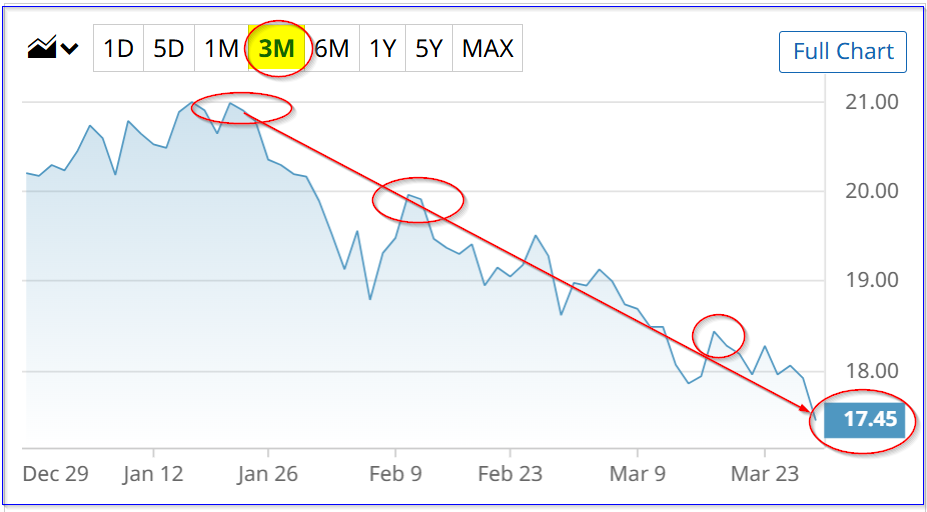
But will this really happen when Ares Capital Corp is set to announce its next quarterly dividend at the end of April, just about a month from now? (Last year, it declared the Q1 dividend on April 29.)
Historically Undervalued
After all, it has consistently paid the same 48-cent quarterly dividend per share (DPS) for the past 14 quarters since Q4 2022.
If it does so again, and keeps this payment for the next 4 quarters (i.e., $1.92), the ongoing annualized yield is 11.00%:
$1.92 / $17.45 = 0.110
That's well over where it has historically traded. For example, Morningstar says it averaged 9.49%, and over the last 5 years, the average was 8.87%.
So, if ARCC were to trade at 9.49%, it would be worth $20.23, i.e., +15.9% more:
$1.92 / 0.0949 = $20.23 target price
That's close to its peak price earlier this quarter.
However, let's assume the worst. For example, even if the market is correct and the company has to cut its dividend by say 15%, here is what it might be worth:
$1.92 - 15% = $1.632 DPS
$1.632 / 0.0949 = $17.20 target price (TP)
That implies ARCC might be a little overvalued (i.e., a potential drop of 25 cents from here, i.e., a -1.43% drop to $17.20).
So, what is likely to happen?
Strong Cash Flow and Scenario Probabilities
Last quarter, Ares Capital Corp reported 52 cents per share in net investment income and paid out 48 cents to shareholders. However, after realized and unrealized losses, the GAAP net income was just 41 cents.
Ares Capital makes income by lending money to corporations and usually takes a senior secured lending position. However, given the credit issues this past several months, it seems likely the company's loans may be under pressure.
Let's say that its investment income drops by 15%. Would that potentially force the company to cut its dividend? Possibly, but management has made a great deal about its “core earnings in excess of our dividends” (CEO Kort Schnabel).
For example, even if earnings are temporarily lower due to unrealized or realized losses, Ares may be able to earn higher net investment income with new, higher-yielding loans. That might lead management to believe that its earnings will be strong enough in the long-term to keep the dividend stable.
Probability Scenario. Let's say there is a one-third chance the dividend will be cut 15% and a 67% chance the dividend stays stable. Here is how that affects the expected target price (TP):
0.33 x $17.20 (see above) = $5.68
0.67 x $20.23 = $13.55
Total: $5.16 + $14.16 = $19.23 expected TP
In other words, even under this scenario, ARCC looks 10% undervalued (i.e., $19.23/$17.45 = 1.102).
In fact, even with using a 50/50 probability, the expected TP is still over 7% higher at $18.72:
0.5 x $17.20 = $8.60
0.5 x $20.23 = $10.12
Total: $8.60 +10.12 = $18.72 expected TP
The point is that ARCC is at least 7 to 10% undervalued at today's price.
However, that does not mean ARCC won't keep falling. As a result, one way value investors can play this is to sell short out-of-the-money (OTM) puts in one-month expiry periods.
Shorting OTM ARCC Puts
Selling short puts that have a lower strike price (i.e., out-of-the-money) over the next month allows an investor to set a lower potential buy-in point and also get paid.
For example, the April 17 expiry period shows that the $16.00 put contract has a midpoint premium of 13 cents. That means an investor who secures $1,600 with their broker can enter an order to “Sell to Open” 1 put contract. The account will then immediately receive $13.00.
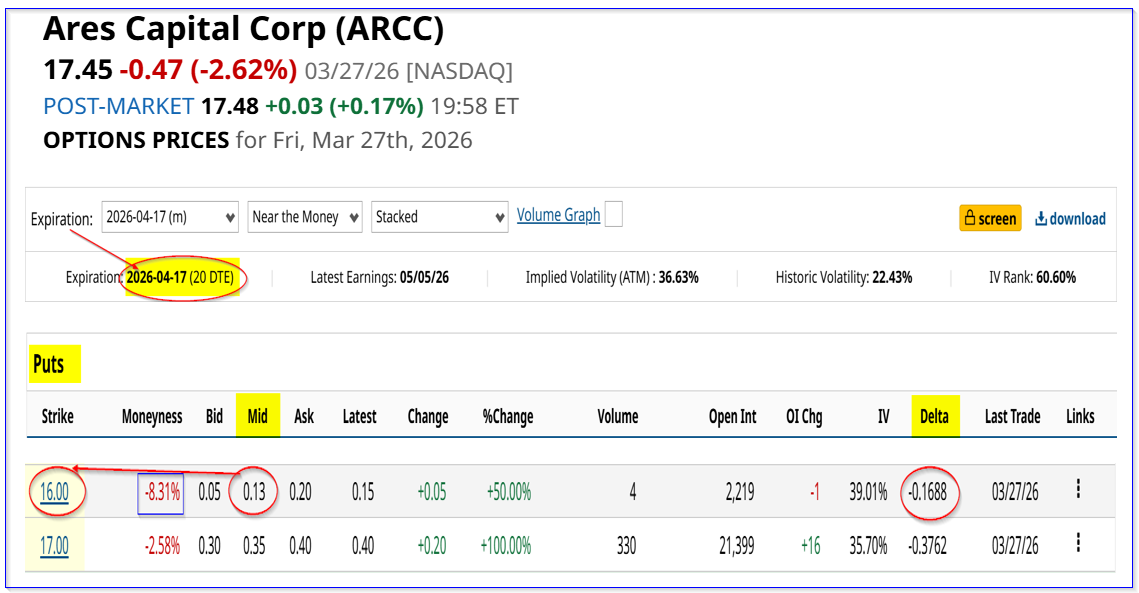
That works out to a one-month yield of 0.815%: (i.e., $13/$1,600). As a result, over three months, if this can be repeated each month, the investment income is 39 cents (i.e., $0.13 x 3):
$39 / $1,600 = 0.024375 = 2.4375% quarterly yield
2.4375% x 4 = 9.75% annualized yield
In other words, repeating this play each month (assuming the premiums stay at this level) allows an investor to make almost the same yield as buying ARCC today. The potential buy-in point is lower as well.
For example, even if ARCC falls to $16.00, the investor has a lower breakeven point, given all the income received.
The bottom line is that ARCC looks undervalued here, and shorting OTM puts might be a way to play it.
On the date of publication, Mark R. Hake, CFA did not have (either directly or indirectly) positions in any of the securities mentioned in this article. All information and data in this article is solely for informational purposes. For more information please view the Barchart Disclosure Policy here.
More news from Barchart
- Strategy Inc Has Unusual Call Options Volume Today - Popular Covered Call Play
- The S&P 500 Is Down 7% but Caterpillar Stock Is Not. This Bull Put Trade Pays You to Bet on It.
- Will Ares Capital Cut Its Dividend? ARCC Stock's Tumble Implies This. But Not So Fast
- Bear Call Spread Opportunities for March 30