On the surface, the market doesn’t look great.
The S&P 500 Index is down 7% year to date. The big names like Nvidia and Microsoft are taking a beating, as though something fundamental has changed. The sky, it seems, is falling.
And then, other sectors are performing well despite overall market weakness. The S&P 500 Industrials sector, for example, is up 3% YTD and was named one of the two most favored market sectors for the next 12 months.
So, if you were a glass-half-full kind of trader, then selling bull put spreads on top industrial stocks may reward your optimism.
What are bull put spreads?
A bull put spread is an options trading strategy that involves selling an out-of-the-money put option and simultaneously buying a put at a lower strike price on the same underlying asset, with the same expiration dates. The strategy starts with a net credit.
Bull puts are often used when you expect a more neutral or slightly bullish trading environment for your underlying asset. This is because, with the bull put, you get a defined profit and loss profile. Your maximum profit is the net credit you receive from the trade, while the maximum loss is the difference between your strike prices (the width of the spread) minus your net credit.
Just remember, all per-share values are multiplied by 100, since each options contract is typically worth 100 shares.
What S&P 500 Industrials stock should you choose?
Now, several industrial stocks are in the S&P 500. But, for my money, I’d suggest picking Caterpillar (CAT).
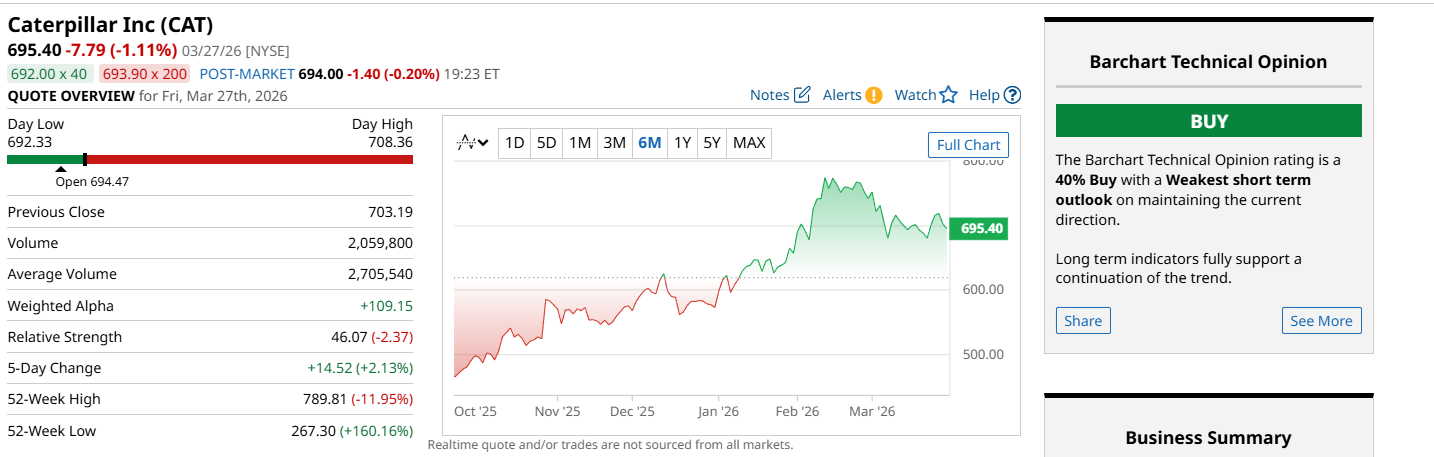
Caterpillar is one of the most recognizable industrial brands in the world. Not only that, it has a Buy rating from Barchart's Technical Opinion and a Moderate Buy rating from Wall Street analysts.
How to find bull put trades on CAT
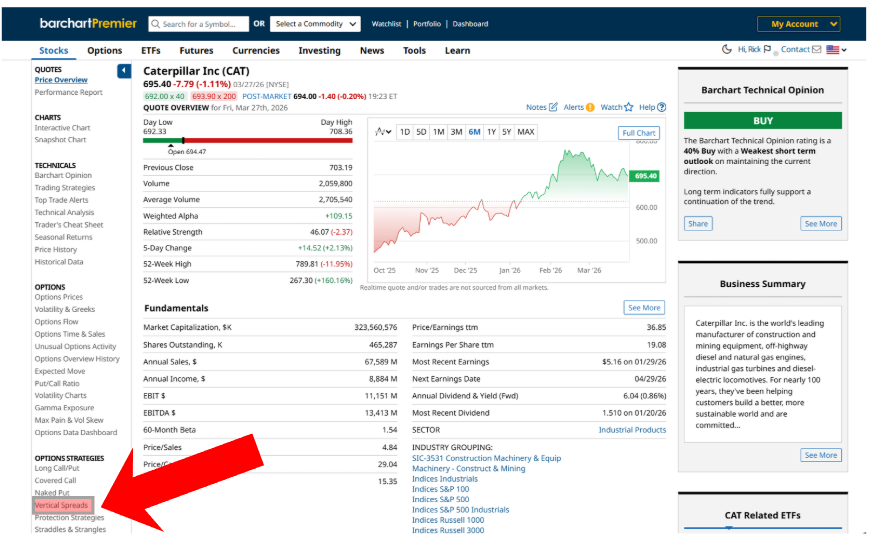
From the stock’s main page, click on Vertical Spreads right here, then click the bull put tab.
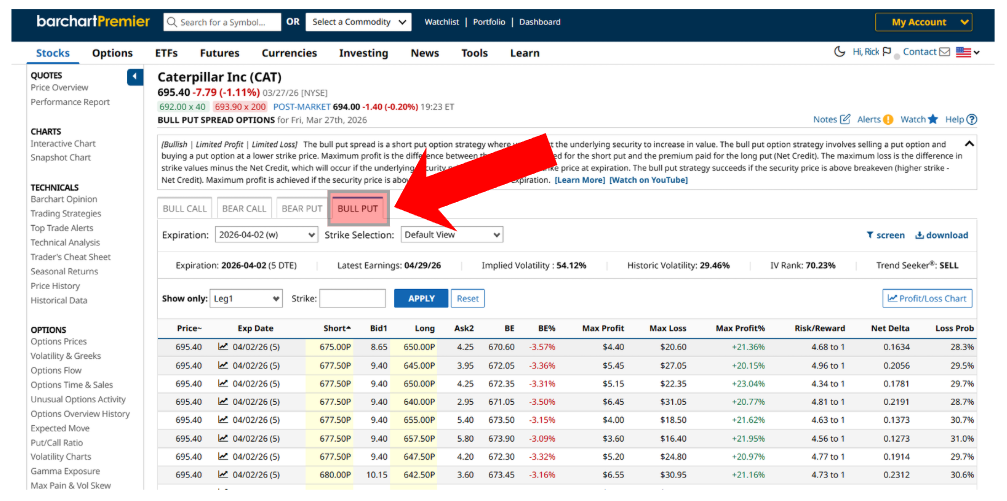
Once there, the first thing you need to do is change the expiration date.
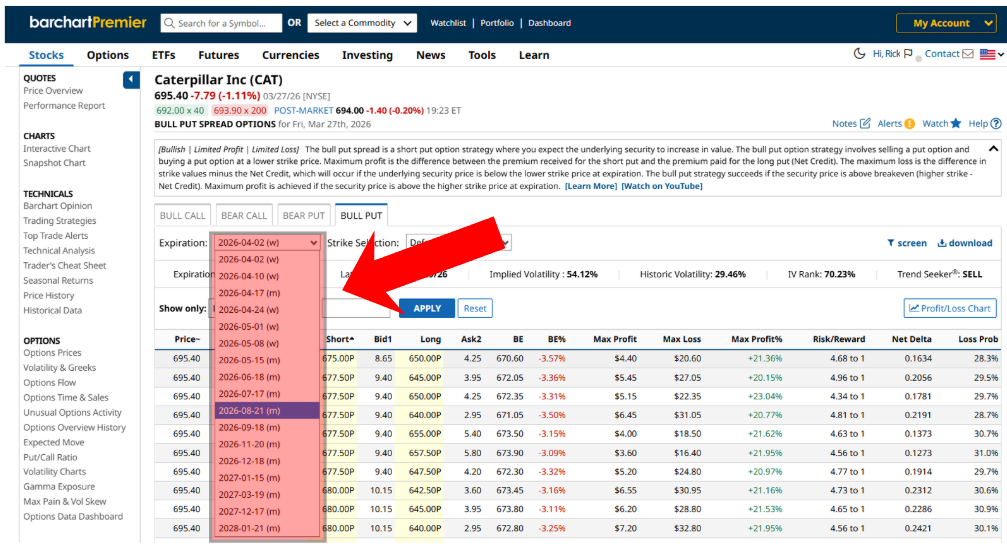
Now, when I sell bull puts, I prefer selling them 30 to 45 days out. This could give me a balance of higher net credit and more time to adjust the trade if necessary. So, for this example, I’ll set the expiration date to May 1, 34 days from now.
Once there, I’ll rearrange the results based on the lowest loss probability, then I'll use the top trade and break it down.
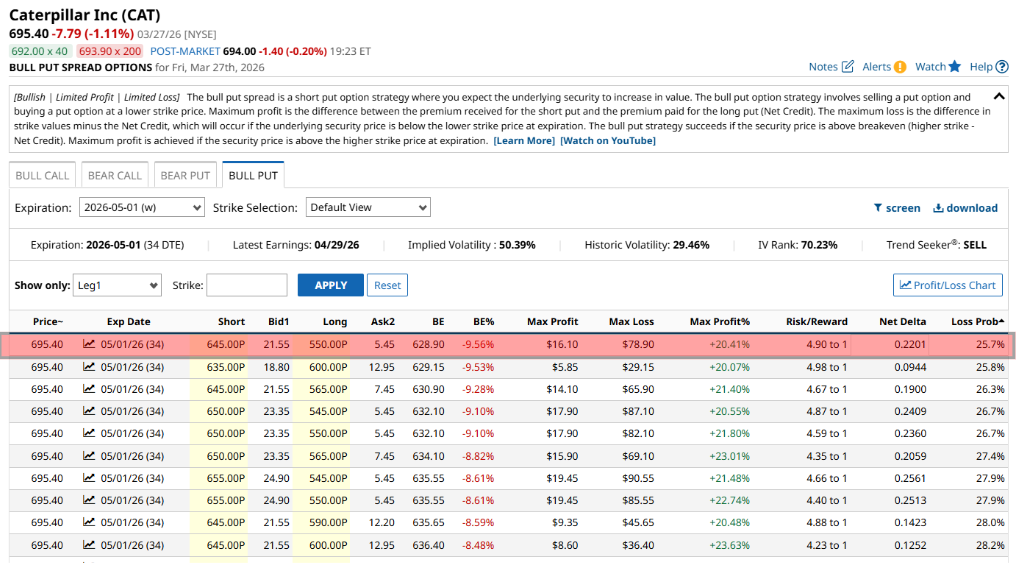
Trade breakdown
According to the screener, you can sell a 645-strike put on Caterpillar and receive a total of $2,155 for the contract. At the same time, you can buy a 550-strike put and pay $545, bringing your net credit to $1,610 total for the entire spread. As long as Caterpillar trades above $645 at expiration, the options expire worthless, and you keep that $1,610 in full.
This trade has a 26% chance of expiring at a loss, which is decent, and a 4.90-to-1 risk/reward ratio, quite favorable.
Now, you do have to look out for the massive $7,890 potential max loss, which will kick in if Caterpillar trades anywhere below $550 at expiration.
Adjustments
If the stock does trade near either your short put or long put by expiration and you want to either mitigate or avoid losses, you can always adjust your trade as long as it still has time left before expiration. Adjustments or “rolling” is done by closing the spread and selling a new one with either a different strike or expiration date, or both.
However, rolling changes your profit-and-loss profile, since premiums will have changed by then. For example, if the stock is trading close to your short put, closing it will likely cost more than what you initially received.
That’s why trade adjustments are only done if you still believe that the trade will work in your favor, or, if the stock is already trading near your long put, if you’re avoiding a large, inevitable loss.
Final thoughts
Even in a generally bearish market, there are still viable and, more importantly, rewarding contrarian strategies that you can use to generate income. The only thing is, you need to pick out the best strategy and pair it with the best underlying asset for it to work.
In this case, Caterpillar’s moderately bullish moves, coupled with the positive expectations from its overall sector, make it one of the best assets to sell bull puts on. Just remember, every trade comes with risk, so keep an eye out for sudden market swings. And never use a strategy that doesn’t fit your trading thesis and goals.
On the date of publication, Rick Orford did not have (either directly or indirectly) positions in any of the securities mentioned in this article. All information and data in this article is solely for informational purposes. For more information please view the Barchart Disclosure Policy here.
More news from Barchart
- Strategy Inc Has Unusual Call Options Volume Today - Popular Covered Call Play
- The S&P 500 Is Down 7% but Caterpillar Stock Is Not. This Bull Put Trade Pays You to Bet on It.
- Will Ares Capital Cut Its Dividend? ARCC Stock's Tumble Implies This. But Not So Fast
- Bear Call Spread Opportunities for March 30