
Rare earth demand is rising fast. Between 2024 and 2030, global demand for rare earths is projected to increase by 45%, mainly because electric vehicles (EVs) and renewable energy keep expanding. As demand climbs, countries are paying closer attention to where rare earths come from and who controls the supply chain, especially as China still dominates global processing capacity. At the same time, President Donald Trump's renewed interest in Greenland has put the island’s mineral resources back in focus, helping to lift mining stocks tied to Greenland.
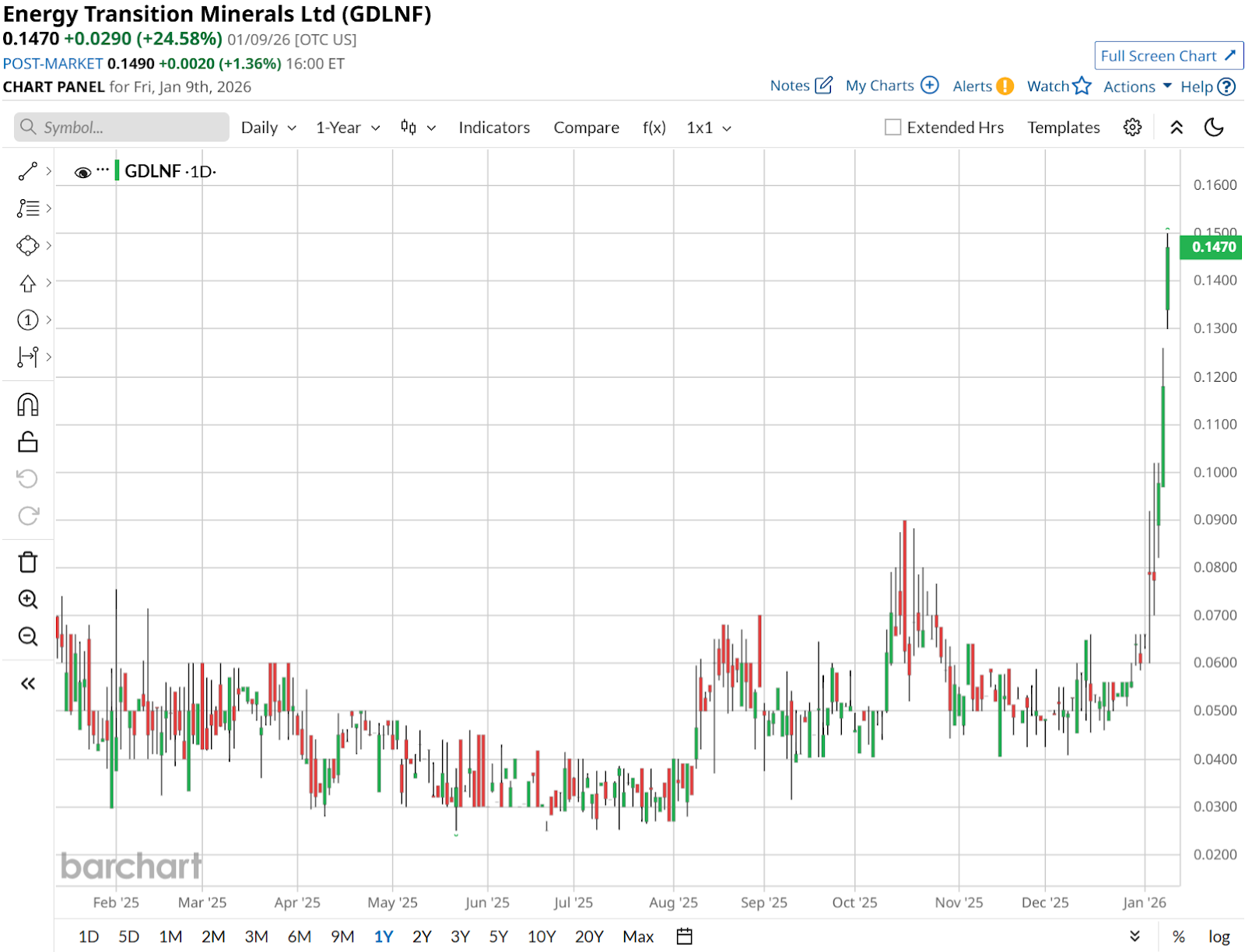
Energy Transition Minerals (GDLNF), an Australian explorer advancing the Kvanefjeld rare earth project in southern Greenland, has become one of the clearest winners from this renewed attention. GDLNF stock has surged 87% over the past month.
The company’s flagship Kvanefjeld deposit ranks as one of the largest land-based rare earth deposits globally, with more than 11 million metric tons of reserves and resources, including 370,000 metric tons of heavy rare earths. With Washington exploring deeper involvement in Greenland's strategic direction, does the fundamental value of this pre-revenue miner justify the rally? Or are investors chasing a geopolitically fueled speculative move that could reverse just as quickly? Let’s take a closer look.
GDLNF’s Financial Engine
Energy Transition Minerals (GDLNF) is an Australia-based critical-minerals developer best known for its Kvanefjeld rare earths project in Greenland. Its business model is straightforward and typical for a pre-production miner. The firm builds and advances a portfolio of mineral assets, works through technical and legal milestones to reduce project risk, and funds most of that work through equity raises rather than operating cash flow.
Over the past 52 weeks, shares of GDLNF stock are up about 119%. Year-to-date (YTD), the gain is roughly 102%.
The company’s half-year report shows “other income” of $796,000 (up from $264,000 a year earlier), mostly from interest on cash deposits. That helps, but it also highlights that the business still is not generating operating revenue.
Net loss before tax narrowed to $1.81 million from $2.39 million in the same period of the prior year. Loss per share improved to $0.12 from $0.17, while total comprehensive loss came in at $1.69 million after a positive foreign-currency translation impact.
Expenses also show where the attention has been. Exploration and evaluation spending fell to $101,000 from $425,000, which lines up with a stretch where legal strategy mattered more than fieldwork. Professional fees dropped to $169,000 from $601,000.
Liquidity is the main support here. Cash and equivalents rose to $18.48 million from $11.98 million at the end of 2024, as financing inflows (including the January 2025 placement) more than covered operating outflows of $2.34 million for the half. Total liabilities fell to $337,000 from $1.59 million, pushing net assets up to $23.6 million. Investors should also note that the Kvanefjeld project is fully impaired to a “nil carrying value” despite roughly $99 million of gross spend, which is accounting’s way of pointing to the regulatory overhang.
Even after such an impressive move in the stock, traditional valuation signposts remain limited. There is no meaningful revenue, earnings-based ratios do not help much, and mainstream analyst coverage is essentially absent. That leaves GDLNF stock trading mainly on cash runway, optionality tied to arbitration and licensing outcomes in Greenland, and the expectation that today’s funding base can eventually support an operating business.
The Fundamentals Behind This Greenland Miner
Energy Transition Minerals has spent years being viewed mainly as a single-asset Greenland arbitration story, but the last few months have started to change that. The biggest shift is the Penouta deal.
In August 2025, the company won the auction to acquire the Penouta tin-tantalum-niobium mine and processing plant in Galicia, Spain. By October 2025, a Spanish insolvency court confirmed Energy Transition Minerals as the successful buyer. That gives the company the only producing tantalum and niobium mine in Europe and, more importantly, a way to pursue near-term cash flow while Kvanefjeld remains tied up in permitting and arbitration.
Kvanefjeld is still the long-term swing factor. The project holds over 1 billion tonnes of JORC-compliant mineral resources across three zones, which puts it among the world’s largest undeveloped rare earth deposits. However, regulatory uncertainty has pushed the company to fully impair its carrying value to zero despite roughly $99 million in historical spending.
To improve its financing options and visibility, Energy Transition Minerals has brought in two prominent U.S. advisors to support a potential Nasdaq listing and help secure capital for Kvanefjeld’s future development. Since GDLNF stock trades over-the-counter today, shares mostly attract retail money. A move to a U.S. main board could open access to an $8 trillion-plus institutional pool, including mutual funds, pensions, and asset managers that cannot hold OTC shares. Those are the kinds of investors that can fund billion-dollar project builds.
Beyond Greenland and Penouta, the company has also been adding earlier-stage options in Europe and Canada. For example, the Villasrubias lithium project in Spain is still early and does not drive near-term valuation, but it lines up with European Union battery supply-chain priorities and adds a second potential growth path.
The Bottom Line
At this point, GDLNF stock looks more like a fast-moving rare earths options ticket than a stock most investors should chase after a moonshot. The company has real levers in play — from a huge undeveloped rare earth deposit to a newly acquired producing asset in Spain and a possible future Nasdaq listing — but everything still sits on top of legal, regulatory and financing uncertainty rather than steady cash flows. For most, this stock rally is one to watch rather than buy into. If anything, the risk skew from here suggests the next meaningful move is more likely to be sideways to lower than a smooth continuation higher — unless the company lands clear, de-risking milestones in short order.
On the date of publication, Ebube Jones did not have (either directly or indirectly) positions in any of the securities mentioned in this article. All information and data in this article is solely for informational purposes. For more information please view the Barchart Disclosure Policy here.
More news from Barchart
- Thanks to Trump, Elon Musk’s Prophesy About Chinese EV Companies Might Come True
- ‘They Can Build a Hospital In a Weekend’: Nvidia’s Jensen Huang Warns China Builds Way Faster Even if the U.S. Is ‘Generations Ahead’ on AI
- Should You Buy, Sell, or Hold Visa Stock for January 2026?
- Trump Just Juiced the Bull Case for Lockheed Martin to $1.5 Trillion. Does That Make LMT Stock a Buy Here?