
TARRYTOWN, NY / ACCESS Newswire / August 19, 2026 / CreditRiskMonitor.com, Inc. (OTCQX:CRMZ) reported revenues of $5.2 million, an increase of approximately 2%, for the second quarter of fiscal 2026 compared to the same period of fiscal 2025. The Company reported an operating loss of approximately $664 thousand for the second quarter of fiscal 2026 compared to an operating loss of approximately $8 thousand for the same period of fiscal 2025. The decrease in operating income was primarily driven by increased expenses related to the addition of senior technology leadership, extraordinary professional services incurred during transformation initiatives, and recording sales tax. The Company reported a net loss of approximately $475 thousand for the second quarter of fiscal 2026 compared to a net income of approximately $135 thousand for the same period of fiscal 2025.
Mike Flum, CEO, said, "I want to start by addressing the restatement directly. Upon management's initiative, the Company commissioned a nexus study with an external tax advisor and determined that it had established economic and physical nexus in state and local jurisdictions in which it had not been collecting and remitting sales and use tax or filing income tax returns. We have recorded a sales tax liability of approximately $2 million and an income tax liability of approximately $210 thousand, inclusive of interest, though our review remains ongoing and these figures are subject to change pending resolution with each impacted state. These updated figures reflect a revision from our preliminary estimate disclosed in our August 6, 2026 Form 8-K as additional jurisdictions were evaluated.
Concurrently, we identified a material weakness in our internal control over financial reporting related to the identification and monitoring of state and local tax nexus. Although the Company had not received an audit notice, assessment, non-compliance notice, notice of deficiency, or any other communication from any taxing authority indicating that sales tax was due, we elected to submit Voluntary Disclosure Agreements ("VDAs") as a pre-emptive, voluntary compliance action to satisfy potential sales tax and income tax exposure.
The VDA process limits lookback periods while eliminating penalty assessments, and the Company is in various stages of review, submission, acceptance, and payment with each impacted state. Management has also developed a remediation plan for the material weakness, including engaging an independent third-party provider of automated sales tax solutions. That system is designed to continuously identify, monitor, and evaluate our transaction activity and physical presence, with the objective of determining when we are approaching qualifying thresholds in new jurisdictions so we can register, file, and remit accordingly. We will also be evaluating our ability to recover sales and use tax payments made to states that were previously remitted by our clients as part of their own compliance processes. At this time, our focus is on closing VDAs.
If we ran a less conservative balance sheet with significantly fewer liquid assets, like most $20 million revenue businesses today, this event could have presented a solvency problem. Instead, we can absorb this cost and move on precisely because we have maintained no debt and hold approximately $17.8 million in cash, cash equivalents, and short-term held-to-maturity U.S. Treasury securities, plus approximately $1 million in non-current held-to-maturity U.S. Treasuries. That conservatism has looked unexciting for years, but events like this illustrate why it is so important to stay robust while we strive for anti-fragility. Although we are disappointed to see shareholder equity take a hit, we believe that the Company is on firmer footing after addressing this issue. Our family is the Company's largest shareholder and, as Jerry always likes to say, 'we eat our own cooking.' The Company remains focused on delivering value to our clients who have trusted us for decades.
The restatement aside, the underlying business is healthy. Retention is strengthening under our new Client Success model, and the playbooks we have built are lifting performance across customer cohorts. Our trade contributor program is experiencing an uptick from direct outreach, marketing campaigns, and our SOC 2 Type I certification. This expansion is particularly interesting as trade providers have higher retention rates, prospects who trial with trade data have high close rates, and growing our trade file directly adds to coverage, improving our services for all users.
Our new Solutions team is finding real demand for collections prioritization and credit limit recommendation workflows, along with our native connectors into leading software and intelligence platforms. On the product development front, our connectors for large language models drew significant client interest and positive feedback when demonstrated at major national events like the NACM's 130th Credit Congress & Expo and the Credit Research Foundation's 2026 August Forum & EXPO. This response was an important piece of market feedback as we move further towards Data and Intelligence-as-a-Service business models. We are enthusiastic about our partnerships in the A/R management and Credit Application spaces as accretive revenue channels, with a particular highlight on our July announcement regarding native integration with Nuvo, putting our risk intelligence inside an agentic order-to-cash network.
Finally, our internal experimentation with AI and automation continues to unlock cost and capacity across Quality Assurance, Engineering, Product, Data Science, Marketing, and Revenue. Several workflows are now migrating into production, and AI-assisted coding has become a routine part of our development practice. Upfront, I want to be clear: it is at best a guess when all of these changes will show a clear degree of impact on revenue and cost. These specific unknowns are part and parcel of navigating new technologies, and we don't claim to have a crystal ball on timing or magnitude.
We believe that the macroeconomic environment continues to move in our direction. Large U.S. corporate bankruptcies reached 372 in the first half of 2026, the highest first-half total in sixteen years, while small business filings rose 50% over the prior year period. Germany recorded nearly 5,000 corporate insolvencies in the second quarter, its highest second-quarter figure since 2005. Energy markets remain disrupted by the Strait of Hormuz blockade, the Russo-Ukrainian war continues to seed disruption in major commodity markets, Chinese deflation and export dumping are squeezing producers worldwide, and U.S. federal debt service now runs roughly $3 billion per day. Meanwhile, equity markets keep climbing even as the underlying economy softens with GDP decelerating quarter-over-quarter, and July retail sales down 0.6% month-over-month.
Reported corporate earnings are increasingly dependent on non-operating items: unrealized gains on equity stakes accounted for 71% of Alphabet's and 66% of Amazon's most recent quarterly profits, and excluding those two companies, trailing S&P 500 earnings growth falls from 31% to 24%. This adjusted level of earnings growth is still exceptional, but it highlights the concentration effects caused by market cap-based indexing and circular financing, which compound systemic risk. At the same time, roughly $3 trillion in AI-related lease and purchase commitments across the largest technology companies sits off balance sheet under current accounting rules, obligations that are largely non-cancelable and several times larger than the debt and leases those companies actually report. For our subscribers, the exposure is not primarily to the hyperscalers. It is to the long tail of private contractors, equipment suppliers, and energy developers who have levered up to serve this buildout and whose order books assume it continues. We have seen versions of this before in telecommunications and fiber, where the capital committed to future demand outlasted the demand itself, and the failures concentrated among suppliers rather than the sponsors. Identifying which of those counterparties can survive a slowdown is precisely what our analytics are built to do.
Private credit is showing the strain we flagged last year, with defaults at the largest managers at their highest levels since at least 2021 and nontraded funds paying out more in redemptions than they take in. What concerns us more is that the disclosed numbers keep proving more favorable than the underlying condition, whether in non-accrual rates that omit borrowers' other debt, liquidity metrics with no standard definition, or the off-balance-sheet commitments described above. Cutting through that gap is the entire premise of what we do. Our PAYCE® Score flagged elevated risk at Tricolor and First Brands more than a year before either filing, and we expect more of the same as this cycle develops. When asset prices and counterparty fundamentals diverge to this degree, our intelligence delivers meaningful value to our clients.
Financial and geopolitical risk remain top concerns for the companies we serve, which continues to drive demonstrations and pipeline, particularly for our SupplyChainMonitor™ product. As always, our north star remains delivering subscription services whose value exceeds their cost to our clients."
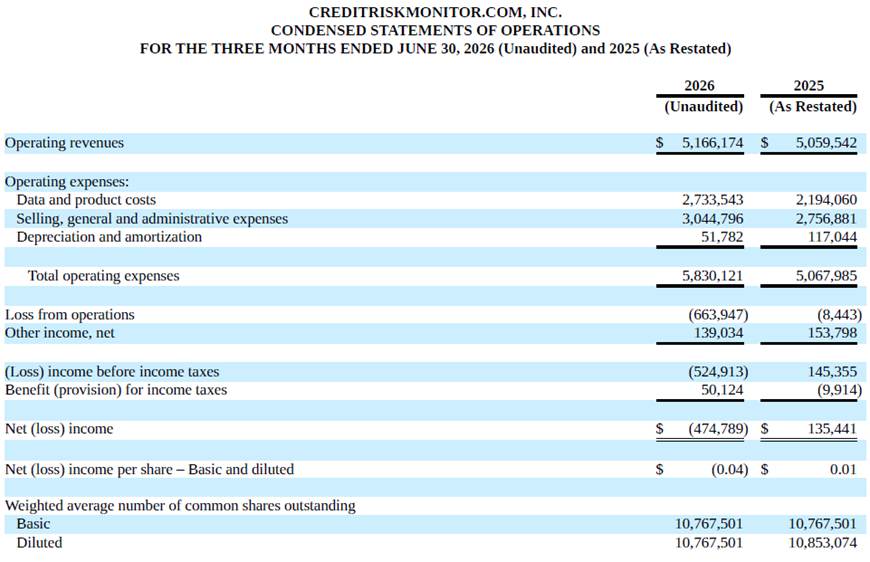
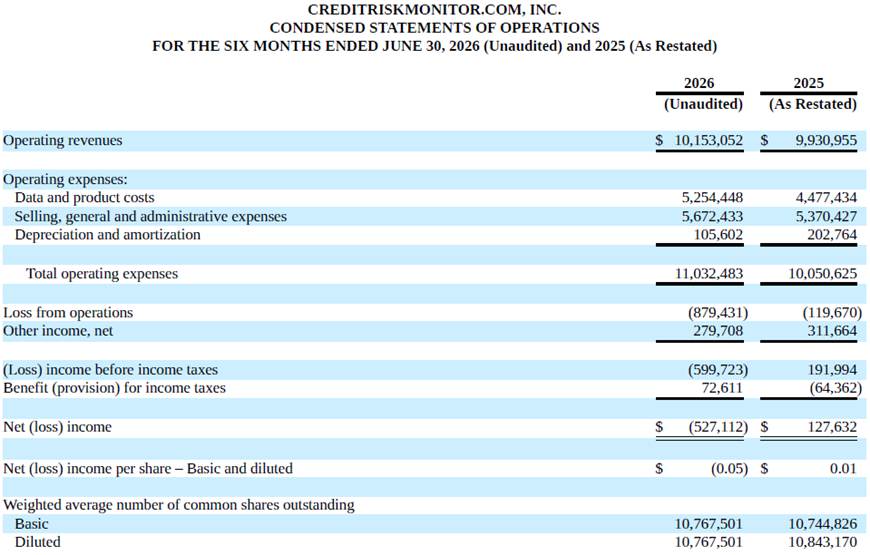
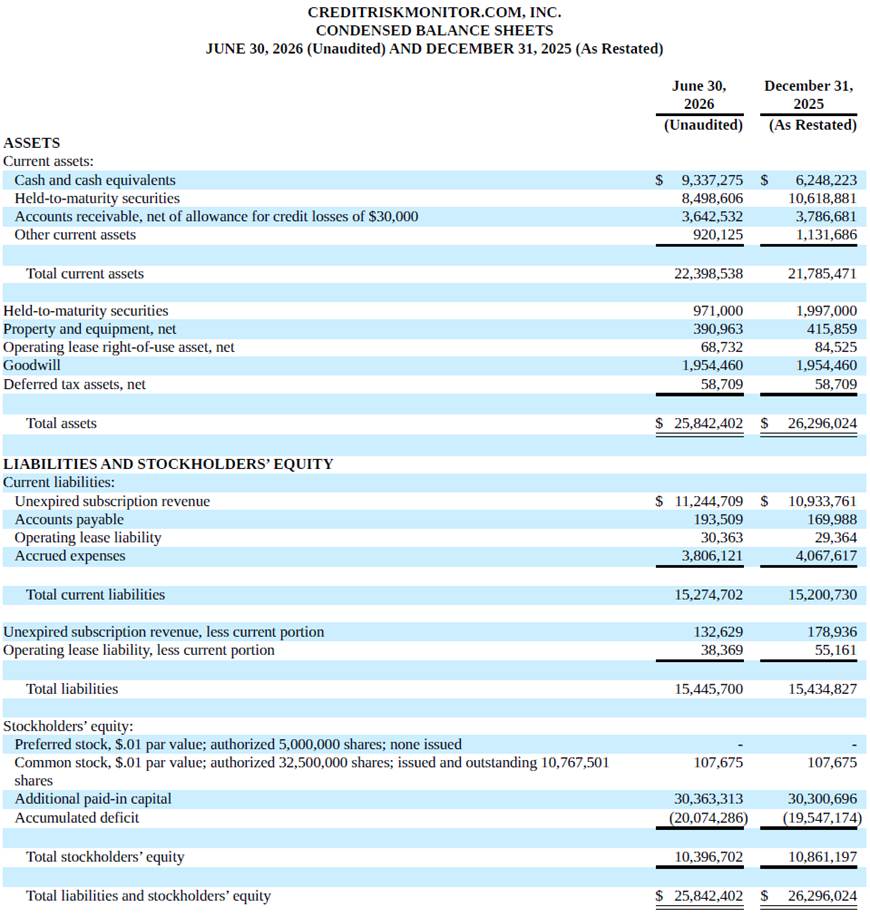
A full copy of the financial statements can be found at https://crmz.ir.edgar-online.com/
Overview
CreditRiskMonitor.com, Inc. (creditriskmonitor.com) sells a suite of web-based, SaaS subscription products providing access to comprehensive commercial credit reports, bankruptcy risk analytics, financial and payment information, and curated news on public and private companies worldwide. Our primary SaaS subscription products for analyzing commercial financial risk are CreditRiskMonitor® and SupplyChainMonitor™. These products help corporate credit and procurement professionals stay ahead of and manage financial risk more quickly, accurately, and cost-effectively. Our subscribers include nearly 40% of the Fortune 1000 and well over a thousand other large corporations worldwide.
To help subscribers prioritize and monitor counterparty financial risk, our SaaS platforms offer the proprietary FRISK® and PAYCE® Scores as well as the FAST Rating, the well-known Altman Z"-Score, agency ratings from key Nationally Recognized Statistical Rating Organizations ("NRSROs"), curated news, and detailed financial spreads & ratios. Our FRISK® and PAYCE® Scores are financial distress classification models that measure a business's probability of bankruptcy within a year. The FRISK® score also includes a risk signal based on the aggregate research behaviors of our subscribers, who control counterparty access to trade credit at some of the most sophisticated companies in the world. The inclusion of this risk signal boosts the overall accuracy of this bankruptcy analytic by lowering the false positive rate for the riskiest corporations.
Through its Trade Contributor Program, the Company receives monthly confidential accounts receivables data from hundreds of subscribers and non-subscribers, which it parses, processes, aggregates, and reports to summarize the invoice payment behavior of B2B counterparties without disclosing the specific contributors of this information. The size of the Trade Contributor Program's current annualized trade credit transaction data is approximately $3 trillion.
Safe Harbor Statement
Certain statements in this press release, including statements prefaced by the words "anticipates", "estimates", "believes", "expects" or words of similar meaning, constitute "forward-looking statements" within the meaning of the Private Securities Litigation Reform Act of 1995. Forward-looking statements include details of the accounting restatement, the expected impact of the accounting restatement and the remediation of the related material weakness in internal control over financial reporting. Such forward-looking statements involve known and unknown risks, uncertainties and other factors which may cause the actual results, performance, expectations or achievements of the Company to be materially different from any future results, performance or achievements expressed or implied by such forward-looking statements, including, among others, those risks, uncertainties and factors referenced from time to time as "risk factors" or otherwise in the Company's Registration Statements or Securities and Exchange Commission Reports. There can be no assurance that (i) the consequences of the Company's restated results will be as anticipated above and (ii) the Company will be able to promptly and efficiently implement the appropriate remediation steps into its financial reporting. We disclaim any intention or obligation to revise any forward-looking statements, whether as a result of new information, a future event, or otherwise.
CONTACT:
CreditRiskMonitor.com, Inc.
Mike Flum, Chief Executive Officer
(845) 230-3037
ir@creditriskmonitor.com
SOURCE: CreditRiskMonitor.com, Inc.
View the original press release on ACCESS Newswire