
The transition from static to adaptive neurotechnology is primarily driven by the clinical shortcomings of traditional open-loop stimulation, which often results in neural habituation and adverse side effects.
NEWARK, DE / ACCESS Newswire / March 27, 2026 / Future Market Insights (FMI) reveals that The global neuromodulation closed-loop brain-computer interfaces (BCI) market is entering a decisive transformation phase, where intelligent, adaptive neurostimulation is replacing static implantable therapies. According to Future Market Insights (FMI), the market is projected to grow from USD 460.0 million in 2026 to USD 2,100 million by 2036, advancing at a robust 16.40% CAGR.
What was once a hardware-driven category is now evolving into a data-first, algorithm-powered therapeutic ecosystem, fundamentally reshaping how hospitals, neurosurgeons, and healthcare systems approach neurological care.
Discover Growth Opportunities in the Market - Get Your Sample Report Now - https://www.futuremarketinsights.com/reports/sample/rep-gb-32402
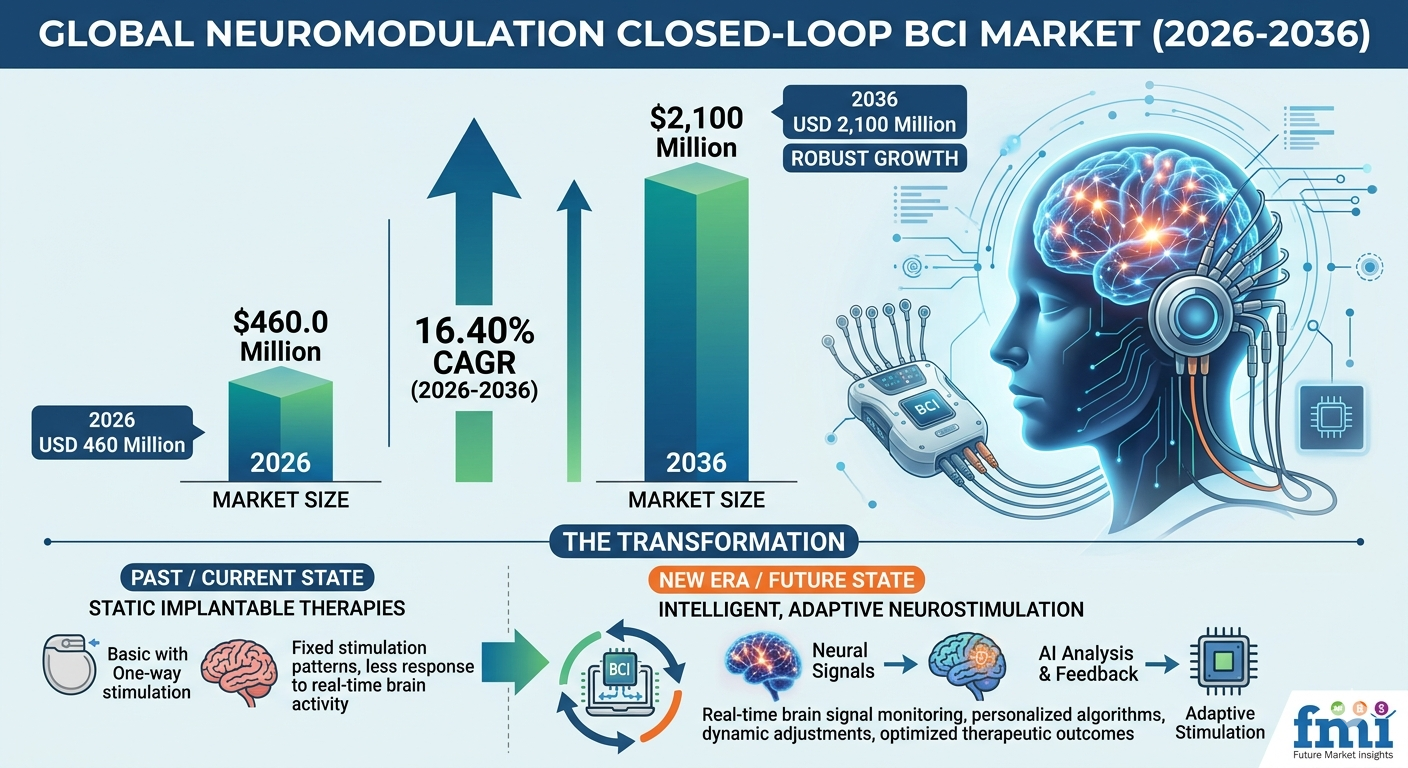
Quick Stats Snapshot
2026 Market Value: USD 460.0 million
2036 Forecast Value: USD 2,100 million
CAGR (2026-2036): 16.40%
Top Indication: Drug-resistant epilepsy (35% share)
Leading End Users: Tertiary neurology & neurosurgery centers (52% share)
Fastest Growing Markets: India (19.4%), China (18.2%), United States (17.8%)
The Shift: From Devices to Data Ecosystems
Closed-loop BCIs are no longer evaluated solely on electrode precision or battery life. Decision-makers are now prioritizing algorithm upgradeability, cloud telemetry integration, and long-term data utility.
Hospitals face a critical inflection point:
Choosing closed, static systems risks long-term obsolescence
Investing in adaptive, AI-enabled platforms ensures continuous therapeutic evolution without repeat surgeries
This shift is redefining procurement-from buying a device to adopting a lifetime neurodata platform.
Why Demand is Accelerating
Three structural forces are driving adoption:
Clinical limitations of open-loop stimulation
Continuous stimulation leads to neural habituation and side effects, pushing clinicians toward adaptive systems that respond in real time.
Explosion of longitudinal neurodata
Implants now generate massive datasets, enabling machine learning algorithms to refine therapy without surgical intervention.
Rising pharmaceutical failure rates
In drug-resistant neurological conditions, especially epilepsy, healthcare systems are increasingly authorizing implantable neurotechnology to reduce long-term care costs.
Segment Intelligence: Where Growth is Concentrated
Implantable responsive neurostimulation systems dominate with 41% share, driven by proven clinical outcomes in epilepsy care
Sensing + adaptive stimulation architectures lead innovation with 46% share, enabling real-time biomarker-driven therapy
Commercial therapy platforms account for 57%, signaling transition from trials to standard-of-care deployment
Regional Outlook: Global Growth Anchored in Infrastructure Expansion
United States (17.8% CAGR): Remains the commercialization hub due to strong reimbursement pathways and concentration of epilepsy centers
India (19.4% CAGR): Rapid expansion of private neurosurgical infrastructure fuels adoption
China (18.2% CAGR): Domestic innovation and policy-driven self-reliance accelerate growth
Europe: Adoption shaped by stringent health economic validation and regulatory frameworks
"Competitive advantage in this market is no longer about miniaturizing electrodes-it's about transforming neural telemetry into actionable clinical intelligence. Manufacturers that fail to bridge this gap risk commoditization."
Strategic Takeaways for Decision Makers
Hospitals: Must standardize interoperable neurodata platforms to avoid vendor lock-in
Manufacturers: Need to prioritize cloud-linked telemetry and firmware upgradeability
Clinical Teams: Should integrate AI-driven insights into workflows to manage growing data volumes
Payers: Expected to unlock market scale by introducing billing codes for algorithm-driven therapy adjustments
Competitive Landscape: Data Dominance Defines Leadership
The market remains highly concentrated due to regulatory complexity and data barriers. Leaders such as Medtronic and NeuroPace maintain dominance through proprietary neural datasets and clinically validated algorithms.
Emerging innovators including Synchron, Precision Neuroscience, and Paradromics are focusing on high-density recording and minimally invasive deployment to disrupt incumbents.
However, the industry's trajectory suggests continued consolidation, as smaller players face immense challenges in independently scaling regulatory and data infrastructure.
Market Reality: The Bottleneck to Watch
Despite strong growth, a critical constraint persists-clinical workflow overload.
Continuous neural data streams exceed the capacity of traditional outpatient models, creating a gap between data generation and actionable insight.
The next wave of growth will depend on:
AI-powered summarization tools
Automated therapy adjustments
Seamless EHR integration
The neuromodulation closed-loop BCI market is not just expanding-it is redefining neurological care delivery. As therapy becomes adaptive, predictive, and data-driven, the winners will be those who can integrate hardware, software, and clinical intelligence into a unified ecosystem.
For an in-depth analysis of evolving formulation trends and to access the complete strategic outlook for the High Protein Yogurt Market through 2036, Full Report Request - https://www.futuremarketinsights.com/reports/neuromodulation-closed-loop-brain-computer-interfaces-market
Explore More Related Studies Published by FMI Research:
Gastrointestinal Therapeutics Market: https://www.futuremarketinsights.com/reports/gastrointestinal-therapeutics-market
Preterm Birth Prevention and Management Market: https://www.futuremarketinsights.com/reports/preterm-birth-prevention-and-management-market
Single Use Pump Market: https://www.futuremarketinsights.com/reports/single-use-pump-market
Radiology Drainage Catheters Market: https://www.futuremarketinsights.com/reports/radiology-drainage-catheters-market
Digital Health for Obesity Market: https://www.futuremarketinsights.com/reports/digital-health-for-obesity-market
About Future Market Insights (FMI)
Future Market Insights (FMI) is a leading provider of market intelligence and consulting services, serving clients in over 150 countries. Headquartered in Delaware, USA, with a global delivery center in India and offices in the UK and UAE, FMI delivers actionable insights to businesses across industries including automotive, technology, consumer products, manufacturing, energy, and chemicals.
An ESOMAR-certified research organization, FMI provides custom and syndicated market reports and consulting services, supporting both Fortune 1,000 companies and SMEs. Its team of 300+ experienced analysts ensures credible, data-driven insights to help clients navigate global markets and identify growth opportunities.
For Press & Corporate Inquiries
Rahul Singh
AVP - Marketing and Growth Strategy
Future Market Insights, Inc.
+91 8600020075
For Sales - sales@futuremarketinsights.com
For Media - Rahul.singh@futuremarketinsights.com
For web - https://www.futuremarketinsights.com
SOURCE: Future Market Insights, Inc.
View the original press release on ACCESS Newswire