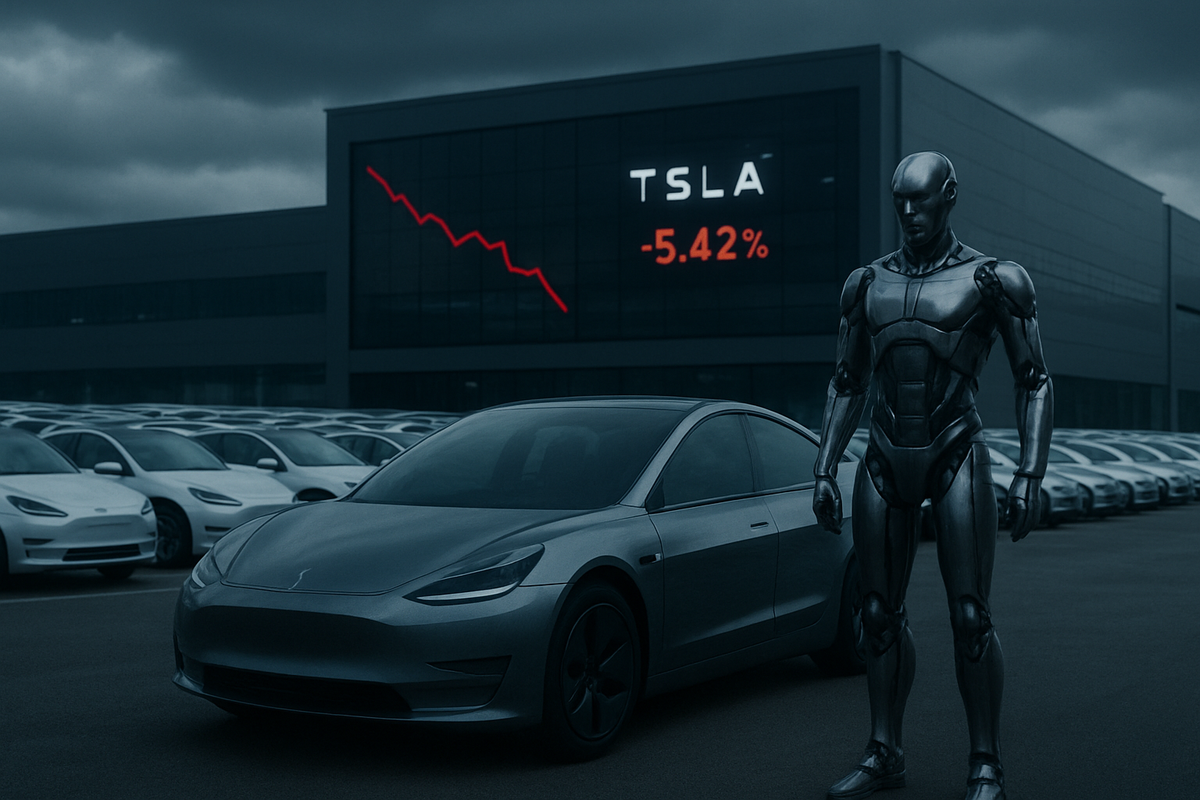
Tesla (NASDAQ: TSLA) sent shockwaves through the electric vehicle market on April 2, 2026, after releasing a Q1 production and delivery report that underscored a deepening divide between the company’s automotive reality and its artificial intelligence ambitions. While the company managed a modest year-over-year increase in deliveries, a sharp double-digit decline from the previous quarter and a record gap between production and sales triggered a 5.42% sell-off, leaving investors to grapple with the stock’s losing momentum in 2026.
The report, which comes at a pivotal moment for the Austin-based automaker, revealed that Tesla delivered 358,023 vehicles in the first three months of the year. Although this represented a 6.3% rise compared to the dampened Q1 2025—a period marred by factory retooling for the "Juniper" Model Y update—it fell 14.4% short of the 418,227 vehicles delivered in Q4 2025. More concerning to Wall Street was the production figure of 408,386 vehicles, creating a massive inventory overhang of over 50,000 units that suggests Tesla is no longer a company limited by how many cars it can build, but rather by how many it can sell.
A Growing Gap: The Q1 Report by the Numbers
The market's reaction was swift and unforgiving. By the close of trading on April 2, Tesla (NASDAQ: TSLA) shares had fallen to $360.59, wiping out nearly $70 billion in market value. The primary catalyst was the realization that the "demand cliff" analysts had feared following the September 2025 expiration of the federal EV tax credit has materialized with full force. For the first time in the company's history, the production-to-delivery gap exceeded 50,000 vehicles, a statistic that signals a fundamental shift from a "waitlist" brand to one that must aggressively push inventory through price cuts or marketing.
The timeline leading to this report was defined by a strategic pivot away from the company's legacy programs. Throughout Q1, CEO Elon Musk confirmed that Tesla had officially ceased taking orders for the Model S and Model X, signaling the end of an era for the flagship luxury vehicles. This move was made to prioritize manufacturing capacity for the Optimus humanoid robot and the upcoming Cybercab. However, with the energy storage business also showing signs of a slowdown—deploying just 8.8 GWh in Q1 compared to 14.2 GWh in the prior quarter—the immediate revenue pillars of the company appear to be wobbling just as the transition to "Physical AI" begins in earnest.
Key stakeholders, including institutional bulls like Cathie Wood’s ARK Invest and outspoken skeptics at various hedge funds, are now at an impasse. While the bull case relies on Tesla's ability to monetize the Cybercab and Optimus, the immediate financial data suggests a core automotive business that is shrinking in a high-interest-rate environment. The market’s "easy comparison" to the weak Q1 2025 was supposed to provide a tailwind for the stock; instead, failing to meet even those tempered expectations has left many questioning the 2026 growth story.
Winners and Losers in the EV Shakeout
The primary beneficiary of Tesla's slowing momentum appears to be BYD (OTC: BYDDY), which has continued to dominate the Chinese market and expand its footprint in Europe with budget-friendly models that Tesla (NASDAQ: TSLA) currently lacks. As Tesla focuses on $100,000 robotics projects and high-margin autonomous tech, legacy manufacturers like Ford (NYSE: F) and General Motors (NYSE: GM) are finding a second wind in the hybrid market, capturing consumers who are deterred by the lack of federal subsidies and the volatility of pure-EV charging infrastructure.
In the luxury segment, Lucid Group (NASDAQ: LCID) and Rivian Automotive (NASDAQ: RIVN) are poised to pick up the slack left by the discontinuation of the Model S and Model X. While these companies still face their own scaling challenges, the sudden absence of Tesla’s flagship models provides a rare opening in the high-end EV space. Conversely, Tesla’s battery suppliers, such as Panasonic (OTC: PCRFY), may face a difficult year as Tesla’s growing inventory suggests a slowdown in future cell orders, potentially impacting the entire global battery supply chain.
For Tesla itself, the "win" is localized in its internal R&D. By freeing up Fremont factory space previously dedicated to legacy models, the company is betting the house on the Optimus robot. If Tesla can successfully pivot to a robotics-first company, the current delivery miss will be seen as a minor footnote. However, for the average retail investor who bought into the "mass-market EV" vision, the current trajectory feels like a significant loss of value and direction.
The Broader Market and Geopolitical Context
The Q1 2026 report does not exist in a vacuum. It is being weighed against a backdrop of intense geopolitical instability. With crude oil prices hovering around $111 per barrel due to ongoing tensions in the Middle East, one might expect EV demand to skyrocket. However, the cooling of the "EV fever" is being driven by more than just fuel prices. In 2026, the lack of government incentives in the U.S. and a maturing market in Europe have led to what many are calling the "EV Winter."
This event mirrors historical precedents such as the 2000s tech bubble or the mid-century consolidation of the American automotive industry. In those instances, the initial "hype phase" was followed by a brutal reality check where only the most operationally efficient companies survived. Tesla’s current struggle to maintain its 50% compound annual growth rate (CAGR) target is a classic sign of a maturing industry where brand loyalty is no longer enough to overcome macroeconomic headwinds like inflation and the high cost of financing.
Furthermore, regulatory scrutiny is intensifying. As Tesla shifts its focus toward the Cybercab, the National Highway Traffic Safety Administration (NHTSA) has signaled that it will subject autonomous-only vehicles to a much higher standard of safety than traditional cars. This regulatory hurdle, combined with the lack of a steering wheel in the Cybercab design, means that Tesla’s pivot is as much a legal gamble as it is a technological one.
The Road Ahead: 2026 and Beyond
In the short term, all eyes are on Tesla’s April 22 earnings call. Investors will be looking for more than just Musk’s usual visionary rhetoric; they will be looking for a concrete plan to clear the 50,000-unit inventory backlog. A significant price war in Q2 2026 is almost a certainty, which will likely weigh on gross margins—a metric that has already been under pressure for two years. If Tesla cannot stabilize its delivery numbers, the consensus target of 1.69 million vehicles for the full year 2026 will be unreachable, marking the third consecutive year of declining or stagnant growth.
Long-term, the company’s survival as a trillion-dollar entity depends on the "Physical AI" narrative. The market is currently valuing Tesla as a robotics company, not a car company. If the Cybercab pilot programs slated for later this year fail to impress or face further regulatory delays, the stock could see a massive "re-rating" to align more closely with traditional automotive multiples. Conversely, if Optimus begins its "one million unit" production run in Fremont as scheduled, the Q1 2026 delivery miss may be remembered as the moment the old Tesla died to make way for the new.
Summary and Outlook
Tesla’s Q1 2026 performance is a tale of two companies: a legacy automaker struggling with a massive inventory build and the end of its flagship programs, and an AI startup betting its future on robotics. The 5.42% drop in share price reflects the market's discomfort with this transition. While year-over-year growth was technically achieved, the sequential decline and the collapse of the energy storage business suggest that the headwinds are stiffening.
For the remainder of 2026, investors should keep a close watch on inventory levels and margin compression. The pivot to robotics is high-risk and high-reward, but it leaves the company vulnerable in the interim. As the "EV Winter" continues, Tesla (NASDAQ: TSLA) must prove that its vision for an autonomous future can produce the same cash-flow reliability that its Model 3 and Model Y once did.
This content is intended for informational purposes only and is not financial advice.