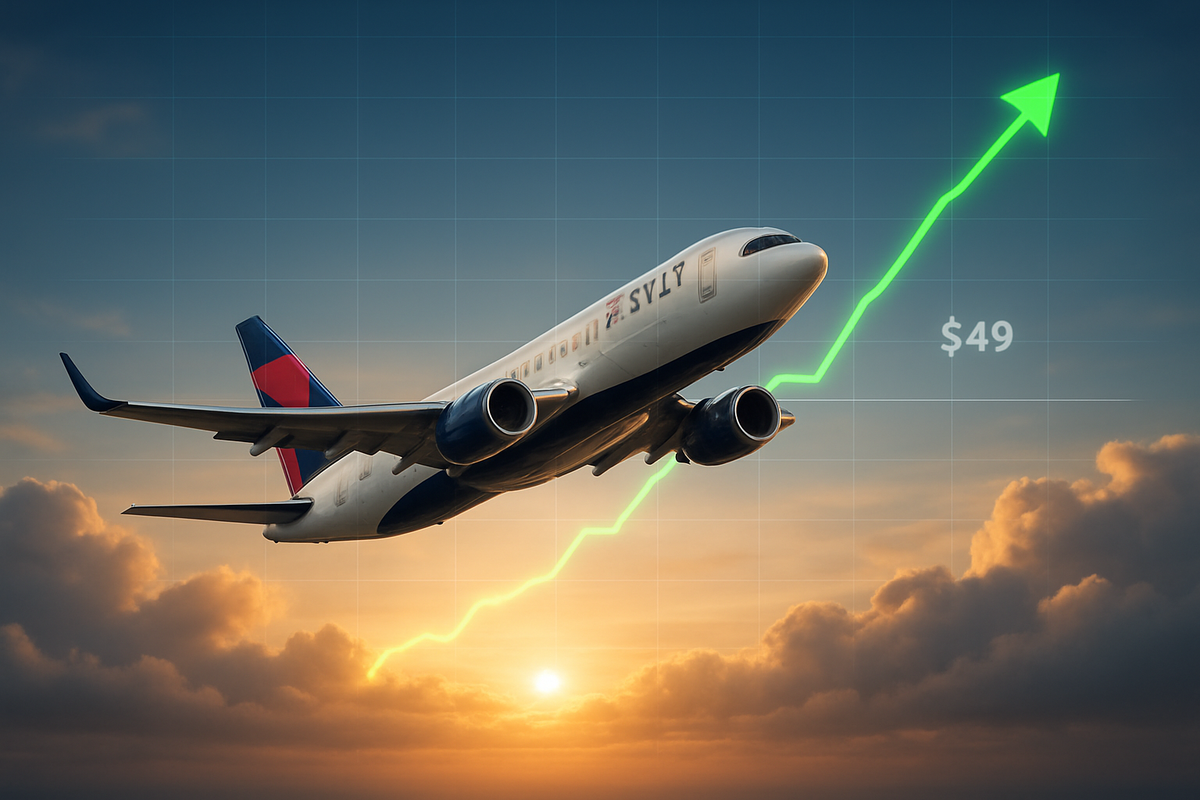
As of April 10, 2026, the aviation sector is witnessing a dramatic shift in market sentiment, led by a powerhouse performance from Delta Air Lines (NYSE: DAL). After a period of intense volatility triggered by geopolitical instability in the Middle East, Delta’s stock has not only cleared its long-standing $49 resistance level but has surged into the $70 range following a stellar first-quarter earnings report. This breakout marks a pivotal moment for the airline industry, suggesting that the "relentless" demand for premium travel is finally decoupling from the traditional anchor of fluctuating energy costs.
The immediate implications are clear: the market is rewarding airlines that demonstrate operational discipline and diversified revenue streams. While higher fuel costs—which peaked at nearly $4.88 per gallon earlier this year—had previously cast a shadow over the sector, Delta’s ability to pass costs to consumers and leverage its unique refinery assets has turned a potential crisis into a showcase of corporate resilience.
The Technical Breakout and the Q1 Earnings Catalyst
The path to the current $73 trading price was anything but linear. In early March 2026, Delta’s stock hit a local low of approximately $35.46, as fears of a prolonged closure of the Strait of Hormuz sent crude oil prices spiraling above $115 per barrel. However, a "V-shaped" recovery began in late March as diplomatic progress in the Middle East signaled a potential ceasefire. Technically, the stock faced a massive psychological and structural hurdle at the $49 mark. Analysts noted that once Delta cleared $49 on heavy volume in the final days of March, the technical outlook shifted from bearish to "strongly bullish," triggering algorithmic buying and a short-covering rally.
The momentum reached a fever pitch on April 8, 2026, when Delta released its Q1 financial results. The airline reported an adjusted earnings per share (EPS) of $0.64, handily beating the analyst consensus of $0.56. Revenue for the quarter hit $15.85 billion, driven by a 7% increase in passenger revenue and double-digit growth in corporate travel bookings. Key stakeholders, including CEO Ed Bastian, highlighted that the airline’s "capacity discipline" and the high "willingness to spend" among premium passengers allowed Delta to maintain high margins even as fuel costs spiked. This report acted as the ultimate validation of the $49 breakout, propelling the stock upward by 11% in just 48 hours.
A Widening Gap: Winners and Losers in the New Sky
The current environment is creating a stark divide between the "haves" and the "have-nots" of the airline industry. Delta and its primary rival, United Airlines (NASDAQ: UAL), have emerged as the dominant victors. United recently issued ambitious 2026 guidance, targeting an EPS between $12.00 and $14.00, signaling confidence in the long-term viability of the international and premium markets. These carriers benefit from a affluent customer base that appears largely immune to the inflationary pressures affecting the broader economy.
Conversely, the picture is much grimmer for American Airlines (NASDAQ: AAL). Hampered by a massive debt load exceeding $30 billion and razor-thin margins of just 3.1%, American’s stock has declined nearly 30% year-to-date. Unlike Delta, American lacks a refinery to hedge against fuel price shocks, leaving it fully exposed to the Q1 price spikes. Meanwhile, Southwest Airlines (NYSE: LUV) is in the midst of a radical strategic pivot. To combat stagnating growth, Southwest officially introduced assigned seating and checked-bag fees in January 2026—a move that has polarized its loyal customer base but is seen as necessary to reach its $4.00 EPS target for the year.
Wider Industry Significance and Historical Precedents
This breakout is significant because it mirrors the post-2008 recovery, yet with a modern twist: "premiumization." Historically, airline stocks were treated as proxies for oil prices; when oil went up, airlines went down. However, the 2026 market dynamics suggest that brand loyalty and high-margin services (like Delta's SkyMiles program and premium cabins) have created a buffer. Delta’s ownership of the Trainer refinery provided a $300 million benefit in Q1 alone, a strategic advantage that is becoming the envy of the industry.
The broader industry has also had to navigate regulatory and infrastructure hurdles in early 2026. A brief U.S. government shutdown in February disrupted TSA and air traffic control operations, costing the sector hundreds of millions. Yet, the industry’s ability to bounce back so quickly underscores a fundamental change in consumer behavior: travel is no longer viewed as a discretionary luxury but as a non-negotiable lifestyle component for many. This shift is forcing competitors and partners, including aircraft manufacturers and travel tech providers, to align their strategies with a "high-yield, high-service" model.
What Comes Next: Strategic Pivots and Market Risks
In the short term, investors are looking for Delta to test its all-time highs as it heads into the busy summer travel season. The primary short-term risk remains the fragility of the recent ceasefire in the Middle East; any resumption of hostilities could send oil back toward the $110 level, testing the floor of the recent breakout. Strategically, Delta has announced orders for 95 new, more fuel-efficient aircraft to be delivered throughout 2026 and 2027, a move aimed at reducing its "carbon and cost" footprint simultaneously.
Long-term possibilities include a potential consolidation in the low-cost carrier (LCC) space, as smaller airlines struggle to compete with the scale and efficiency of the "Big Three." Market participants should watch for potential shifts in corporate travel patterns; while current growth is strong, any sign of a broader economic cooling could test the durability of those high-margin tickets. For now, the "Delta Flywheel"—where loyalty revenue funds fleet expansion, which in turn attracts more premium flyers—remains the industry’s most successful blueprint.
The Investor Wrap-Up: Navigating the 2026 Skies
The story of Delta Air Lines in the first half of 2026 is one of structural strength over cyclical weakness. By breaking past the $49 resistance level and holding those gains despite the most volatile energy market in a generation, Delta has proven that its business model is robust. The key takeaways for investors are clear: quality, scale, and strategic hedging (via the refinery) are the new requirements for success in the airline sector.
Moving forward, the market will likely continue to reward carriers that focus on "revenue quality" rather than just "load factor." Investors should keep a close eye on jet fuel price stability and the upcoming Q2 guidance from peers like United and Southwest. As we navigate the remainder of 2026, the question is no longer whether people will fly, but how much they are willing to pay for the privilege—and currently, the answer is "more than ever before."
This content is intended for informational purposes only and is not financial advice.