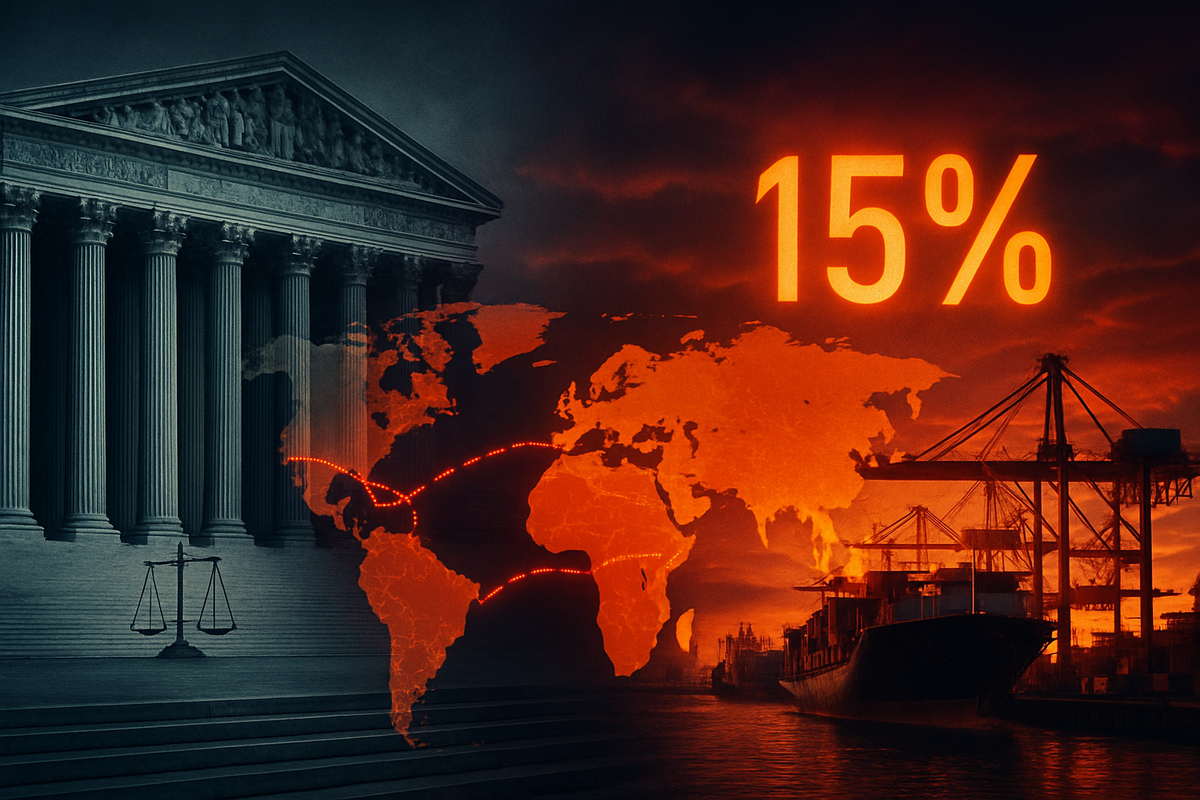
In a high-stakes legal showdown that has sent shockwaves through global markets, the United States Supreme Court today struck down President Trump’s hallmark "reciprocal" tariff regime, ruling that the administration exceeded its constitutional authority by bypassing Congress to set trade duties. The decision, a major victory for a coalition of retailers and importers, appeared to briefly signal a reprieve for international trade—until the White House retaliated hours later. Invoking the rarely used Section 122 of the Trade Act of 1974, the President immediately imposed a 15% across-the-board tariff on all imported goods, citing a "large and serious" balance-of-payments deficit that constitutes a national economic emergency.
The sudden pivot from targeted "mirror" tariffs to a universal surcharge has plunged the financial world into a state of "tariff whiplash." While the Supreme Court's ruling in Learning Resources, Inc. v. Trump initially sparked a relief rally in tech and retail stocks, the subsequent 15% imposition under Section 122—the maximum allowed by the 1974 statute—has forced analysts to radically revise inflation and margin forecasts. As of this afternoon, March 27, 2026, the S&P 500 remains volatile as investors weigh the reality of a persistent, high-tariff environment that now utilizes a different, albeit time-limited, legal foundation.
The Legal Gauntlet: From Reciprocity to Section 122
The path to today’s constitutional crisis began during the 2024 campaign, when then-candidate Trump proposed the "Reciprocal Trade Act," a plan to match any foreign tariff on U.S. goods with an identical domestic duty. Upon taking office in 2025, the administration implemented these "mirror tariffs" via executive order, leveraging the International Emergency Economic Powers Act (IEEPA). This move was met with immediate litigation from a coalition led by Learning Resources, Inc., alongside major retail groups, who argued that Article I, Section 8 of the Constitution gives Congress—not the President—the exclusive power to "lay and collect Taxes and Duties."
In a 6-3 decision, the Supreme Court sided with the importers, invoking the "Major Questions Doctrine." Chief Justice John Roberts wrote for the majority that a tariff regime of such "vast economic and political significance" requires explicit and narrow authorization from Congress, which IEEPA did not provide for broad-based taxation. The ruling effectively dismantled the "reciprocal" framework, which had seen duties on certain electronics and consumer goods soar as high as 100%.
However, the administration’s response was instantaneous. By invoking Section 122 of the Trade Act of 1974, the President tapped into a specific "balance-of-payments" authority designed to protect the U.S. dollar and address trade imbalances. While Section 122 is limited to a 150-day window and a 15% cap, it provides the White House with a legal "bridge" to maintain trade pressure while it pressures Congress for new permanent legislation. Critics argue this is a "protectionist wolf in sheep's clothing," but for now, the 15% surcharge is the law of the land.
Corporate Winners and Losers in the New Tariff Era
The shift to a 15% universal tariff creates a stark divergence of fortunes across the S&P 500. For high-volume retailers like Walmart (NYSE: WMT) and Target (NYSE: TGT), the news is a double-edged sword. While the 15% rate is lower than some of the "reciprocal" duties they previously faced on Chinese imports, the universal nature of the new tariff means there is no "safe haven" for sourcing. Goods from Mexico, Vietnam, and Canada—previously seen as shelters—are now subject to the same 15% levy. Analysts expect Walmart to face significant margin pressure, as its ability to absorb these costs is nearing its limit, likely leading to a 3-5% increase in shelf prices by summer.
Technology giants, most notably Apple (NASDAQ: AAPL) and NVIDIA (NASDAQ: NVDA), find themselves in a similarly precarious position. Apple has already spent an estimated $3.3 billion on tariff-related costs since 2025; a flat 15% tax on its global supply chain could slice nearly $0.30 off its annual earnings per share unless passed on to consumers. Conversely, domestic manufacturers are cheering the move. Steel producers such as Nucor (NYSE: NUE) and Steel Dynamics (NYSE: STLD) saw their stocks climb in mid-day trading, as the 15% surcharge provides a "floor" of protection against foreign competitors, further tightening a domestic market that is already seeing historic order backlogs.
First Solar (NASDAQ: FSLR) has emerged as a unique beneficiary of the day’s chaos. While the Supreme Court's ruling initially threatened the specific "reciprocal" protections the company enjoyed against Chinese solar panels, the immediate 15% universal surcharge—combined with existing solar-specific duties—effectively maintains a high barrier to entry for foreign competitors. This ensures that domestic "green" energy manufacturing remains insulated from a flood of low-cost imports, even as the legal basis for that insulation shifts.
A Global Paradigm Shift and the Nixon Parallel
The broader significance of today’s events cannot be overstated. This is the most aggressive use of executive trade authority since the "Nixon Shock" of 1971, when President Richard Nixon imposed a 10% import surcharge to force a devaluation of the dollar. Much like the 1971 event, the current 15% surcharge is being used as a geopolitical "bargaining chip" to force trading partners to the table. However, the global economy of 2026 is far more interconnected than that of 1971, and the risk of a "tit-for-tat" escalation is significantly higher.
The regulatory implications are also profound. By pivoting to Section 122, the Trump administration is testing the boundaries of what constitutes a "balance-of-payments" emergency. If the courts allow this definition to include chronic trade deficits, it could provide a permanent blueprint for future presidents to bypass the Commerce Clause. Furthermore, the 15% tariff is expected to be a major inflationary catalyst. With J.P. Morgan and S&P Global already revising 2026 CPI projections toward the 3.5%–4.0% range, the Federal Reserve may be forced to keep interest rates "higher for longer," complicating the economic landscape for the remainder of the year.
The 150-Day Countdown: What Comes Next?
The immediate focus for the market is now the 150-day expiration clock attached to Section 122. Under the statute, the 15% surcharge will expire in late August 2026 unless Congress passes legislation to extend it. This sets the stage for a summer of intense lobbying and political maneuvering on Capitol Hill. Investors should expect the administration to use this window to push for the "Reciprocal Trade Act" to be codified into law, using the 15% tariff as a "pain point" to force Congressional action.
Strategic pivots are already underway in corporate boardrooms. The "China Plus One" strategy is rapidly evolving into a "Domestic Plus One" strategy, as companies realize that even non-Chinese imports are no longer tariff-exempt. We may see an acceleration of "near-shoring" to Mexico, though the Section 122 surcharge applies globally, meaning the only true escape is domestic U.S. production. Market opportunities may emerge in "tariff-exempt" services and software, which do not cross physical borders, potentially benefiting the broader SaaS and cloud sectors.
Summary and Investor Outlook
Today’s events represent a pivotal moment in American trade history. The Supreme Court has successfully asserted its role as a check on executive overreach, but the administration’s rapid pivot to Section 122 demonstrates the vast array of tools still available to a President determined to pursue an "America First" trade policy. The key takeaway for investors is that the era of low-cost, friction-free global trade has definitively ended, replaced by a regime of "managed trade" where duties are a permanent feature of the balance sheet.
Moving forward, the market will likely remain in a state of heightened sensitivity to trade data and inflation reports. The 15% surcharge is a blunt instrument that will test the resilience of the American consumer and the adaptability of global supply chains. In the coming months, investors should watch for three things: the first round of legal challenges to the Section 122 proclamation, the Q2 earnings calls of major importers for signs of margin erosion, and any signals from the Federal Reserve regarding the "tariff-induced" inflation spike. The "Trade War of 2026" has entered a new, more unpredictable chapter.
This content is intended for informational purposes only and is not financial advice.