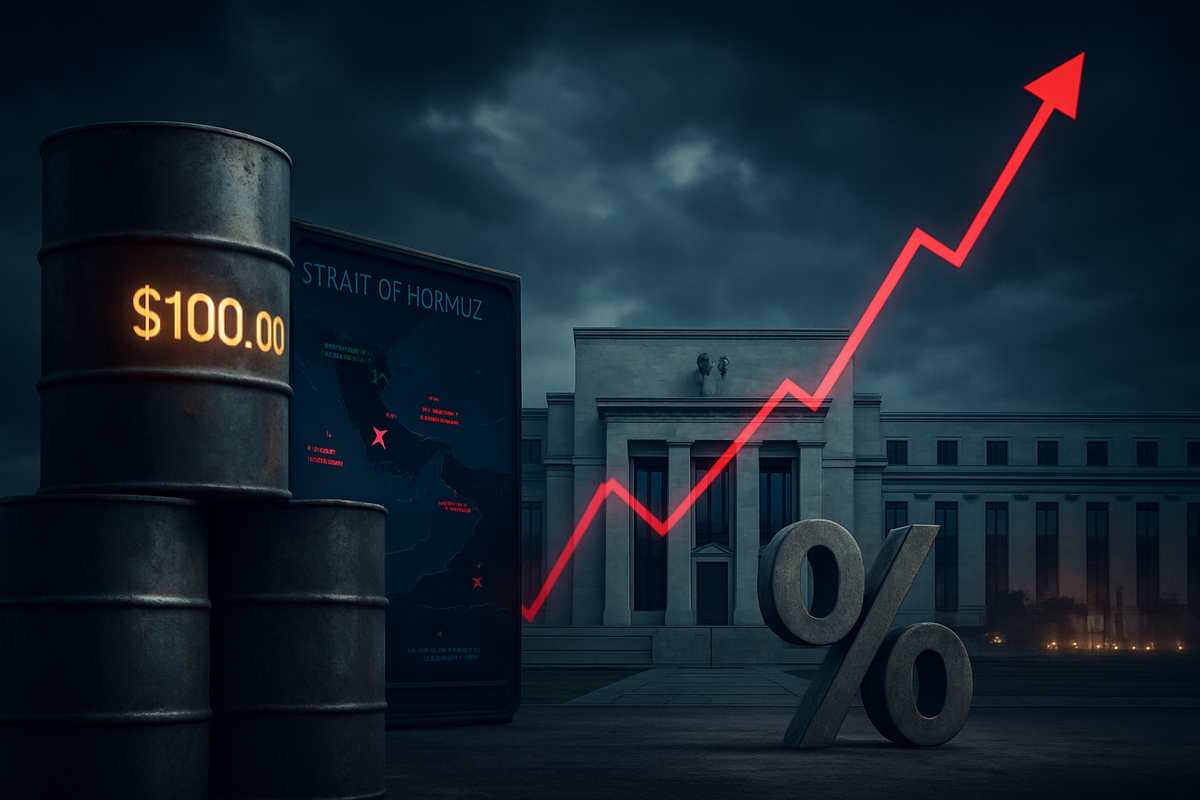
The Federal Reserve is entering its highly anticipated March 17-18, 2026, policy meeting under a shadow of geopolitical instability and a sudden, violent reversal in energy prices. What was expected to be a victory lap for the central bank—potentially marked by the first interest rate cut in years—has instead transformed into a defensive crouch. As West Texas Intermediate (WTI) crude oil surged past $100 per barrel this week, peaking at $120 following a strategic blockade in the Strait of Hormuz, the narrative of "cooling inflation" has been abruptly incinerated.
This energy-driven inflationary shock has fundamentally altered the Federal Open Market Committee's (FOMC) calculus. Investors who were pricing in a 25-basis-point cut as recently as last month are now bracing for a "hawkish pause." With the Strait of Hormuz—the world’s most critical oil chokepoint—effectively closed, the immediate implications are clear: a renewed spike in consumer prices and a significant drag on global GDP growth, leaving the Fed with little choice but to keep the federal funds rate steady at its current 3.5%–3.75% range.
The Hormuz Shock: A Timeline of the Energy Pivot
The current market volatility can be traced back to the escalating conflict in the Middle East, which culminated in the disruption of the Strait of Hormuz early in the first quarter of 2026. This passage, which carries approximately 20% of the world’s daily oil consumption, has seen its traffic plummet as regional tensions reached a breaking point. By March 17, Brent crude had mirrored WTI’s climb, holding firmly near $100 per barrel. This "physical disruption" of supply is fundamentally different from the speculative spikes seen in years past, creating a "cost-push" inflation environment that is notoriously resistant to traditional monetary policy tools.
The Federal Reserve’s "higher-for-longer" rhetoric has returned with a vengeance. Federal Reserve Chair Jerome Powell, in recent remarks leading up to the March meeting, adopted a distinctly hawkish tone, noting that the "path to 2% inflation has become significantly more obstructed." The market's initial reaction has been swift; the 10-year Treasury yield has spiked as traders recalibrate for a world where interest rates may not fall for the remainder of the year. This shift has cast a pall over equity markets, which had been banking on a transition to a more accommodative monetary environment.
Corporate Winners and Losers in the $100 Oil Era
The sudden return to triple-digit oil prices has created a stark divide in the corporate world. Energy giants are the primary beneficiaries of the supply crunch. Exxon Mobil Corp (NYSE: XOM) and Chevron Corp (NYSE: CVX) have seen their stock prices surge as the "Hormuz premium" inflates their upstream margins. These companies, which had been focusing on capital discipline and shareholder returns, are now finding themselves at the center of a geopolitical windfall, though they face the looming threat of windfall profit taxes and increased regulatory scrutiny as energy costs hit consumers.
On the other side of the ledger, the transportation and logistics sectors are reeling. United Airlines Holdings (NASDAQ: UAL) and Delta Air Lines (NYSE: DAL) have already issued profit warnings, citing the "unprecedented" rise in jet fuel costs. For airlines, which are often the first to feel the impact of energy volatility, the combination of rising fuel prices and high interest rates—which makes financing their massive debt loads more expensive—creates a perfect storm of margin compression. Similarly, delivery giants like FedEx Corp (NYSE: FDX) are grappling with the need to implement fuel surcharges that could potentially dampen consumer demand.
The impact on the precious metals sector is particularly nuanced. While inflation typically boosts the appeal of gold and silver, the Fed's hawkish stance is acting as a massive anchor. Newmont Corporation (NYSE: NEM) and Pan American Silver Corp. (NASDAQ: PAAS) have seen their recent gains limited as the dollar strengthens on the back of higher-for-longer rate expectations. Investors in the SPDR Gold Shares (NYSE: GLD) have noted that while gold reached a high of $5,595 per ounce in January, it has dipped to approximately $5,115 as of mid-March, reflecting the "tug-of-war" between gold's role as an inflation hedge and its sensitivity to rising real interest rates.
A Ghost of the 1970s: Wider Significance and Historical Parallels
The current economic landscape bears a striking, and uncomfortable, resemblance to the stagflationary era of the 1970s. Much like the oil shocks of 1973 and 1979, the 2026 crisis is a supply-side shock that the Federal Reserve cannot "fix" by simply adjusting the cost of money. In the 1970s, the Fed's initial hesitation to tackle inflation allowed expectations to become unanchored, eventually requiring the aggressive, recession-inducing hikes of the Volcker era. Today, the Fed is determined to avoid that mistake, signaling a willingness to sacrifice growth—which slowed to a tepid 0.7% in Q4 2025—to keep inflation from spiraling.
This event also highlights the fragility of the "soft landing" narrative that dominated 2024 and 2025. The disruption in the Strait of Hormuz is a reminder that geopolitical risks remain the ultimate "wild card" for global markets. Furthermore, the shift in policy from the Fed is likely to have a ripple effect on other central banks, such as the European Central Bank (ECB) and the Bank of England, both of which are also facing energy-driven inflation. This synchronized hawkishness could lead to a global slowdown, raising the specter of a "hard landing" that many analysts thought had been avoided.
The Road Ahead: Scenarios for 2026
In the short term, the market will be hyper-focused on the FOMC’s updated "dot plot" and Chair Powell’s press conference on March 18. If the Fed signals that rate hikes are back on the table, we could see a further liquidation in "safe-haven" assets like gold and silver as the dollar's dominance is reinforced. Conversely, if the Fed emphasizes the risk to economic growth, it may signal that they are nearing the end of their hawkishness, which could provide a floor for precious metals and a relief rally for the broader market.
Long-term, the strategic pivot for corporations will involve a massive acceleration in energy diversification and supply chain resilience. Companies that can decouple their operations from fossil fuel volatility will likely emerge as the winners of the late 2020s. However, the immediate challenge remains: surviving a period of high costs and high interest rates. Strategic pivots toward "near-shoring" and energy efficiency are no longer optional "ESG" goals; they have become existential necessities in a world where the Strait of Hormuz can be shuttered overnight.
Investor Takeaway: Navigating the Hawkish Pivot
As the Fed concludes its March meeting, the key takeaway for investors is that the era of easy money remains a distant memory. The "Hormuz premium" is now a permanent fixture in energy pricing, and its inflationary impact has forced the Fed into a hawkish corner. Moving forward, the market will be defined by extreme volatility as it balances the reality of $100 oil against the Fed's resolve to crush inflation at any cost.
Investors should closely monitor two key metrics: the duration of the Hormuz blockade and the core inflation data for April. Any sign that energy costs are "bleeding into" core inflation (services and non-energy goods) will likely prompt even more aggressive rhetoric from the Fed. For now, the "hawkish pause" is the new baseline, and the bullish momentum in precious metals will remain capped by the weight of high real interest rates. Caution, rather than exuberance, remains the order of the day.
This content is intended for informational purposes only and is not financial advice.