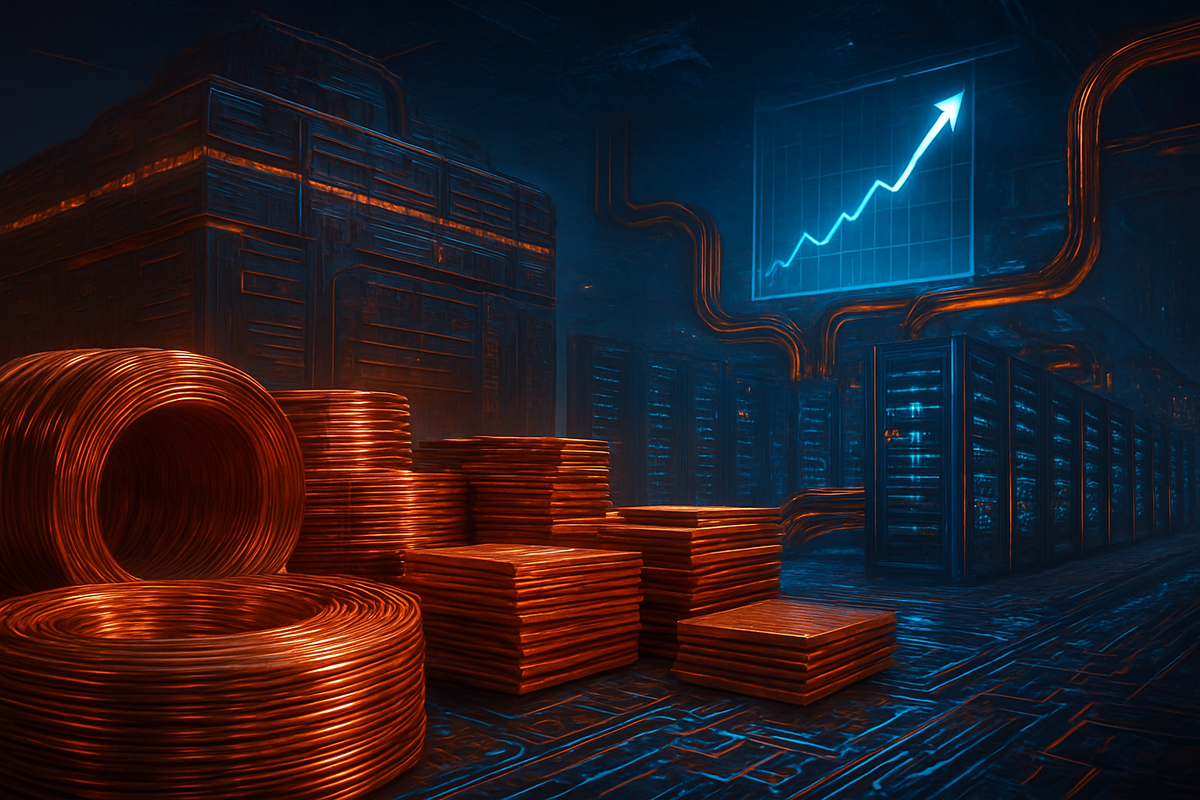
The global copper market is currently grappling with a baffling contradiction that analysts are calling the "Copper Paradox." As of February 26, 2026, copper prices on the London Metal Exchange (LME) have shattered historical records, surging past $13,000 per metric tonne before settling into a volatile range between $12,700 and $13,100. Ordinarily, such sky-high prices would be the result of extreme scarcity; however, global warehouses are currently bulging with the largest stockpiles seen in over two decades. This decoupling of price from immediate physical availability has sent shockwaves through the industrial and financial sectors, signaling a fundamental shift in how the world’s most critical industrial metal is valued.
This "Inventory Paradox" is most visible in the record-breaking figures coming out of major global exchanges. Stocks at COMEX have hit a staggering all-time high of 536,563 tons, while the Shanghai Futures Exchange (SHFE) reports its highest inventory levels since early 2024. Total global inventories now exceed 1.1 million metric tons—levels not seen since 2003. Despite this massive surplus on paper, the market remains aggressively bullish. The immediate implication is a bifurcated market where short-term oversupply is being ignored in favor of a projected long-term structural deficit, driven by an insatiable appetite for copper in the burgeoning artificial intelligence and green energy sectors.
The Perfect Storm: Supply Shocks and the AI Infrastructure Race
The current price surge is anchored by a catastrophic supply disruption at one of the world’s premier mining sites. On September 8, 2025, a massive mudslide struck the Grasberg mine in Indonesia, the second-largest copper operation on the planet. The event forced Freeport-McMoRan (NYSE: FCX) to declare force majeure as the site’s block cave was inundated with nearly 800,000 metric tons of material. By February 2026, production at Grasberg remains crippled, operating at only 40% of its total capacity. This sudden removal of hundreds of thousands of tons from the global production pipeline has created a sense of urgency among industrial buyers, who are racing to secure what little "free float" copper remains available.
Simultaneously, the "AI Infrastructure Race" has fundamentally altered the demand side of the equation. Tech giants like Meta (NASDAQ: META) and Google (NASDAQ: GOOGL) have moved beyond being mere consumers of chips; they are now major players in the energy and raw materials markets. In early 2026, both companies secured unprecedented long-term contracts for data center power distribution and infrastructure. Google’s recent $4.75 billion acquisition of Intersect Power and Meta’s 6.6 GW nuclear energy package highlight a shift toward vertical integration. These massive "private grids" require vast quantities of copper for transformers, busbars, and high-voltage transmission lines. This strategic hoarding by Big Tech explains why prices remain high despite record exchange inventories: much of the "available" copper is already spoken for through long-term delivery contracts.
Winners and Losers in a High-Price, High-Stockpile Era
In this environment, major producers and specialized financial instruments are seeing varied impacts. Freeport-McMoRan (NYSE: FCX) has faced a complex few months. While the Grasberg mudslide severely hampered their short-term output, the company recently secured a massive victory by signing a Memorandum of Understanding with the Indonesian government to extend their mining rights until 2061. The high prevailing copper prices have helped offset the costs of the $20 billion investment required for this extension, positioning FCX as a long-term titan if it can successfully navigate the phased restart of Grasberg’s underground caves scheduled for Q2 2026.
Conversely, Southern Copper Corp (NYSE: SCCO) stands as a primary beneficiary of the current market tension. With its low-cost operations primarily located in Peru and Mexico, SCCO has not been plagued by the operational disasters seen in Indonesia. The company is currently enjoying record margins, selling into a $13,000/mt market while maintaining steady production levels. For investors seeking direct exposure to the metal's price action without the operational risks of specific miners, the United States Copper Index Fund (NYSE Arca: CPER) has seen a surge in inflows. CPER has become a preferred vehicle for those betting that the "Inventory Paradox" will eventually resolve in favor of even higher prices as the AI build-out accelerates toward the end of the decade.
A Structural Shift: Why This Time is Different
The wider significance of the Copper Paradox lies in its departure from historical market cycles. Traditionally, copper has been a bellwerther for global manufacturing and construction—sectors that are currently showing signs of cooling in some regions. However, the modern "Energy Transition" and "AI Revolution" have created a demand floor that did not exist during the 2003 inventory peak. Analysts at Citigroup suggest that the record stocks currently seen at COMEX and SHFE are "illusory." They argue that as corporations move to de-risk their supply chains against geopolitical instability and climate-related mining disruptions, they are carrying larger "just-in-case" inventories that will never hit the open market.
This shift mirrors the "Silicon Scarcity" of the early 2020s, but on a much larger, more permanent scale. Regulatory and policy implications are also mounting, as governments in the U.S. and Europe begin to view copper as a matter of national security. The massive infrastructure requirements for AI data centers are competing directly with the copper needed for electric vehicle (EV) charging networks and renewable energy grids. This competition for a limited resource is expected to keep prices sustainably high, regardless of short-term warehouse fluctuations, as the world moves toward a "private grid" model led by the wealthiest technology firms.
The Road Ahead: 2026 and Beyond
Looking forward, the market is bracing for a potential "supply cliff." While the phased restart of the Grasberg mine in Q2 2026 is expected to bring some relief, full capacity is not anticipated until 2027. Citigroup’s latest forecasts suggest that copper will break and hold the $12,000/tonne level sustainably by year-end 2026, with some scenarios predicting a spike toward $14,000 as early as May. The short-term challenge for the market will be managing the volatility as the record COMEX inventories are either absorbed by industrial players or held as strategic reserves.
For major players, the strategic pivot is clear: diversification and vertical integration. We may see more "mining-to-cloud" partnerships where tech companies provide the capital for mine expansions in exchange for guaranteed off-take agreements. This would further reduce the amount of copper traded on open exchanges, potentially leading to even more dramatic price swings in the future. The ability of miners like Freeport-McMoRan to restore production without further incident will be the most critical factor to watch in the coming months.
Summary and Investor Outlook
The Copper Paradox of 2026 represents a landmark moment in commodity history. The coexistence of $13,000/mt prices and 23-year inventory highs suggests that the market is pricing in a future where copper is no longer just an industrial commodity, but a critical strategic asset. The primary drivers—the Grasberg production crisis and the Meta/Google AI infrastructure boom—show no signs of abating. While the record stockpiles provide a temporary cushion, they appear to be largely sequestered or designated for specific long-term projects, leaving the spot market vulnerable to any further supply shocks.
Moving forward, investors should keep a close eye on the quarterly production reports from Freeport-McMoRan and the pace of data center expansion announcements from the tech sector. If inventories begin to draw down while prices remain at these levels, it could signal the start of a true "super-cycle." For now, the copper market remains a high-stakes environment where the old rules of supply and demand are being rewritten by the digital age.
This content is intended for informational purposes only and is not financial advice.