
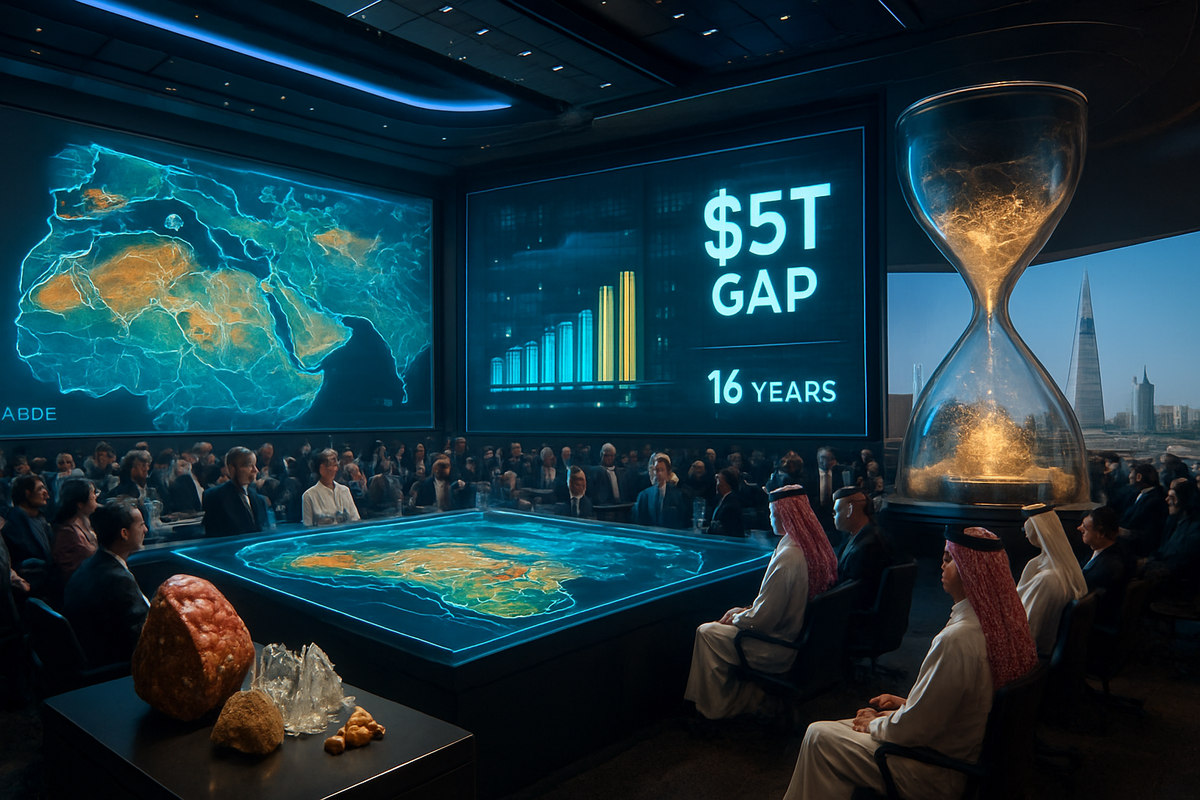
RIYADH, Saudi Arabia — As the doors opened today at the King Abdulaziz International Conference Center for the fifth annual Future Minerals Forum (FMF) 2026, the atmosphere among the world’s mining elite was one of calculated urgency. While the "Super Region" stretching from Africa to Central Asia remains the focus of the world's untapped geological wealth, a sobering set of data points dominated the opening keynotes: a staggering $5 trillion investment gap and a "lost generation" of supply caused by 16-year development timelines.
The immediate implications are clear: the global race for Net Zero is no longer just a policy debate but a brutal logistical scramble. With the current date of January 13, 2026, marking the midpoint of a decade originally intended for rapid decarbonization, the forum has become the "Davos of Mining," where the Saudi government is attempting to bridge the divide between capital-starved junior explorers and the insatiable demand of the electric vehicle (EV) and renewable energy sectors.
The 16-Year Bottleneck and the Quest for $5 Trillion
The headline figures released on Day 1 of the forum have sent shockwaves through the industry. According to the inaugural "Future Minerals Barometer," a report co-authored by the Saudi Ministry of Industry and Mineral Resources and McKinsey & Company, the world requires approximately $5 trillion in cumulative investment by 2035 to meet the demand for critical minerals like copper, lithium, and nickel. Currently, global exploration spending is hovering at just a fraction of what is required, leaving a 40% to 50% funding deficit for early-stage projects.
Compounding this financial void is the "16-year reality check." Data presented by industry leaders, including Dominic Barton, Chairman of Rio Tinto (NYSE: RIO), confirmed that the average time from the initial discovery of a mineral deposit to the first commercial production now exceeds 16 years. This timeline—driven by complex permitting, lack of infrastructure in frontier markets, and increasingly stringent ESG requirements—means that a mine discovered today will likely not contribute to global supply until 2042, far too late for most 2030 and 2035 climate targets.
Key players at the event, including H.E. Bandar AlKhorayef, Saudi Minister of Industry and Mineral Resources, and Bob Wilt, CEO of Ma’aden (TADAWUL: 1211), argued that the only way to compress these timelines is through radical regulatory harmonization across the "Super Region." The forum saw the announcement of the "Gateway to Funding" initiative, a partnership with BMO intended to connect institutional "patient capital" with junior mining firms that are currently struggling to survive the "valley of death" between discovery and development.
Strategic Winners and the Vulnerable Middle
The current supply-demand mismatch is creating a stark divide between the "haves" and "have-nots" in the corporate world. Among the winners are the diversified mining giants like BHP (NYSE: BHP) and Vale (NYSE: VALE), which possess the balance sheets to weather long lead times and the capital to acquire de-risked assets. Ivanhoe Electric (NYSE: IE) is also emerging as a frontrunner, utilizing its proprietary Typhoon™ technology to accelerate exploration in the Arabian Shield, potentially shaving years off the traditional discovery phase.
On the downstream side, the "vertical integration" masters are winning the race. BYD (HKEX: 1211) has largely insulated itself from the 16-year delay by aggressively securing lithium and cathode assets in Africa and South America years ago. In contrast, Tesla (NASDAQ: TSLA) remains more exposed to market volatility, forcing the company into a strategic pivot toward direct mining partnerships and the development of refining capacity in Texas to bypass traditional supply chain bottlenecks.
The primary "losers" in this scenario are the junior mining companies and mid-tier manufacturers who lack the capital to wait 16 years for a return on investment. Without the "patient capital" discussed at FMF 2026, many promising projects in Central Asia and Africa risk being mothballed, further widening the $5 trillion gap. Additionally, traditional automotive manufacturers who were slow to secure long-term off-take agreements for battery metals are now facing the prospect of significantly higher input costs, which could price their EVs out of the mass market.
A Geopolitical Shift to the "Super Region"
The significance of FMF 2026 extends far beyond mere economics; it represents a fundamental shift in the geopolitics of energy. For decades, the mining industry was centered around established hubs in Australia, Canada, and Chile. However, as those jurisdictions face declining grades and social opposition, the focus has shifted to the 80-nation "Super Region." Saudi Arabia is positioning itself as the "anchor" for this new mineral corridor, using its Public Investment Fund (PIF) to de-risk projects that Western banks are often too timid to touch.
This event fits into a broader trend of "resource nationalism" and the "friend-shoring" of supply chains. The launch of the World Bank-backed infrastructure corridors at the forum—designed to link landlocked resources in Africa to global markets via Saudi-funded ports and rail—is a direct challenge to existing supply chain models. It echoes historical precedents like the development of the Pilbara region in Australia, but on a much more massive, multi-continental scale.
Regulatory implications are also coming to the fore. The FMF’s push for an ISO-certified copper traceability standard, supported by firms like Glencore (LSE: GLEN), suggests that "green copper" will soon command a premium. This move is designed to satisfy the ESG requirements of Western investors while allowing "Super Region" nations to monetize their resources responsibly.
The Road Ahead: Strategic Pivots and AI Integration
In the short term, the market should expect a wave of consolidation. As the $5 trillion gap becomes more apparent, major miners will likely use their cash reserves to buy up junior explorers who have made significant discoveries but lack the funds to navigate the 16-year development path. This M&A activity is already being seen in the copper sector, with Barrick Gold (NYSE: GOLD) and First Quantum Minerals (TSX: FM) frequently mentioned in deal-flow rumors at the forum.
Long-term, the industry must pivot toward technological solutions to survive the "16-year squeeze." We are likely to see an explosion in the use of AI and satellite imaging for "precision mining," as well as a shift toward alternative chemistries. If the minerals gap cannot be closed, EV makers will be forced to accelerate the adoption of sodium-ion batteries and other technologies that do not rely on the most bottlenecked minerals.
Market opportunities will emerge for companies specializing in mining services and infrastructure. As Saudi Arabia awards more than 2,000 mining contracts as part of Vision 2030, the demand for drilling, processing, and logistics expertise will skyrocket. However, the challenge remains: can the world find a way to fund the "lost decade" of exploration before the supply crunch becomes an irreversible drag on the global economy?
Wrap-Up: The Race for the 21st Century's Oil
The Future Minerals Forum 2026 has laid bare the uncomfortable truth of the energy transition: we are mathematically behind. The $5 trillion investment gap and the 16-year lead times for new mines are the two most significant hurdles to a carbon-neutral future. The key takeaway for investors is that the "easy" minerals have been found; the next generation of supply will come from frontier markets and will require unprecedented levels of capital and political cooperation.
Moving forward, the market will likely reward companies that have secured their own supply chains or possess the technology to speed up the discovery-to-production cycle. The "Super Region" is no longer a peripheral player; it is the new center of the mining world. Investors should closely watch the deployment of Saudi "patient capital" and the progress of permitting reforms in Africa and Central Asia in the coming months.
The "New Minerals Age" has arrived, but it is currently underfunded and running behind schedule. The decisions made in Riyadh this week will determine whether the 2030s are characterized by a green energy boom or a series of expensive, mineral-driven supply shocks.
This content is intended for informational purposes only and is not financial advice.