

Medical technology company iRhythm Technologies (NASDAQ: IRTC) met Wall Street’s revenue expectations in Q3 2026, with revenue up 14.9% year on year to $221.6 million. On the other hand, the company’s full-year revenue guidance of $892.5 million at the midpoint came in 1.5% below analysts’ consensus estimates. Its non-GAAP profit of $0.82 per share was significantly above analysts’ consensus estimates.
For more on iRhythm, read our free full research report.
iRhythm (IRTC) Q3 2026 highlights:
- Revenue $221.6 million vs S&P analysts’ consensus estimates of $222.3 million (14.9% year-on-year growth, in line)
- Adjusted EPS $0.82 vs S&P analysts’ consensus estimates of $0.05 (significant beat)
- Adjusted EBITDA $51.18 million vs analysts’ consensus estimates of $27.82 million (23.1% margin, 84% beat)
- Revenue guidance The company slightly lifted its revenue guidance for the full year to $892.5 million at the midpoint from $885 million
- Operating margin -14.7%, down from -4.4% in the same quarter a year earlier
- Market capitalization $4.42 billion
“Our third quarter results reflect the continued strength of our core business. Demand for Zio Monitor remains robust, exceeding our expectations in the quarter, driven by volume growth across care settings and channels. We also continued to take meaningful steps forward with significant margin expansion, and consistent execution against our strategic priorities,” said Quentin Blackford, President and Chief Executive Officer of iRhythm. “With the acquisition of VitalConnect now closed, we are encouraged by the early opportunities we see to broaden our capabilities and serve more patients within the ambulatory cardiac monitoring market and across the continuum of care. With an immediate FDA-cleared mobile cardiac telemetry device, we are excited to be able to offer the marketplace a best-in-class MCT portfolio of options. We remain focused on advancing innovation, expanding access to Zio, and investing in the growth initiatives that we believe will create durable value for patients, clinicians, and stockholders.”
Revenue growth
Examining a company’s long-term performance can provide clues about its quality. Any business can have short-term success, but a top-tier one grows for years. Over the last five years, iRhythm grew its revenue at a strong 21.7% compounded annual growth rate. Its growth beat the average healthcare company and shows its offerings resonate with customers.
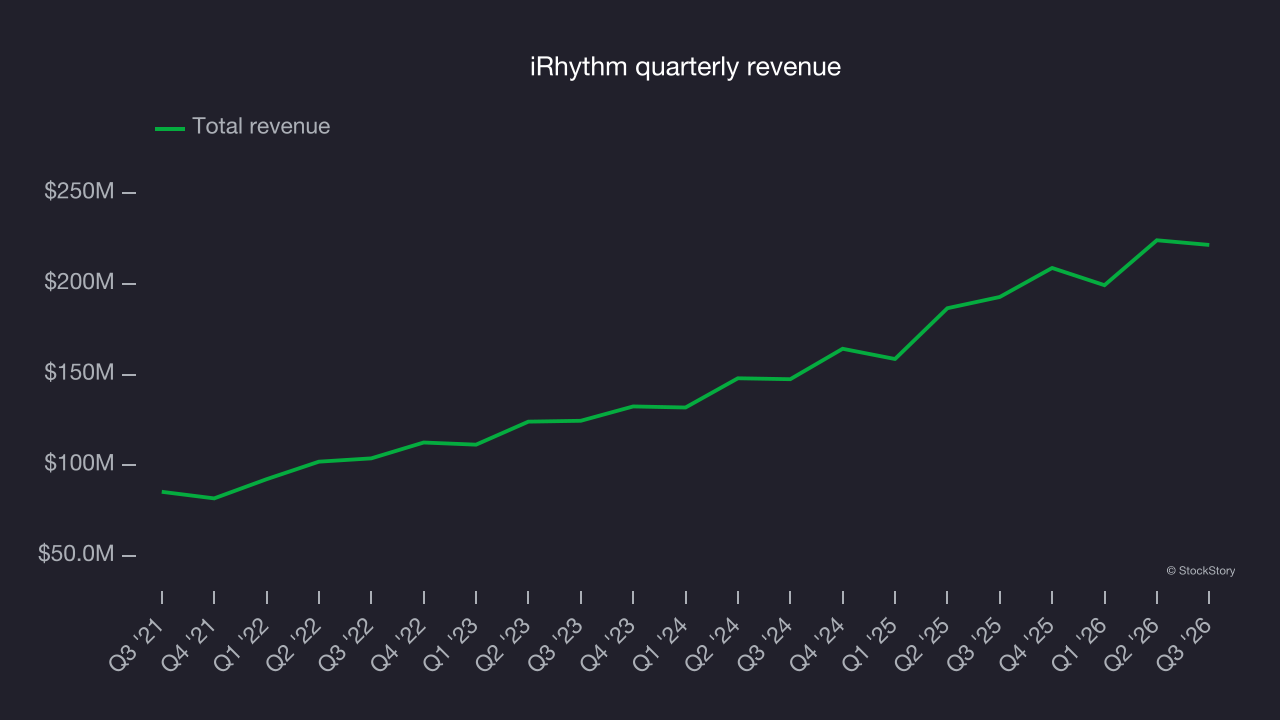
Long-term growth is the most important, but within healthcare, a half-decade historical view may miss new innovations or demand cycles. iRhythm’s annualized revenue growth of 23.5% over the last two years is above its five-year trend, suggesting its demand was strong and recently accelerated. 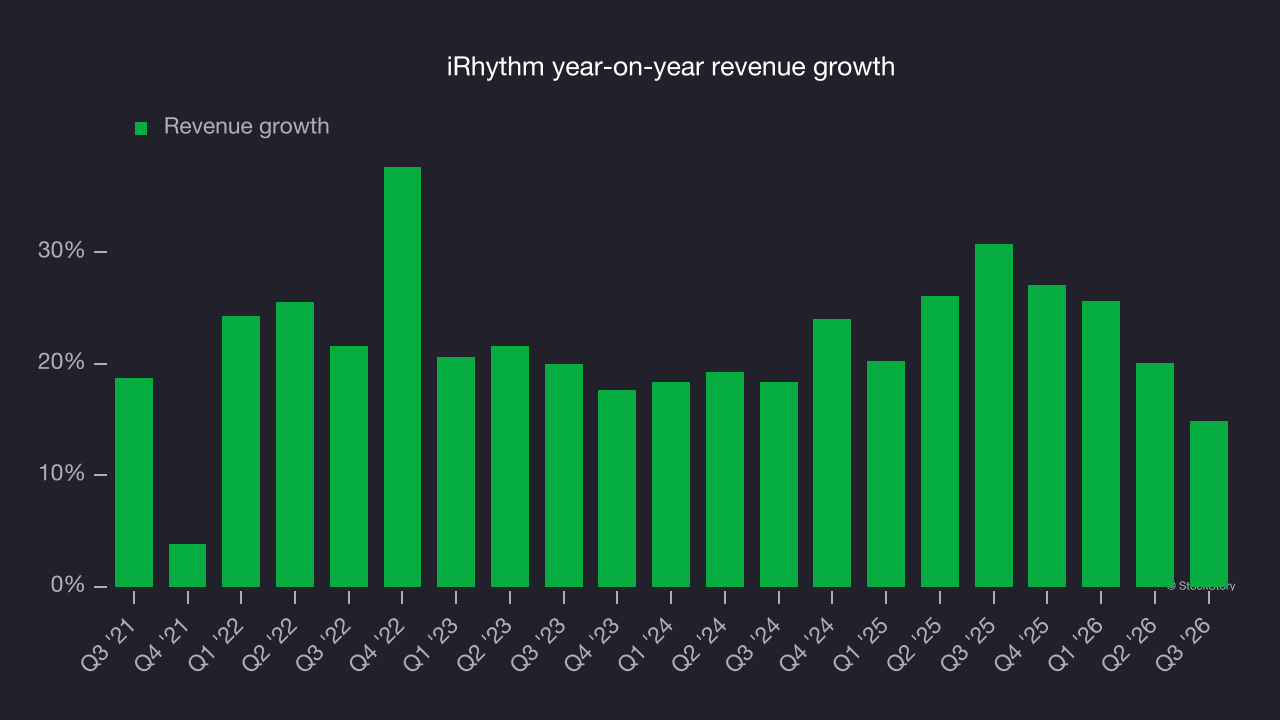
This quarter, iRhythm’s year-on-year revenue growth was 14.9%, and its $221.6 million of revenue was in line with Wall Street’s consensus estimates.
Looking ahead, sell-side analysts expect revenue to grow 18.7% over the next 12 months, according to S&P, a deceleration versus the last two years. Still, this projection is noteworthy and implies the market sees success for its products and services.
Adjusted operating margin
iRhythm’s high expenses have contributed to an average adjusted operating margin of negative 12.2% over the last five years. Unprofitable healthcare companies require extra scrutiny because they can be vulnerable when conditions deteriorate.
On the positive side, iRhythm’s adjusted operating margin rose by 25.4 percentage points over the last five years, as its revenue growth provided operating leverage. Its more recent performance shows that trajectory remains intact, as its margin has also increased by 23.1 percentage points on a two-year basis. These gains are encouraging and show continued momentum.
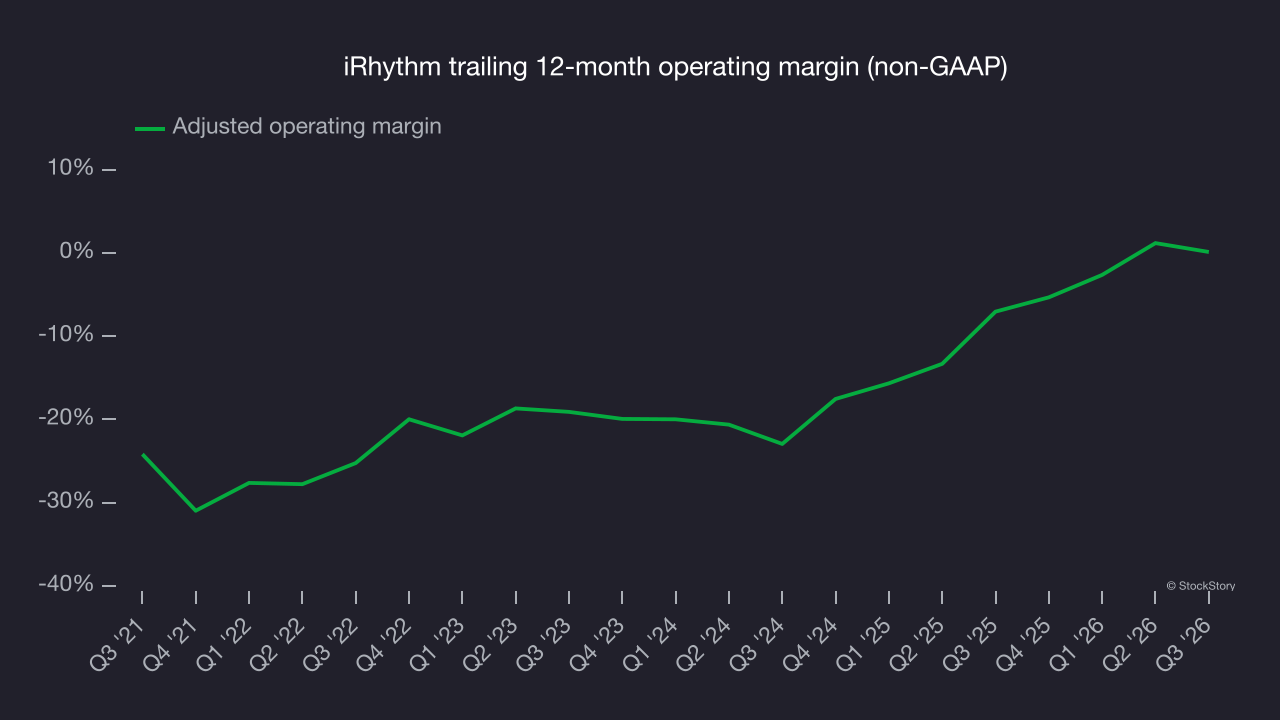
This quarter, iRhythm generated a negative 5.9% adjusted operating margin.
Earnings per share
Revenue trends explain a company’s historical growth, but the long-term change in earnings per share, or EPS, points to the profitability of that growth. For example, a company could inflate its revenue through excessive spending on advertising and promotions.
iRhythm’s full-year EPS flipped from negative to positive over the last five years. This is a good sign and shows it’s at an inflection point.
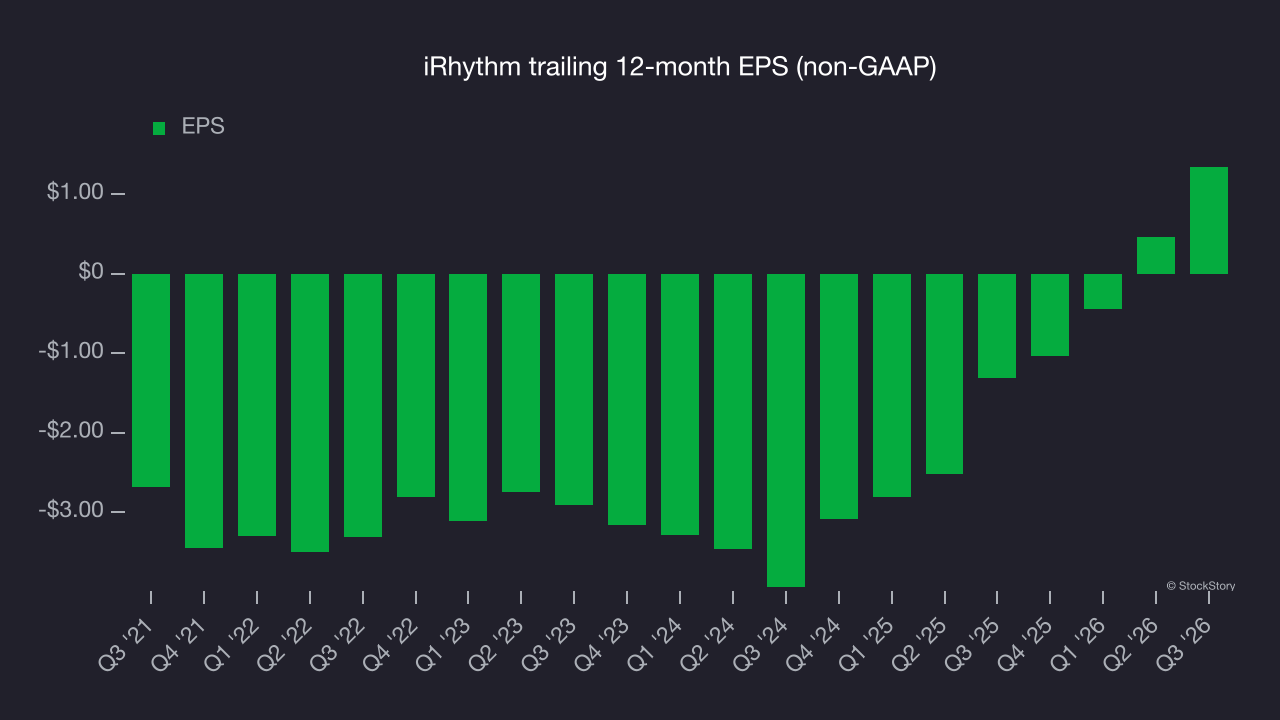
In Q3, iRhythm reported adjusted EPS of $0.82, up from negative $0.06 in the same quarter last year. This result came in well above analysts’ consensus estimates. Over the next 12 months, Wall Street expects iRhythm’s full-year EPS to shrink by 61.6% from $1.34 to $0.51, according to S&P. This is unusual as its revenue and operating margin are anticipated to increase, signaling the fall likely stems from “below-the-line” items such as taxes.
Key takeaways from iRhythm’s Q3 results
iRhythm delivered a mixed Q3: EPS topped analysts’ consensus estimates, but revenue was in line with Wall Street’s expectations and full-year revenue guidance fell slightly short. Investors were likely hoping for more. Shares plunged 12.4% to $114.50 immediately after the results.
Before investing in iRhythm, consider the bigger picture of valuation and business quality alongside the latest earnings. Read the full research report here (it’s free).