

Healthcare staffing company AMN Healthcare Services (NYSE: AMN) announced better-than-expected revenue in Q3 2026, with revenue up 13% year on year to $717.3 million. Guidance for next quarter’s revenue was better than expected at $662.5 million at the midpoint, 1.6% above analysts’ consensus estimates. Its non-GAAP profit of $1.16 per share was significantly above analysts’ consensus estimates.
For more on AMN Healthcare Services, read our free full research report.
AMN Healthcare Services (AMN) Q3 2026 highlights:
- Revenue $717.3 million vs S&P analysts’ consensus estimates of $649.1 million (13% year-on-year growth, 10.5% beat)
- Adjusted EPS $1.16 vs S&P analysts’ consensus estimates of $0.23 (significant beat)
- Adjusted EBITDA $93.57 million vs analysts’ consensus estimates of $43.71 million (13% margin, significant beat)
- Revenue guidance $662.5 million at the midpoint for Q4 2026, above analysts’ consensus estimates of $652 million
- Operating margin 7%, in line with the same quarter last year
- Free cash flow -$77.53 million, down from $14.76 million in the same quarter last year
- Sales volumes rose 15.6% year on year (-10.4% in the same quarter last year)
- Market capitalization $1.84 billion
"We are encouraged by the continued growth in nursing and allied staffing. Demand strengthened during the third quarter and through October and our team is delivering for our clients through faster recruiting, automation, and around-the-clock execution. We also are making progress on improvements in our other segments," said Cary Grace, President and Chief Executive Officer of AMN Healthcare. "Healthcare organizations increasingly want better visibility and more strategic management of their total workforce. Our strategy to bring together our talent engagement, trusted client relationships, operational expertise, and technology-enabled solutions is well-timed with the marketplace's demands."
Revenue growth
Reviewing a company’s long-term revenue performance reveals insights into its quality. Any business can have short-term success, but a top-tier one grows for years. AMN Healthcare Services’s revenue grew at a tepid 1.6% annualized rate over the last five years, falling short of our benchmarks.
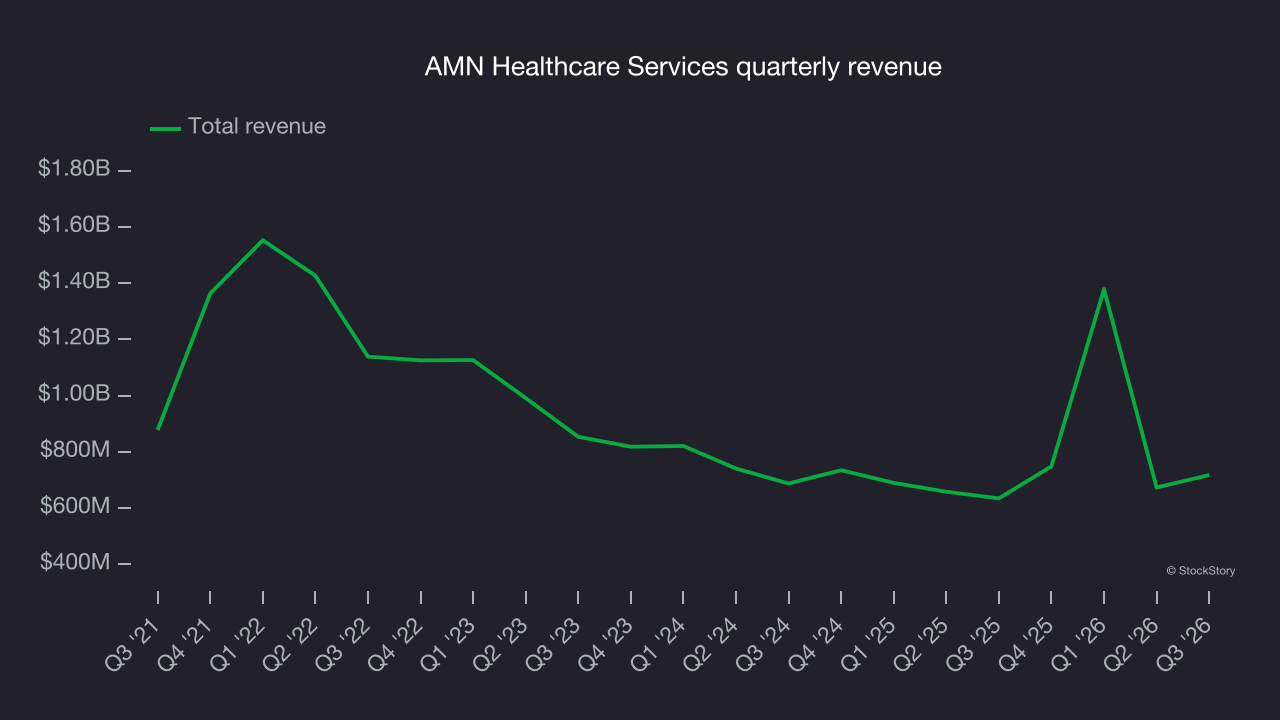
Long-term growth is the most important, but within healthcare, a half-decade historical view may miss new innovations or demand cycles. AMN Healthcare Services’s annualized revenue growth of 7.1% over the last two years is above its five-year trend, a positive sign. 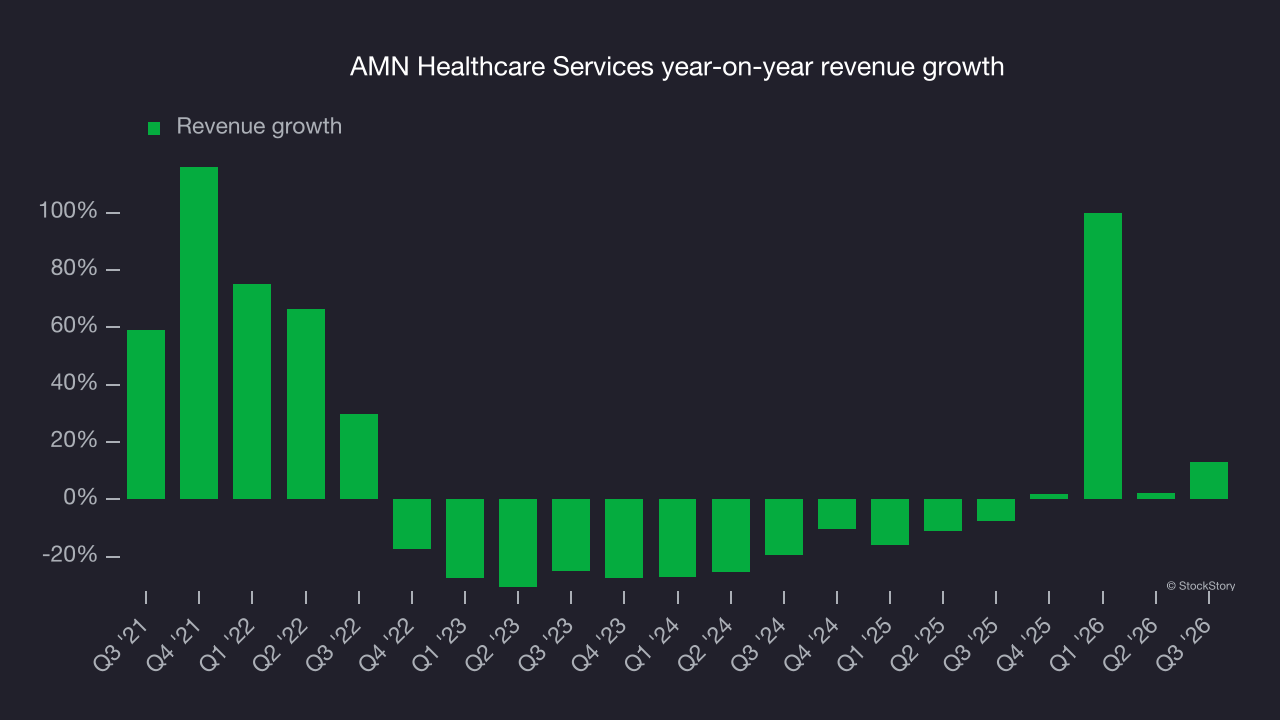
AMN Healthcare Services also reports its number of travelers on assignment, which reached 9,486 in the latest quarter. Over the last two years, AMN Healthcare Services’s travelers on assignment averaged 5.2% year-on-year declines. Revenue growth outpaced this metric, indicating that the company benefited from price increases. 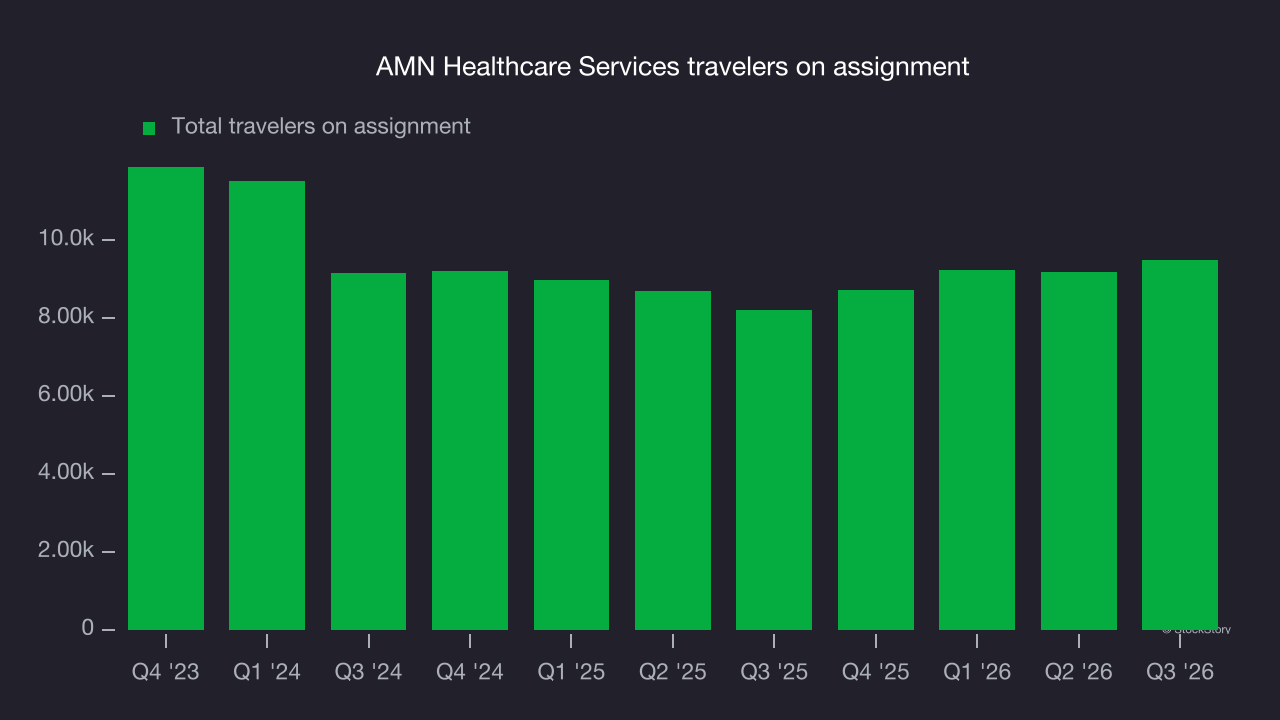
This quarter, AMN Healthcare Services reported year-on-year revenue growth of 13%, and its $717.3 million of revenue exceeded Wall Street’s consensus estimates by 10.5%. Company management is guiding for an 11.5% year-on-year decline in revenue next quarter.
Looking further ahead, sell-side analysts expect revenue to decline by 25.1% over the next 12 months, according to S&P, a deceleration versus the last two years. That underwhelming outlook suggests its products and services will face some demand challenges.
Adjusted operating margin
AMN Healthcare Services was profitable over the last five years but held back by its large cost base. Its average adjusted operating margin of 8.2% was weak for a healthcare business.
AMN Healthcare Services’s adjusted operating margin decreased by 7.4 percentage points over the last five years. This raises questions about the company’s expense base because its revenue growth should have given it leverage on its fixed costs, resulting in better economies of scale and profitability. AMN Healthcare Services’s performance was poor, showing that costs were rising and it couldn’t pass them on to its customers.
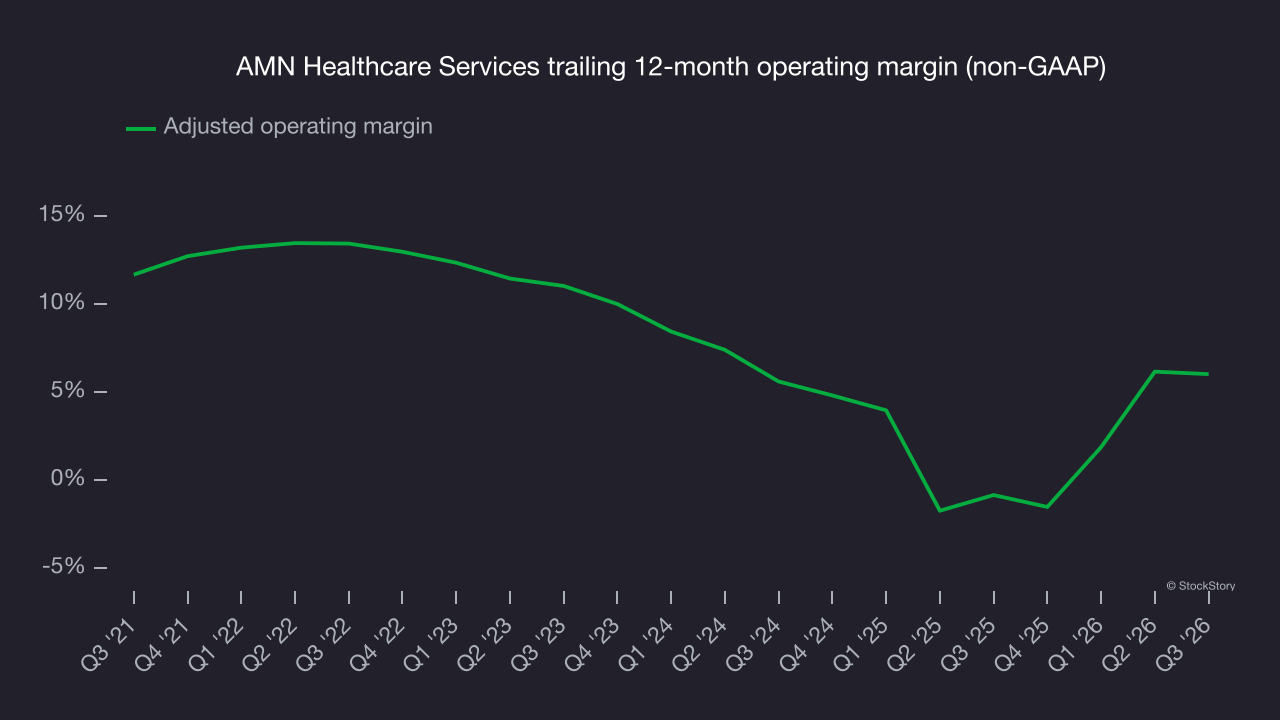
In Q3, AMN Healthcare Services generated an adjusted operating margin of 7%, in line with the same quarter last year. This indicates the company’s overall cost structure has been relatively stable.
Earnings per share
Revenue trends explain a company’s historical growth, but the long-term change in earnings per share, or EPS, points to the profitability of that growth. For example, a company could inflate its revenue through excessive spending on advertising and promotions.
AMN Healthcare Services’s EPS declined by 6.9% annually over the last five years while its revenue grew by 1.6%. This indicates the company became less profitable on a per-share basis as it expanded due to non-fundamental factors such as interest expenses and taxes.
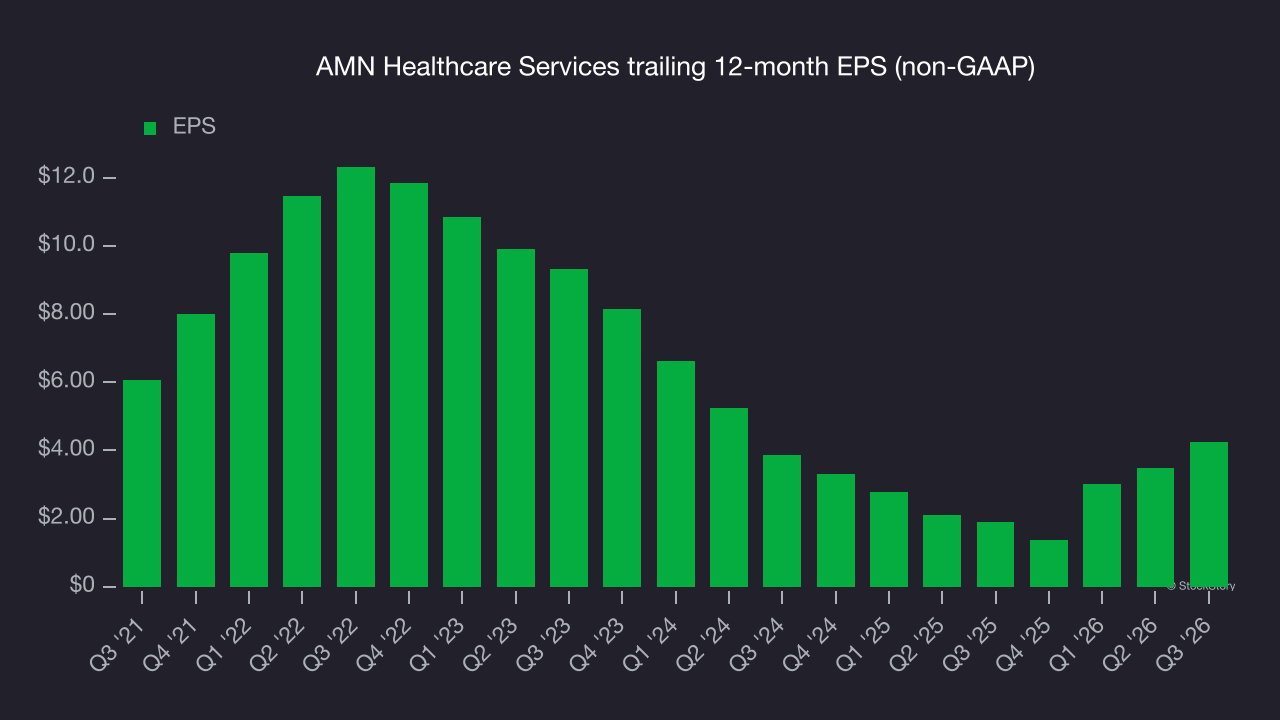
A closer look at AMN Healthcare Services’s earnings helps explain its performance. AMN Healthcare Services’s adjusted operating margin was flat this quarter but declined by 7.4 percentage points over the last five years. This was the most relevant factor (aside from the revenue impact) behind its lower earnings; interest expenses and taxes can also affect EPS but don’t tell us as much about a company’s fundamentals.
In Q3, AMN Healthcare Services reported adjusted EPS of $1.16, up from $0.39 in the same quarter last year. This was well above analysts’ consensus estimates, a positive result for shareholders. Over the next 12 months, Wall Street expects AMN Healthcare Services’s full-year EPS to shrink by 79.7% from $4.25 to $0.86, according to S&P.
Key takeaways from AMN Healthcare Services’s Q3 results
AMN Healthcare Services delivered a good quarter, with revenue beating Wall Street’s consensus estimates by a wide margin and EPS also topping analysts’ consensus expectations. Those were clear positives, but investors were likely hoping for more. Shares fell 3.8% to $45.63 immediately after the results.
Should you invest in AMN Healthcare Services? The latest quarter is only one piece of the longer-term business quality picture. Quality, combined with valuation, can help determine whether the stock is a buy. For more on that assessment, read the full research report here (it’s free).