

Social commerce platform Pinterest (NYSE: PINS) missed Wall Street’s revenue expectations in Q3 2026, but revenue rose 11.9% year on year to $1.17 billion. Next quarter’s revenue guidance of $1.45 billion underwhelmed, coming in 4.7% below analysts’ consensus estimates. Its non-GAAP profit of $0.46 per share was 5.2% below analysts’ consensus estimates.
For more on Pinterest, read our free full research report.
Pinterest (PINS) Q3 2026 highlights:
- Revenue $1.17 billion vs S&P analysts’ consensus estimates of $1.21 billion (11.9% year-on-year growth, 2.7% miss)
- Adjusted EPS $0.46 vs S&P analysts’ consensus estimates of $0.49 (5.2% miss)
- Adjusted EBITDA $339.2 million vs analysts’ consensus estimates of $348 million (28.9% margin, 2.5% miss)
- Revenue guidance $1.45 billion at the midpoint for Q4 2026, below analysts’ consensus estimates of $1.52 billion
- EBITDA guidance $563 million at the midpoint for Q4 2026, below analysts’ consensus estimates of $611.8 million
- Operating margin 2.6%, down from 5.6% in the same quarter last year
- Free cash flow margin 25.6%, up from 22.9% in the previous quarter
- Monthly active users 661 million, up 61 million year on year
- Market capitalization $11.85 billion
"Pinterest reached an all-time high of 661 million monthly active users in Q3, with revenue growing 12% year over year,” said Bill Ready, CEO of Pinterest. “Our differentiated AI-driven visual search and shopping experiences are making Pinterest increasingly valuable for users and advertisers alike. We are focused on sharpening our execution, scaling our performance advertising solutions, and building an ecosystem that captures high-intent discovery and converts it into durable, long-term growth."
Revenue growth
A company’s long-term performance is an indicator of its overall quality. Any business can deliver a good quarter or two, but many enduring ones grow for years. Over the last three years, Pinterest grew its revenue at a solid 16.6% compounded annual growth rate. Its growth surpassed the average consumer internet company and shows its offerings resonate with customers.
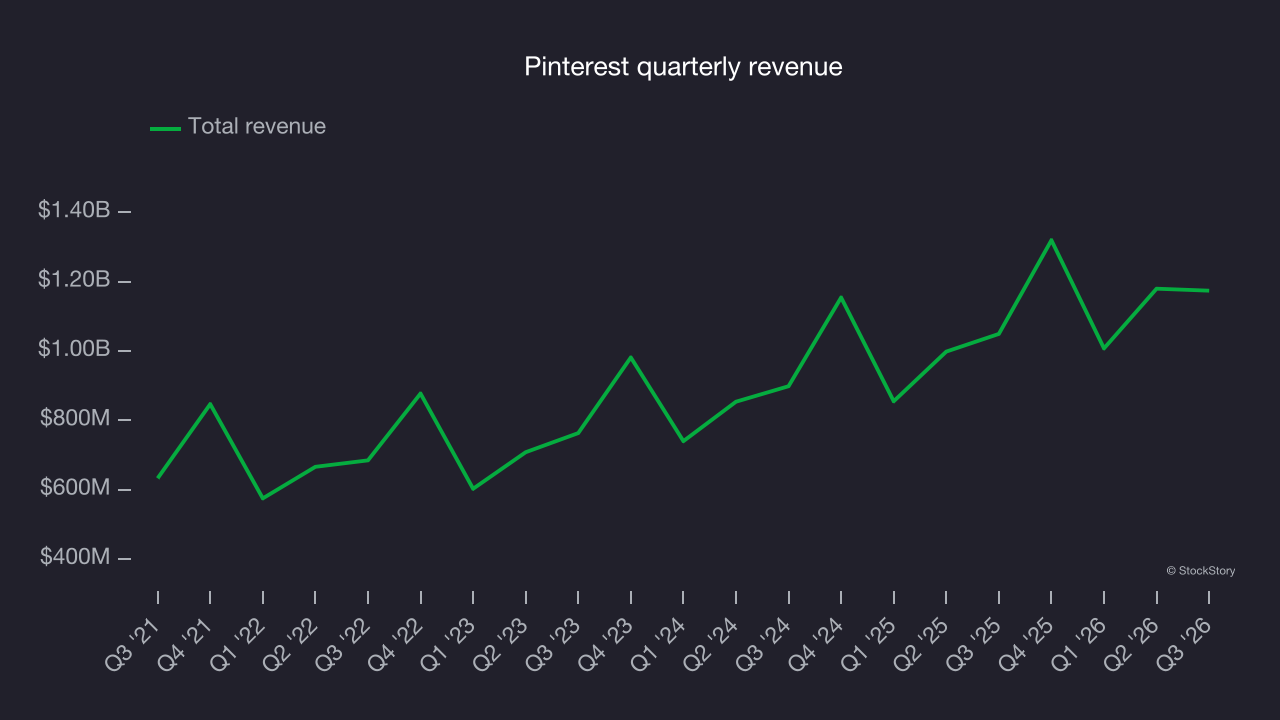
This quarter, Pinterest’s revenue grew by 11.9% year on year to $1.17 billion but fell short of Wall Street’s consensus estimates. Management is currently guiding for a 9.9% year-on-year increase in revenue next quarter.
Looking further ahead, sell-side analysts expect revenue to grow 14.7% over the next 12 months, according to S&P, a slight deceleration versus the last three years. Despite the slowdown, this projection is noteworthy and implies the market sees success for its products and services.
Monthly active users
User growth
As a social network, Pinterest generates revenue growth by increasing its user base and charging advertisers more for the ads each user is shown.
Over the last two years, Pinterest’s monthly active users, a key performance metric for the company, increased by 10.9% annually to 661 million in the latest quarter. This growth rate is strong for a consumer internet business and indicates users value its offerings. 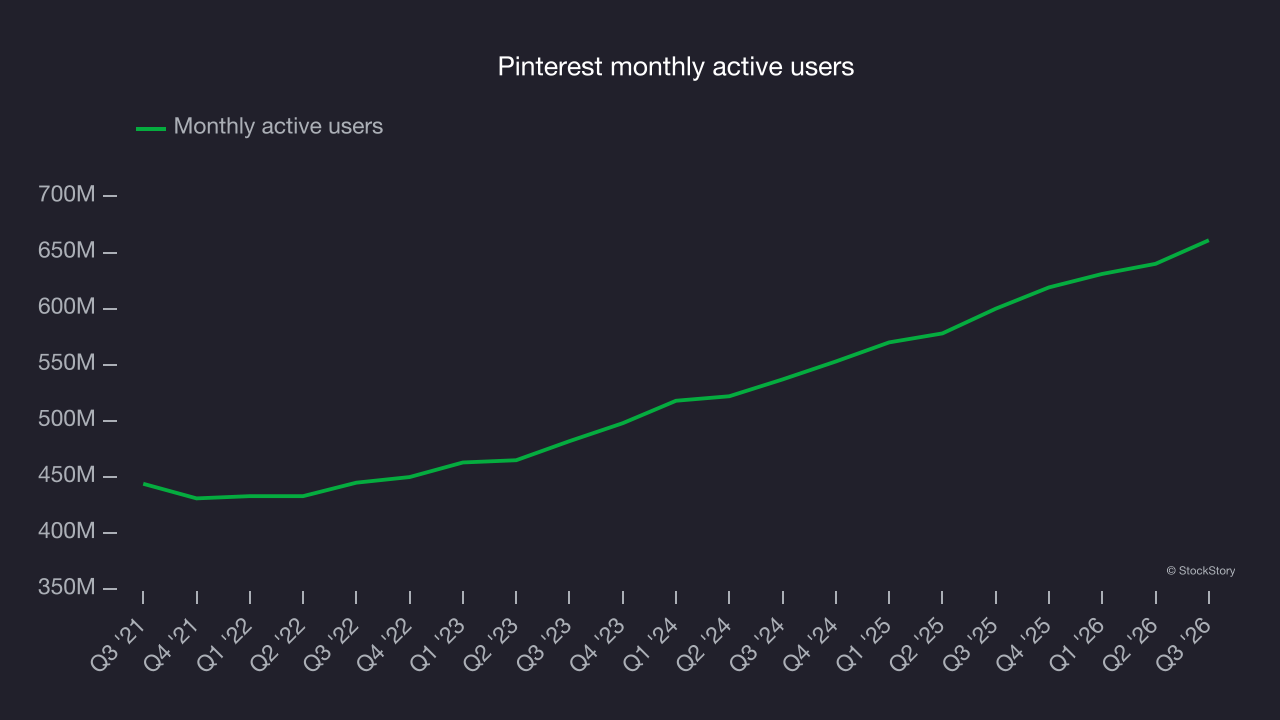
In Q3, Pinterest added 61 million monthly active users, leading to 10.2% year-on-year growth. The quarterly growth rate is similar to its two-year result, suggesting its new initiatives aren’t accelerating user growth yet.
Revenue per user
Average revenue per user (ARPU) is a critical metric to track because it measures how much the company earns from the ads shown to its users. ARPU can also be a proxy for how valuable advertisers find Pinterest’s audience and its ad-targeting capabilities.
Pinterest’s ARPU growth has been mediocre over the last two years, averaging 4.6%, but the increase in monthly active users is more relevant for assessing long-term business potential. If Pinterest takes a more aggressive approach to monetization to boost ARPU, it’s unclear whether its user base can continue growing at the current pace. 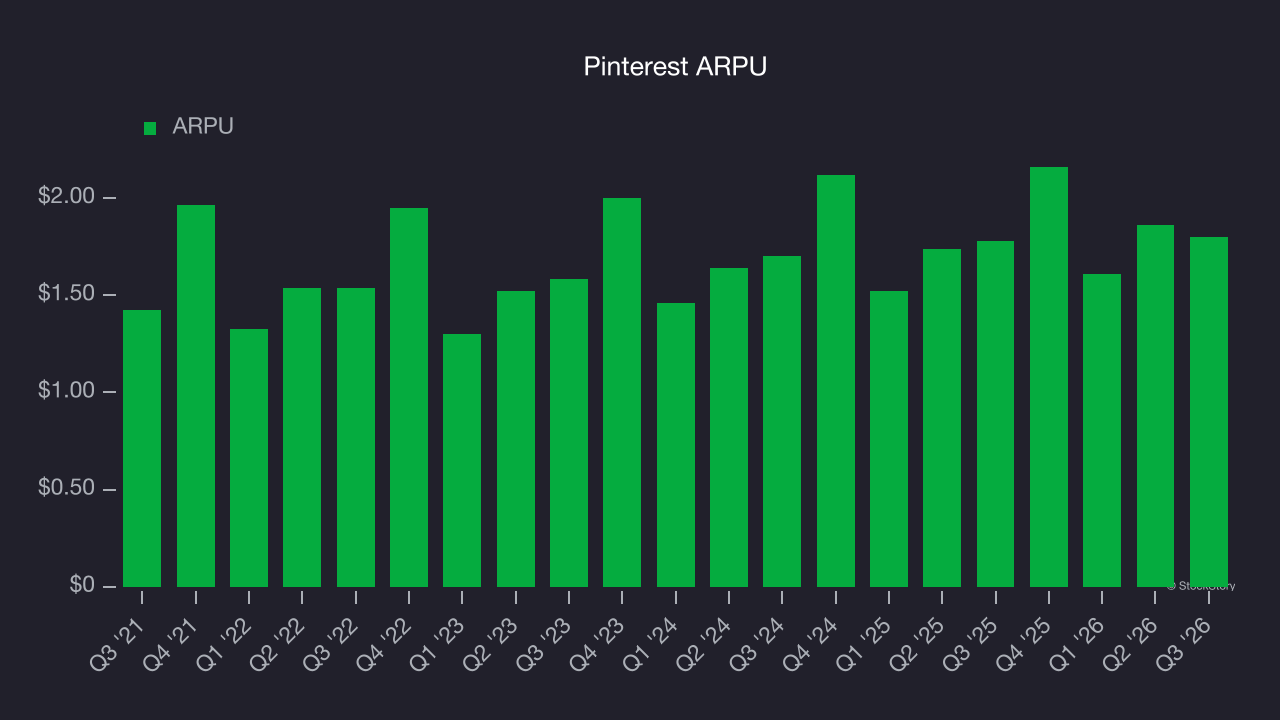
This quarter, Pinterest’s ARPU was $1.80. It grew by 1.1% year on year, slower than its user growth.
Key takeaways from Pinterest’s Q3 results
Pinterest’s user count grew this quarter, but revenue fell short of Wall Street’s consensus estimates and next-quarter revenue guidance also missed expectations. Those shortfalls made this a softer quarter despite the user gains. Shares plunged 14.2% to $17.19 immediately after the results.
Pinterest may have had a tough quarter, but does that create an opportunity to invest now? The latest quarter matters, but not nearly as much as longer-term fundamentals and valuation when deciding whether the stock is a buy. For more on Pinterest’s fundamentals and valuation, read our full research report here (it’s free).