In the high-stakes world of global digital marketing, strategic planning is often perceived as the ultimate challenge. However, in reality, the momentum of a multi-million dollar campaign can be instantly halted by something as seemingly mundane as an API configuration path or an access token code. Traditionally, resolving these technical hiccups required merchants to sift through endless developer documentation, browse forums, and endure costly trial-and-error—all while business growth remained on pause.
Navos, the marketing multi-agent platform developed by Tec-Do, is changing this paradigm by transforming complex technical barriers into a simple, natural language conversation. By eliminating the need for developer backgrounds or dense manuals, Navos demonstrates how vertical AI can seamlessly empower business growth. A recent case study of a home textile merchant highlights exactly how this works.
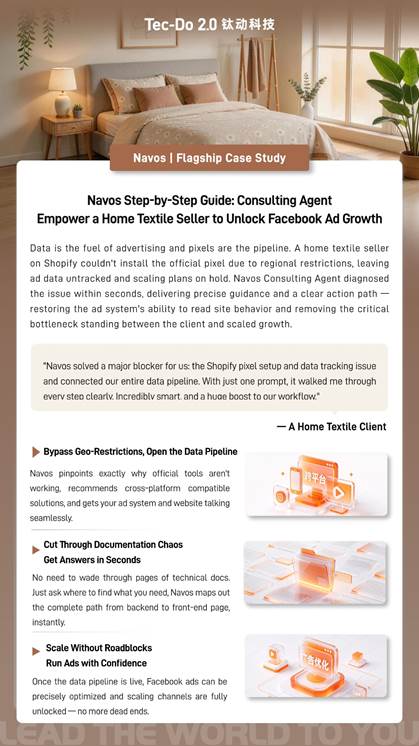
The Technical Bottleneck Halting a 2,000-Order-a-Day Merchant
For cross-border e-commerce brands, the greatest risk isn’t spending ad budget—it’s flying blind without data attribution.
This was the exact challenge faced for over a week by a prominent home textile merchant. Generating a stable volume of nearly 2,000 daily orders via TikTok Shop, the merchant was eager to expand its digital footprint to non-closed-loop channels like Facebook to further scale revenue.
While the expansion strategy was sound, execution hit a wall during the setup of a foundational infrastructure element: the Facebook Pixel.
As an essential data pipeline, the Pixel tracks user behaviors—views, clicks, and purchases—and relays them back to Facebook’s ad delivery system. This real-time feedback loop allows the algorithm to optimize budgets, scaling high-performing ads and pausing inefficient ones. Without it, advertising becomes an expensive guessing game.
Operating on Shopify, the merchant encountered unexpected hurdles while deploying Facebook's official Pixel tools. Turning to Navos for an alternative solution, the merchant attempted to configure Facebook's Conversions API (CAPI)—a critical interface for server-side data transmission. However, the setup stalled when the system requested a specific "Access Token Code." Unable to locate the retrieval path for this token within the complex backend interfaces, the entire data tracking pipeline broke down, forcing the merchant's expansion plans to an abrupt halt.
Actionable Guidance Replaces Endless Documentation
Designed by Tec-Do as a dedicated "AI Growth Assistant" for global enterprises, Navos distinguishes itself from generic conversational AI models. It is deeply trained on industry-specific knowledge, including cross-border e-commerce workflows, ad network algorithms, and platform-specific policies. This specialization allows Navos to understand the precise context of a marketer’s dilemma and output actionable, step-by-step operational workflows.
Rather than forcing users to navigate fragmented developer forums, Navos’s Consulting Agent allows merchants to present specific technical roadblocks in plain language.
The merchant prompted Navos with a direct question:
"When creating a Facebook Pixel, the Conversions API requires an Access Token Code to save. Where exactly do I find this token?"
Within seconds, Navos bypassed the generic links and dense technical jargon. It generated a precise, tailored UI navigation map: which menu to click in the Shopify backend, which option to select, and exactly where the Access Token string was located. It acted as an on-demand, expert technical consultant guiding the user in real-time.
Following the platform’s exact instructions, the merchant retrieved the code and finalized the CAPI and Pixel configuration within minutes. Data began flowing instantly, allowing the Facebook ad algorithm to accurately analyze site traffic and user conversions.
Eliminating the Tech Barrier to Unleash True Scaling
With the data attribution infrastructure secured, the merchant immediately launched its scaled campaigns on Facebook. The ad system automatically optimized bidding strategies, lookalike audiences, and creative assets based on the accurately returned conversion data. Operating across both TikTok and Facebook simultaneously, the brand shattered its previous sales ceiling.
"Navos solved a major bottleneck for us regarding Shopify Pixel creation and data return, successfully bridging our entire data pipeline," the client noted. "With just one simple query, Navos guided me step-by-step with extreme clarity. It’s highly intelligent and has significantly driven our operational efficiency."
The inherent complexity of global e-commerce rarely stems from the core business model itself, but rather from fragmented software ecosystems and cryptic technical jargon. Terms like Pixel, Conversions API, and Access Tokens may be second nature to software engineers, but to merchants focused on supply chain, inventory, and ROI, they represent operational walls.
The core value proposition of Navos lies not merely in being "smarter" than general AI platforms, but in its deep, domain-specific training tailored to the actual scenarios global merchants face. By seamlessly flattening the technical learning curve, Navos allows enterprises to refocus their capital and energy where it matters most: product curation, content strategy, customer service, and sustainable growth. This represents the ultimate, most practical value of AI enablement in global commerce.
About Tec-Do
Founded in 2017, Tec-Do is a leading AI MarTech company delivering result-centric marketing solutions for global business growth. Powered by Tec-Chi multi-modal large language models (MLLMs), the company delivers end-to-end marketing solutions through a suite of AI-native, performance-driven products. These products restructure and autonomize mission-critical marketing processes—including market intelligence, content generation, campaign delivery, and performance optimization—across global media channels. In 2025, Tec-Do served over 100,000 advertisers, representing a diversified customer base that spans e-commerce, gaming, entertainment, and local commerce.