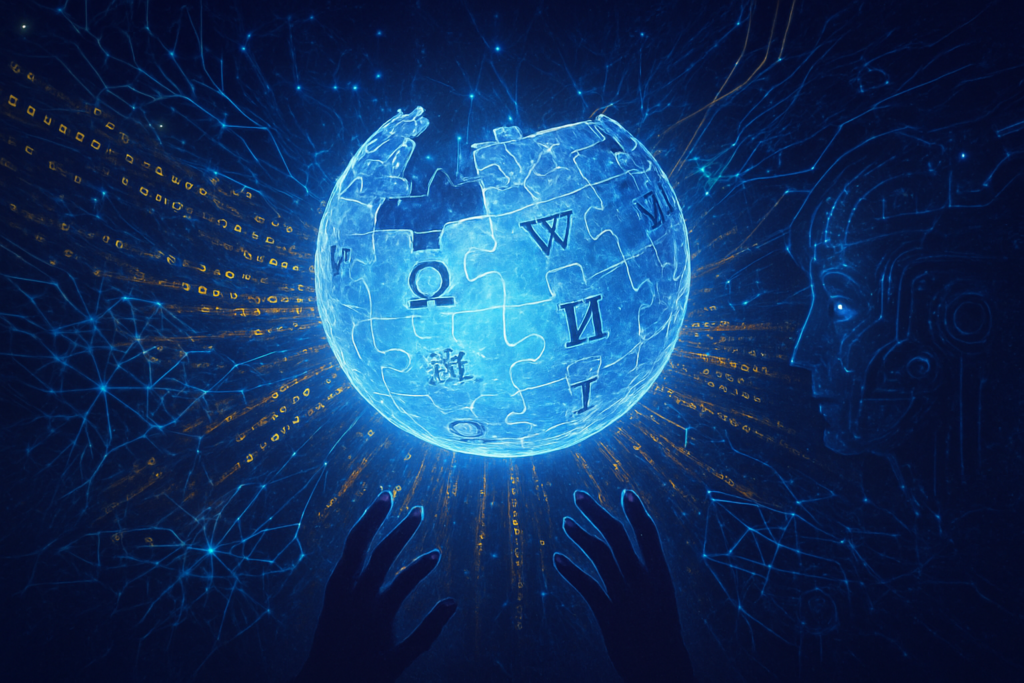
As Wikipedia celebrated its 25th anniversary last month, founder Jimmy Wales issued a historic ultimatum to the world’s leading artificial intelligence companies: the era of "free lunch" for AI training is officially over. Marking a monumental shift in the platform’s philosophy, Wales has transitioned from a staunch advocate of absolute open access to a pragmatic defender of the nonprofit’s infrastructure, demanding that multi-billion dollar AI labs pay their "fair share" for the massive amounts of data they scrape to train Large Language Models (LLMs).
The announcement, which coincided with the January 15, 2026, anniversary festivities, highlights a growing tension between the keepers of human-curated knowledge and the creators of synthetic intelligence. Wales has explicitly argued that Wikipedia—funded primarily by small $10 donations from individuals—should not be used to "subsidize" the growth of private tech titans. As AI scrapers now account for more than 60% of Wikipedia’s total automated traffic, the Wikimedia Foundation is moving to convert that technical burden into a sustainable revenue stream that ensures the survival of its human editor community.
The Wikimedia Enterprise Solution and the War on "AI Slop"
At the heart of this shift is the Wikimedia Enterprise API, a professional-grade data service that provides companies with structured, high-speed access to Wikipedia’s vast repository of information. Unlike traditional web scraping, which can strain servers and return messy, unstructured data, the Enterprise platform offers real-time updates and "clean" datasets optimized for model training. During the foundation’s 2025 financial reporting, it was revealed that revenue from this enterprise arm surged by 148% year-over-year, reaching $8.3 million—a clear signal that the industry is beginning to acknowledge the value of high-quality, human-verified data.
This technical pivot is not merely about server costs; it is a defensive maneuver against what editors call "AI slop." In August 2025, the Wikipedia community adopted a landmark "speedy deletion" policy specifically targeting suspected AI-generated articles. The foundation’s strategy distinguishes between the "human-curated" value of Wikipedia and the "unverifiable hallucinations" often produced by LLMs. By funneling AI companies through the Enterprise API, Wikipedia can better monitor how its data is being used while simultaneously deploying AI-powered tools to help human moderators detect hoaxes and verify citations more efficiently than ever before.
Big Tech Signs On: The New Data Cartel
The strategic push for paid access has already divided the tech landscape into "customers" and "competitors." In a series of announcements throughout January 2026, the Wikimedia Foundation confirmed that Alphabet Inc. (NASDAQ: GOOGL), Microsoft Corp. (NASDAQ: MSFT), Meta Platforms Inc. (NASDAQ: META), and Amazon.com Inc. (NASDAQ: AMZN) have all formalized or expanded their agreements to use the Enterprise API. These deals provide the tech giants with a reliable, "safe" data source to power their respective AI assistants, such as Google Gemini, Microsoft Copilot, and Meta AI.
However, the industry is closely watching a notable holdout: OpenAI. Despite the prominence of its ChatGPT models, reports indicate that negotiations between the Wikimedia Foundation and OpenAI have stalled. Analysts suggest that while other tech giants are willing to pay for the "human-curated" anchor that Wikipedia provides, the standoff with OpenAI represents a broader disagreement over the valuation of training data. This rift places OpenAI in a precarious position as competitors secure legitimate, high-velocity data pipelines, potentially giving an edge to those who have "cleared their titles" with the world’s most influential encyclopedia.
Navigating the Legal Minefield of Fair Use in 2026
The demand for payment comes at a time when the legal definition of "fair use" is being aggressively re-evaluated in the courts. Recent 2025 rulings, such as Thomson Reuters v. Ross Intelligence, have set a chilling precedent for AI firms by suggesting that training a model on data that directly competes with the original source is not "transformative" and therefore constitutes copyright infringement. Furthermore, the October 2025 ruling in Authors Guild v. OpenAI highlighted that detailed AI-generated summaries could be "substantially similar" to their source material—a direct threat to the way AI uses Wikipedia’s meticulously written summaries.
Beyond the United States, the European Union’s AI Act has moved into a strict enforcement phase as of early 2026. General-purpose AI providers are now legally obligated to respect "machine-readable" opt-outs and provide detailed summaries of their training data. This regulatory pressure has effectively ended the Wild West era of indiscriminate scraping. For Wikipedia, this means aligning with the "human-first" movement, positioning itself as an essential partner for AI companies that wish to avoid "model collapse"—a phenomenon where AI models trained on too much synthetic data begin to degrade and produce nonsensical results.
The Future of Human-AI Symbiosis
Looking ahead to the remainder of 2026, experts predict that Wikipedia’s successful monetization of its API will serve as a blueprint for other knowledge-heavy platforms. The Wikimedia Foundation is expected to reinvest its AI-generated revenue into tools that empower its global network of editors. Near-term developments include the launch of advanced "citation-checking bots" that use the same LLM technology they help train to identify potential inaccuracies in new Wikipedia entries.
However, challenges remain. A vocal segment of the Wikipedia community remains wary of any commercialization of the "free knowledge" mission. In the coming months, the foundation will need to balance its new role as a data provider with its core identity as a global commons. If successful, this model could prove that AI development does not have to be extractive, but can instead become a symbiotic relationship where the massive profits of AI developers directly sustain the human researchers who make their models possible.
A New Era for Global Knowledge
The pivot led by Jimmy Wales marks a watershed moment in the history of the internet. For twenty-five years, Wikipedia stood as a testament to the idea that information should be free for everyone. By demanding that AI companies pay, the foundation is not closing its doors to the public; rather, it is asserting that the human labor required to maintain truth in a digital age has a distinct market value that cannot be ignored by the machines.
As we move deeper into 2026, the success of the Wikimedia Enterprise model will be a bellwether for the survival of the open web. In the coming weeks, keep a close eye on the outcome of the OpenAI negotiations and the first wave of EU AI Act enforcement actions. The battle for Wikipedia’s data is about more than just licensing fees; it is a battle to ensure that in an age of artificial intelligence, the human element remains at the center of our collective knowledge.
This content is intended for informational purposes only and represents analysis of current AI developments.
TokenRing AI delivers enterprise-grade solutions for multi-agent AI workflow orchestration, AI-powered development tools, and seamless remote collaboration platforms.
For more information, visit https://www.tokenring.ai/.