

The end of the earnings season is always a good time to take a step back and see who shined (and who didn’t). Let’s take a look at how consumer discretionary - broadcasting stocks fared in Q1, starting with Gray Television (NYSE: GTN).
The Consumer Discretionary sector, by definition, is made up of companies selling non-essential goods and services. When economic conditions deteriorate or tastes shift, consumers can easily cut back or eliminate these purchases. For long-term investors with five-year holding periods, this creates a structural challenge: the sector is inherently hit-driven, with low switching costs and fickle customers. As a result, only a handful of companies can reliably grow demand and compound earnings over long periods, which is why our bar is high and High Quality ratings are rare. Broadcasting companies produce and distribute television and radio content, generating revenue primarily through advertising and, in some cases, retransmission fees (payments cable and satellite operators make to carry local channels). Tailwinds include resilient demand for live sports and event programming, which commands premium ad rates, and political advertising during election cycles. Headwinds, however, are substantial: secular cord-cutting (consumers canceling traditional pay-TV subscriptions) is shrinking linear audiences, digital platforms are capturing an increasing share of advertising budgets, and content production costs continue to rise. Regulatory scrutiny over media consolidation and spectrum ownership further constrains strategic flexibility.
The 6 consumer discretionary - broadcasting stocks we track reported a satisfactory Q1. As a group, revenues beat analysts’ consensus estimates by 1.3% while next quarter’s revenue guidance was 0.6% below.
Amidst this news, share prices of the companies have had a rough stretch. On average, they are down 7.9% since the latest earnings results.
Gray Television (NYSE: GTN)
Specializing in local media coverage, Gray Television (NYSE: GTN) is a broadcast company supplying digital media to various markets in the United States.
Gray Television reported revenues of $768 million, down 1.8% year on year. This print was in line with analysts’ expectations, but overall, it was a softer quarter for the company with a significant miss of analysts’ EPS and adjusted operating income estimates.
Hilton Howell, Jr., Executive Chairman and CEO, commented, “Our first quarter 2026 results were solid, with Core Advertising exceeding our guidance and Political revenue at the high end of our guidance range. A recently resolved dispute with a distribution partner impacted our Net Retransmission Revenue for the quarter. With all scheduled 2026 retransmission negotiations now complete and the improvement in underlying MVPD subscriber trends, we now have visibility on our growth in Net Retransmission Revenue for full year 2026. While we are seeing some softness in core advertising in Q2, we are optimistic that, as the largest owner of top-rated local television stations and a footprint covering most of the competitive races, we will again capitalize on a strong mid-term political cycle.
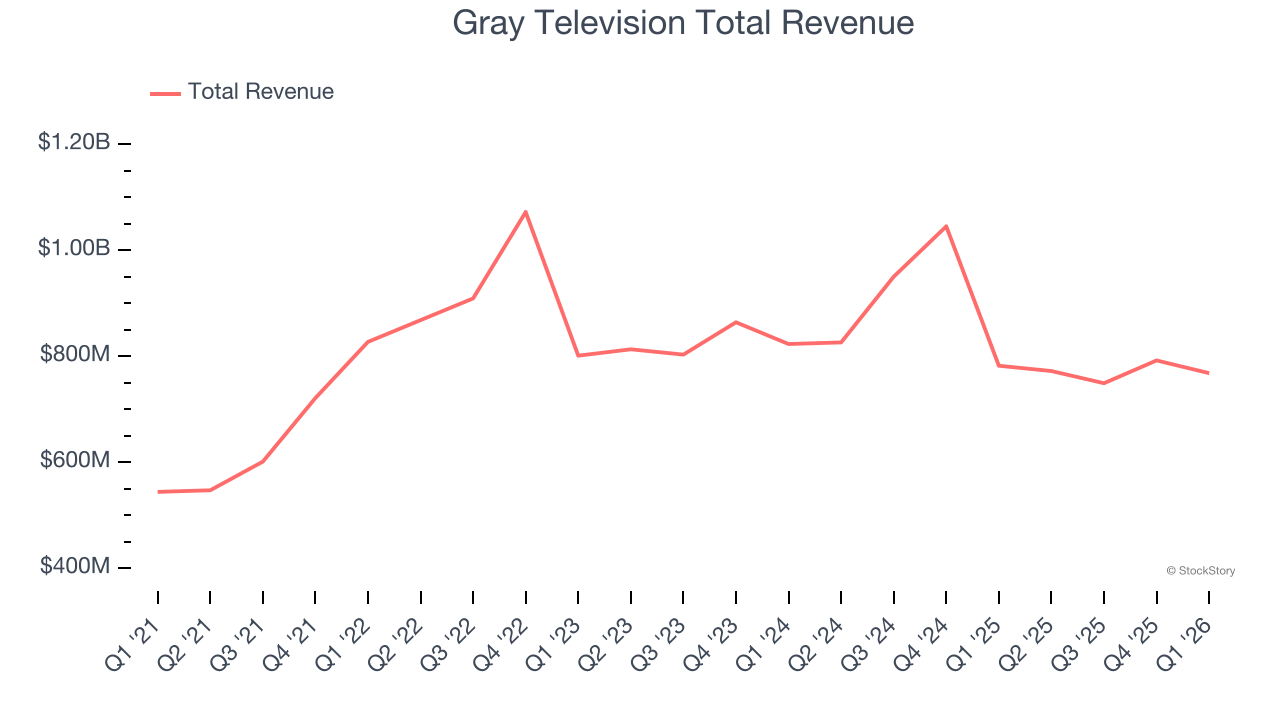
Gray Television delivered the weakest performance against analyst estimates of the whole group. Unsurprisingly, the stock is down 24.7% since reporting and currently trades at $4.17.
Read our full report on Gray Television here, it’s free.
Best Q1: FOX (NASDAQ: FOXA)
Founded in 1915, Fox (NASDAQ: FOXA) is a diversified media company, operating prominent cable news, television broadcasting, and digital media platforms.
FOX reported revenues of $3.99 billion, down 8.6% year on year, outperforming analysts’ expectations by 4.7%. The business had a stunning quarter with a beat of analysts’ EPS and EBITDA estimates.
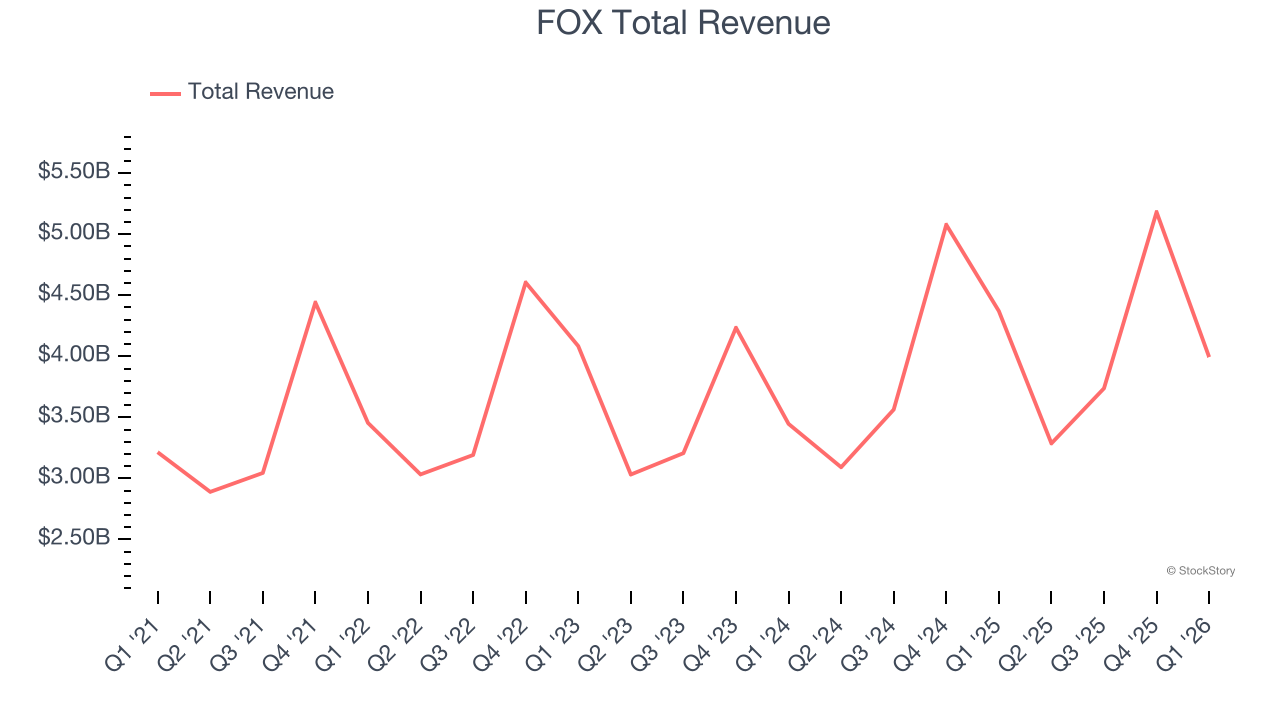
FOX achieved the biggest analyst estimate beat among its peers. The market seems content with the results as the stock is up 4.6% since reporting. It currently trades at $65.83.
Is now the time to buy FOX? Access our full analysis of the earnings results here, it’s free.
Weakest Q1: iHeartMedia (NASDAQ: IHRT)
Occasionally featuring celebrity hosts like Ryan Seacrest on its shows, iHeartMedia (NASDAQ: IHRT) is a leading multimedia company renowned for its extensive network of radio stations, digital platforms, and live events across the globe.
iHeartMedia reported revenues of $884.2 million, up 9.6% year on year, exceeding analysts’ expectations by 1.7%. Still, it was a softer quarter as it posted a significant miss of analysts’ adjusted operating income and EPS estimates.
As expected, the stock is down 11.7% since the results and currently trades at $4.85.
Read our full analysis of iHeartMedia’s results here.
AMC Networks (NASDAQ: AMCX)
Originally the joint-venture of four cable television companies, AMC Networks (NASDAQ: AMCX) is a broadcaster producing a diverse range of television shows and movies.
AMC Networks reported revenues of $542.1 million, down 2.4% year on year. This print was in line with analysts’ expectations. It was a strong quarter as it also put up an impressive beat of analysts’ adjusted operating income estimates.
The stock is up 15.1% since reporting and currently trades at $9.86.
Read our full, actionable report on AMC Networks here, it’s free.
Paramount (NASDAQ: PSKY)
Owner of Spongebob Squarepants and formerly known as ViacomCBS, Paramount Global (NASDAQ: PSKY) is a major media conglomerate offering television, film production, and digital content across various global platforms.
Paramount reported revenues of $7.35 billion, up 2.2% year on year. This result beat analysts’ expectations by 1%. Overall, it was a very strong quarter as it also logged a beat of analysts’ EPS estimates and a solid beat of analysts’ EBITDA estimates.
The stock is down 3.4% since reporting and currently trades at $10.75.
Read our full, actionable report on Paramount here, it’s free.
Market Update
Late in 2025 into early 2026, there was hand-wringing around artificial intelligence. For software companies, the fear was that AI would erode pricing power and compress margins as new tools made it easier to replicate what once required expensive enterprise platforms. Crypto investors had their own version of the same anxiety: if AI agents could trade, allocate capital, and manage wallets autonomously, what exactly was the long-term value of today’s crypto infrastructure?
These concerns triggered a noticeable rotation away from these sectors and into safer havens. But markets rarely dwell on one narrative for long. Spring 2026 came, and the focus shifted abruptly from technological disruption to geopolitical risk. The US’ conflict with Iran became the dominant driver of market psychology, and when geopolitics takes center stage, the script changes quickly. Investors stop debating growth rates and start worrying about oil supply, inflation, and global stability.
Want to invest in winners with rock-solid fundamentals? Check out our Hidden Gem Stocks and add them to your watchlist. These companies are poised for growth regardless of the political or macroeconomic climate.
StockStory’s analyst team — all seasoned professional investors — uses quantitative analysis and automation to deliver market-beating insights faster and with higher quality.