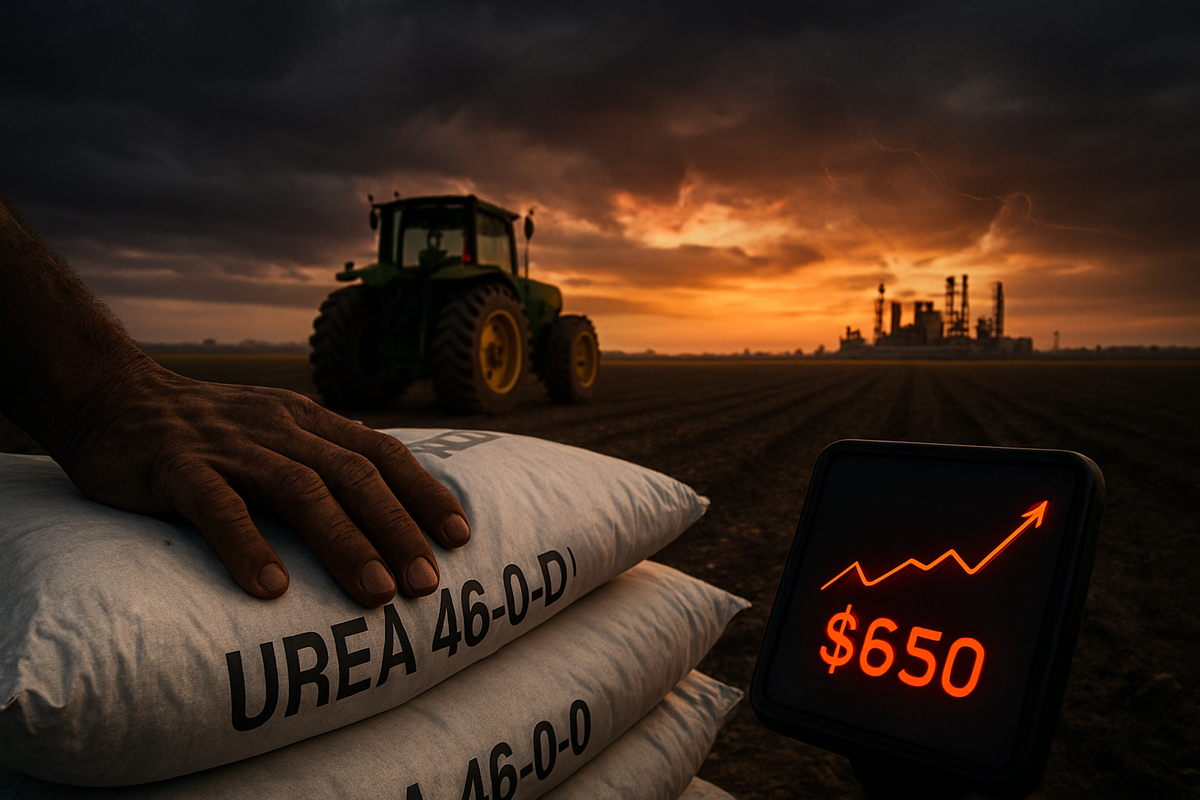
As of April 9, 2026, the global agricultural sector is grappling with a supply shock that has sent shockwaves from the trading floors of Chicago to the fertile plains of the Midwest. The "Fertilizer Crunch of 2026," precipitated by a rapid escalation of conflict in the Middle East, has fundamentally altered the economics of food production. In just over a month, urea prices—the lifeblood of modern nitrogen fertilizer—have skyrocketed from $500 to over $650 per metric ton, with some spot markets reporting prices north of $800.
The immediate implications are dire for U.S. farmers currently in the throes of spring planting. With natural gas prices in the Middle East and Europe surging due to restricted supply routes, the cost of nitrogen production has ballooned. This spike has arrived at the worst possible moment for the American "Corn Belt," forcing producers to make last-minute decisions that could impact global food security and commodity prices for years to come.
Geopolitical Strife and the Nitrogen Spike
The current crisis traces its roots to early March 2026, when escalating military tensions involving Iran led to the effective closure of the Strait of Hormuz. This narrow waterway is a global chokepoint, handling nearly 30% of the world’s nitrogen fertilizer exports and 20% of global Liquefied Natural Gas (LNG). As tanker traffic collapsed by over 90% following initial strikes on maritime infrastructure, the global fertilizer market lost a critical volume of urea and ammonia from major exporters like Qatar and Saudi Arabia.
Because natural gas serves as the primary feedstock for nitrogen production—accounting for roughly 70% to 90% of total manufacturing costs—the energy market’s volatility translated directly into fertilizer price hikes. Industry analysts note a "multiplier effect" where a sudden jump in gas prices leads to a triple-digit per-ton increase in urea. In the U.S., the sudden absence of Middle Eastern imports forced domestic prices to clear the $650 threshold by early April, leaving many farmers who had not pre-purchased their supply in a state of financial panic.
The timeline of the event has been relentless. Following the initial maritime blockades in March, global granular urea prices jumped nearly 30% in just two weeks. By the time the USDA released its Prospective Plantings report on March 31, 2026, the damage was already evident. Farmers, facing nitrogen production costs reaching an estimated $166 per acre for corn, began a frantic "soybean pivot"—abandoning fertilizer-heavy corn in favor of nitrogen-fixing soybeans.
Corporate Fallout: Winners in the Windfall and Losses in the Fields
In the equity markets, the impact of the crunch has created a sharp divide between fertilizer manufacturers and the broader agricultural supply chain. CF Industries Holdings, Inc. (NYSE: CF) has emerged as a primary "geopolitical hedge" for investors. As a leading global nitrogen producer with significant manufacturing capacity in North America, CF Industries benefits from relatively stable domestic natural gas prices while selling its product at inflated global market rates. Shares of the company surged over 13% in early March as the "nitrogen gap" grew.
Conversely, the situation is more complex for The Mosaic Co (NYSE: MOS). While Mosaic is a giant in phosphate and potash, its reliance on ammonia as a feedstock for phosphate fertilizers means its margins are being squeezed by the very price spikes that are boosting its competitors. Meanwhile, Nutrien Ltd. (NYSE: NTR), the world’s largest integrated provider of crop inputs and services, has seen moderate gains. Its massive retail network across North America provides a buffer, though the company has warned that extreme prices may lead to reduced application rates by cash-strapped farmers.
The most visible "losers" in this environment are the equipment manufacturers, led by Deere & Co (NYSE: DE). With farmer profitability decimated by high input costs, the demand for high-horsepower machinery has plummeted. Deere recently lowered its 2026 net income guidance to a range of $4.0 billion to $4.75 billion, citing a "prolonged trough" in the agricultural cycle. Similarly, grain processors like Archer-Daniels-Midland Co (NYSE: ADM) and Bunge Global SA (NYSE: BG) are navigating compressed margins in their oilseed segments, even as they attempt to capitalize on higher trading volumes and renewable diesel demand.
Broader Industry Trends and Global Ripple Effects
The 2026 Fertilizer Crunch is not an isolated event but a magnifying glass on the vulnerabilities of the globalized food system. It echoes the energy crisis of 2022 but with greater intensity due to the increased global reliance on just-in-time fertilizer deliveries. Regulatory bodies and the USDA are now looking closer at domestic supply security, with renewed calls for "nitrogen independence" through the expansion of North American production facilities and the acceleration of "green ammonia" technologies that do not rely on natural gas.
The ripple effects extend far beyond the farm gate. High fertilizer prices are a leading indicator of food inflation. If the current price levels persist, the "soybean pivot"—which saw corn acreage intentions drop to 95.3 million acres (a 3.5% decrease)—will lead to a smaller corn harvest in the fall of 2026. This, in turn, will drive up the cost of livestock feed and corn-based ethanol, creating a secondary wave of inflation for consumers at the grocery store and the gas pump.
Furthermore, this event highlights the "energy-food nexus." As the world transitions toward renewable fuels, the demand for soybeans as a feedstock for renewable diesel remains high. The current shift toward soy acreage might satisfy the energy sector but at the expense of the global feed and food supply, creating a policy dilemma for governments trying to balance climate goals with cost-of-living concerns.
Strategic Pivots and the 2027 Outlook
In the short term, market participants are watching for any signs of de-escalation in the Middle East. Any rumor of a ceasefire or a reopening of the Strait of Hormuz could send urea prices—and the stocks of companies like CF Industries—tumbling back to earth as supply normalizes. However, the physical damage to export hubs in the region suggests that a full recovery of supply could take months, if not years.
Strategically, U.S. farmers are expected to increasingly adopt "precision agriculture" technologies to maximize every pound of fertilizer. This may provide a silver lining for the technology divisions of companies like Deere, even if their hardware sales lag. Looking further ahead, the Purdue Ag Economy Barometer suggests that farmers are already more worried about the 2027 season than 2026. They fear that the "long tail" of this conflict will result in a multi-year supply shortage that current inventories cannot buffer, leading to a permanent shift in American planting rotations.
Summary and Investor Outlook
The Fertilizer Crunch of 2026 stands as a stark reminder of the fragile link between geopolitical stability and the cost of a loaf of bread. With urea prices jumping 30% in a matter of weeks, the financial burden on the American farmer has reached a breaking point, triggering a massive shift from corn to soybeans. While North American nitrogen producers like CF Industries are seeing a temporary windfall, the broader agricultural economy, including machinery giants like Deere & Co, is bracing for a difficult year.
Investors should closely monitor two factors in the coming months: the status of Middle Eastern shipping lanes and the actual acreage numbers reported in the USDA’s June Acreage Report. Any further reduction in corn planting could signal a much tighter grain market in late 2026. For now, the market remains in a defensive posture, awaiting a resolution to a conflict that has made the cost of growing food more expensive than ever before.
This content is intended for informational purposes only and is not financial advice