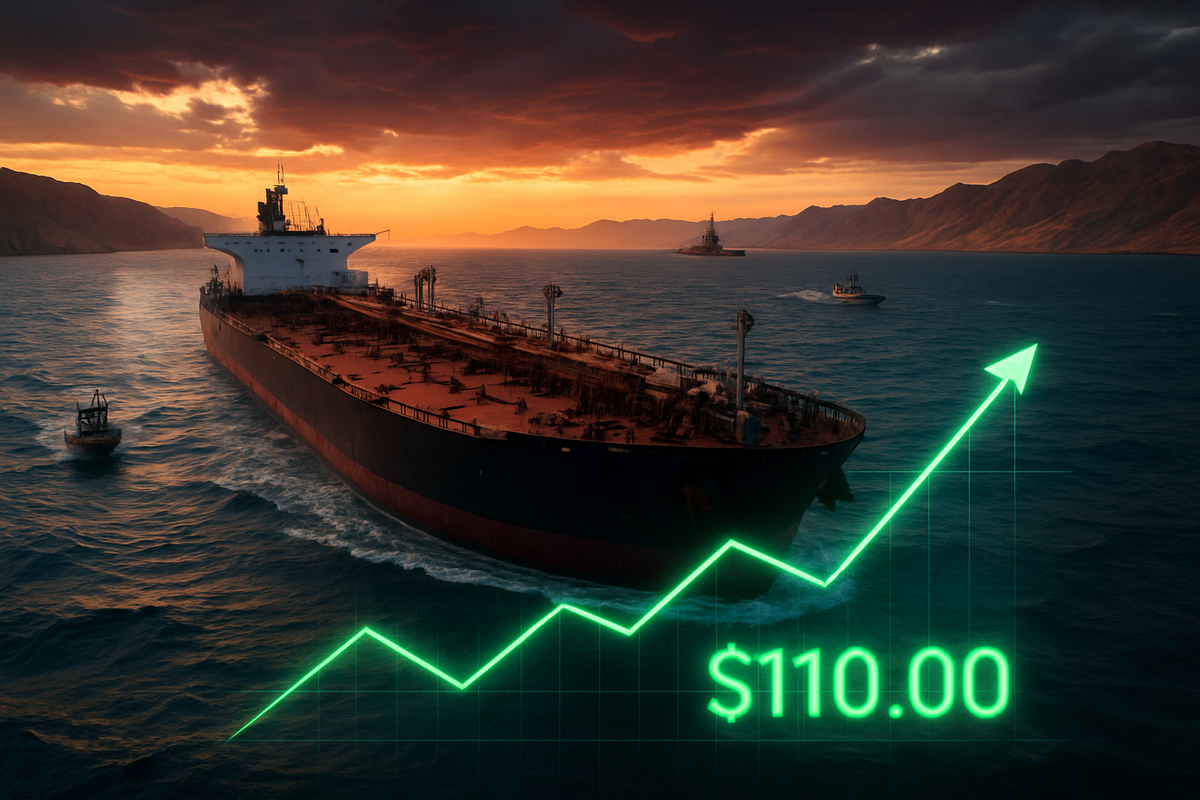
Global energy markets are reeling as West Texas Intermediate (WTI) crude futures surged past $110 per barrel this week, hitting their highest levels in years. The spike is driven by a deepening geopolitical crisis in the Middle East, centered on the Strait of Hormuz, where a virtual blockade has effectively halted a fifth of the world’s daily oil supply. Following a decisive primetime address by the U.S. President on April 1, 2026, which signaled a continued hardline military stance against Iranian regional influence, the "war premium" on crude has become firmly entrenched, sending shockwaves through global equity markets and the transportation sector.
The immediate implications are stark: shipping traffic through the world’s most vital oil artery has slowed to a trickle, with reports indicating that fewer than a dozen vessels are traversing the Strait daily, compared to a pre-crisis average of 150. As global supply chains brace for a prolonged disruption, the International Energy Agency (IEA) has already authorized a record release of 400 million barrels from strategic reserves. Despite these emergency measures, retail gasoline prices across the United States are climbing rapidly toward record territory, threatening to ignite a new wave of inflationary pressure just as the global economy had begun to stabilize.
A Perfect Storm: The Path to $110 Oil
The current crisis is the culmination of nearly a year of escalating hostilities and diplomatic failures. The friction began in earnest in June 2025, during a brief but intense 12-day aerial conflict between Israel and Iran that targeted sensitive nuclear and military infrastructure. While that conflict concluded with a fragile ceasefire, it set the stage for a more structural breakdown in relations. By September 2025, the United Nations Security Council reimposed "snapback" sanctions on Iran after international inspectors reported the country had significantly exceeded uranium enrichment limits. These sanctions effectively isolated the Iranian economy, leading to a historic collapse of the Iranian rial by December 2025 and sparking widespread internal unrest.
The situation turned kinetic in early 2026. Following the failure of "last-chance" diplomatic talks in Geneva in February, the U.S. and its allies launched "Operation Epic Fury," a massive joint strike campaign aimed at neutralizing Iranian retaliatory capabilities. In response, the Iranian Revolutionary Guard Corps (IRGC) deployed advanced anti-ship missiles and naval mines across the Strait of Hormuz, declaring the waterway a closed military zone. This tit-for-tat escalation has created a logistical nightmare for global tankers, forcing many to wait in the Gulf of Oman or seek alternative, more expensive routes that simply cannot compensate for the lost volume of the Strait.
By late March 2026, the market was already on edge, but the catalyst for the current $110 breach was the White House address on April 1. President Trump’s refusal to entertain a proposed ceasefire without total Iranian capitulation shattered market hopes for a quick resolution. The resulting price jump—an 11% rebound in just 48 hours—reflects a market that is no longer pricing in a "temporary disruption" but rather a prolonged conflict that could fundamentally alter global energy flows for the remainder of the decade.
The Energy Giants: Winners and Losers in a High-Price Environment
In the equity markets, the surge has created a bifurcated landscape where domestic energy producers are seeing record valuations even as the broader market frets over energy costs. ExxonMobil (NYSE: XOM) has emerged as a primary beneficiary, with its stock price surging over 41% year-to-date. As the operator of massive, low-cost production assets in the Permian Basin and the high-growth Stabroek block in Guyana, Exxon is uniquely positioned to capture the massive margins afforded by $110 crude. Investors have flocked to the company not just for its production profile, but for its aggressive $20 billion share buyback program and a dividend coverage ratio that currently stands at over 3.0x.
Similarly, Chevron (NYSE: CVX) has seen its shares rise 37% since the beginning of the year, recently touching all-time highs. The company’s successful integration of the Hess Corporation acquisition has proven to be a masterstroke of timing, providing Chevron with a significant non-OPEC production cushion that is insulated from Middle Eastern volatility. Earlier this year, Chevron hit a milestone of 1 million barrels of oil equivalent per day in the Permian Basin, a feat that has solidified its status as a cornerstone for energy-focused portfolios. While these companies face increased windfall tax talk in Washington, their current cash flow generation is at levels not seen since the 2022 energy crisis.
However, the "winners" are not universal even within the sector. While upstream producers thrive, refining margins are beginning to come under immense pressure as the cost of light, sweet crude skyrockets and consumer demand shows the first signs of price-driven "demand destruction." Furthermore, airline and logistics stocks have been hammered, as the cost of jet fuel and diesel has outpaced even the rise in crude. Companies with heavy reliance on Middle Eastern supply, particularly those with significant refining assets in Asia or Southern Europe, are facing acute shortages that could lead to operational shutdowns if the blockade persists beyond the current quarter.
Broader Market Fallout and Regulatory Ripples
The surge in oil prices is not happening in a vacuum; it fits into a broader trend of "energy nationalism" that has been gaining momentum since 2024. Nations are increasingly prioritizing domestic supply security over global market efficiency, a shift that is likely to accelerate as a result of the Hormuz blockade. The reliance on the IEA’s strategic reserves highlights a critical vulnerability in global energy policy—once these reserves are depleted, the world has very little "spare capacity" to draw upon, as OPEC+ members have largely stayed on the sidelines or are themselves restricted by the shipping blockade.
The ripple effects are also being felt in the clean energy sector. While high oil prices historically accelerate the transition to electric vehicles (EVs) and renewables, the current geopolitical climate has complicated the supply chains for the minerals required for that transition. Policymakers in Washington and Brussels are now facing a dual mandate: they must lower immediate energy costs for voters while simultaneously trying to decouple their economies from volatile fossil fuel regimes. This tension is expected to lead to a new wave of subsidies for domestic drilling in the U.S., potentially rolling back some of the environmental regulations enacted earlier in the decade.
Historically, events of this magnitude—such as the 1973 oil embargo or the 1979 Iranian Revolution—have led to permanent shifts in global consumption patterns. The 2026 crisis may be the catalyst that finally pushes the "de-globalization" of energy into high gear. We are already seeing a dramatic increase in "friend-shoring," where Western nations enter into long-term supply agreements with stable allies like Canada, Guyana, and Norway, effectively creating a tiered global oil market where prices may vary significantly based on geopolitical alignment.
The Road Ahead: Scenarios and Strategic Pivots
As we look toward the second half of 2026, the trajectory of oil prices depends entirely on the military and diplomatic outcome in the Persian Gulf. In the short term, a "continued stalemate" scenario is the most likely, which would see oil prices floor at $100 and potentially spike toward $130 if the IRGC escalates its mining operations. This would force a strategic pivot from the major oil companies, who would likely redirect all available capital toward accelerated drilling in "safe" basins like the Permian, even at the expense of long-term exploration projects in more frontier regions.
Alternatively, a "de-escalation" scenario, though currently dismissed by markets, remains a possibility if domestic pressures in both the U.S. and Iran become untenable. If a diplomatic breakthrough occurs, the market could see a historic "price collapse," as the war premium evaporates and the IEA's released reserves create a temporary supply glut. For investors, this creates a high-stakes environment where the "geopolitical hedge" provided by Exxon and Chevron could quickly turn into a liability if a peace deal is signed overnight.
Regardless of the immediate outcome, the long-term market opportunity lies in energy infrastructure that bypasses traditional chokepoints. We expect to see a surge in investment for pipelines that move crude across the Arabian Peninsula to the Red Sea, as well as an acceleration in LNG liquefaction capacity on the U.S. Gulf Coast to provide Europe with an alternative to Middle Eastern and Russian gas. The "strategic pivot" for the global energy industry is no longer just about the transition to green energy, but about the total reimagining of energy logistics in a fragmented world.
Summary and Investor Outlook
The current surge of U.S. Crude past $110 represents a definitive turning point for the 2026 global economy. The virtual blockade of the Strait of Hormuz has exposed the fragility of global energy flows and reaffirmed the dominance of large-cap, integrated domestic producers like ExxonMobil and Chevron. While these companies are currently reaping the rewards of high prices, the broader economic consequences—ranging from record fuel costs to the threat of renewed inflation—pose a significant risk to the wider market's health moving forward.
Investors should remain vigilant, watching for any signs of a diplomatic shift that could puncture the current price bubble. However, the underlying structural issues—limited spare capacity, depleted strategic reserves, and a breakdown in Middle Eastern security—suggest that the era of "cheap energy" may be on a long hiatus. In the coming months, the key metrics to watch will be U.S. refinery utilization rates and the frequency of "gray market" tanker activity, which may indicate how much oil is successfully leaking through the blockade. For now, the "war premium" is the defining feature of the financial landscape, and its impact is only just beginning to be felt.
This content is intended for informational purposes only and is not financial advice.