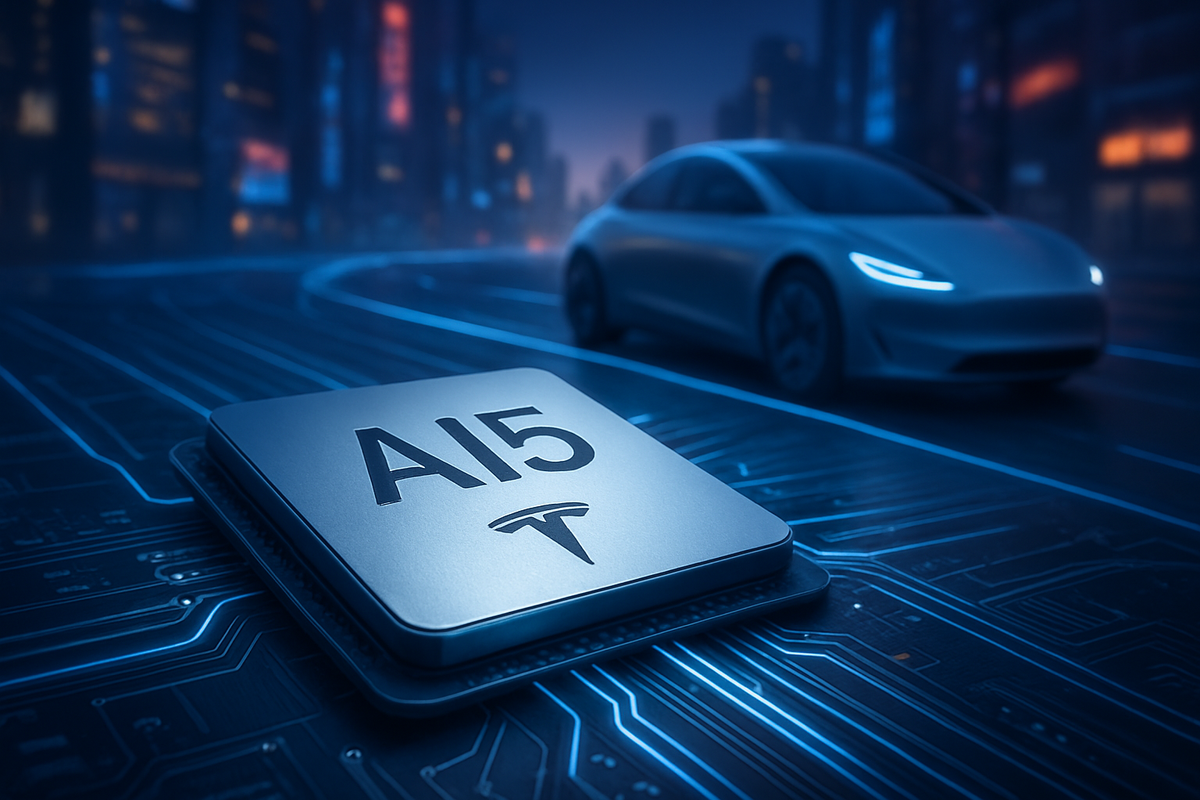
In a move that marks a definitive shift in the global semiconductor landscape, Tesla (NASDAQ: TSLA) CEO Elon Musk officially announced on April 15, 2026, that the company’s next-generation "AI5" silicon has successfully "taped out." This milestone signifies that the final design for Tesla’s most powerful processor to date—formerly known as Hardware 5—has been sent to foundries for physical fabrication. Musk shared the news via a high-resolution photograph of the chip’s packaging on X, hailing it as a "technological apex" for the company’s AI and robotics division.
The immediate implications of the AI5 tape-out are profound. For years, Tesla has been a major customer of third-party chipmakers, but the AI5 represents a transition toward "sovereign silicon" optimized specifically for the company's "System 2" neural networks. By stripping away general-purpose components like traditional GPUs and image signal processors, Tesla claims it has created a chip with "radical simplicity" that can process the complexities of real-world driving and humanoid robotics with unprecedented efficiency.
The Path to AI5: Performance and Integration
The tape-out of the AI5 chip is the culmination of a multi-year engineering sprint aimed at decoupling Tesla's hardware performance from the standard industry cycles of general-purpose AI chips. Built on an advanced 3nm node, the AI5 is dual-sourced from Taiwan Semiconductor Manufacturing Co. (NYSE: TSM) at its Arizona facility and Samsung Electronics (KRX:005930) at its state-of-the-art site in Taylor, Texas. The decision to dual-source highlights Tesla’s focus on supply chain resilience as it prepares for a massive rollout of autonomous hardware across its fleet.
According to technical specifications released alongside the announcement, the AI5 delivers a staggering 8 to 10 times the compute power of its predecessor, Hardware 4 (HW4). While HW4 was a significant upgrade, the AI5 features approximately 192GB of LPDDR5X memory—a ninefold increase—and five times the memory bandwidth. Musk noted that a single AI5 system-on-a-chip (SoC) is roughly equivalent to an Nvidia (NASDAQ: NVDA) H100 for Tesla’s specific neural network workloads. However, this performance comes at a cost of higher energy requirements, with the AI5 expected to draw between 700 and 800 watts under peak load, compared to the roughly 160 watts of HW4.
The timing of the tape-out aligns with the start of mass production for the "Cybercab" at Giga Texas. While the initial fleet of Cybercabs rolling off the line this month will utilize a refined version of Hardware 4 (often referred to as AI4.5), the AI5 is slated for volume production in mid-to-late 2027. It is expected to be the primary engine for the FSD v15 "Large Model"—a neural network with ten times the parameters of current versions—and will serve as the "brain" for the mass-market rollout of the Optimus humanoid robot.
Market Winners and Losers: The Shift to Sovereign Silicon
The primary beneficiary of this announcement appears to be the foundry ecosystem. TSMC and Samsung have solidified their roles as the essential partners for the world’s most advanced AI designs. Samsung, in particular, has seen its stock rise as it secures a reported $16.5 billion contract for future Tesla logic chips, signaling its success in competing with TSMC for high-stakes automotive silicon. For these manufacturers, Tesla’s volume represents a stable, high-margin revenue stream that offsets volatility in the consumer electronics sector.
Conversely, the move presents a strategic challenge for Nvidia (NASDAQ: NVDA). While Nvidia remains the undisputed leader in data center AI training, Tesla’s successful tape-out of a custom inference chip reduces Nvidia's total addressable market in the specialized automotive AI space. Analysts suggest that Tesla’s ability to create a chip 2.5 times more efficient per watt than Nvidia’s Blackwell-class GPUs for specific driving tasks could encourage other automakers to seek custom alternatives, further eroding Nvidia's automotive dominance.
The traditional ADAS (Advanced Driver Assistance Systems) players are also feeling the heat. Mobileye (NASDAQ: MBLY) has struggled to maintain its valuation as Tesla pushes the envelope of vertical integration. Similarly, the ride-hailing industry is bracing for impact. Following the news that Cybercab production has commenced with a targeted operating cost of just $0.20 per mile, shares of Uber (NYSE: UBER) and Lyft (NASDAQ: LYFT) have faced significant downward pressure. Investors are increasingly questioning the long-term viability of human-centric ride-hailing models in the face of a vertically integrated, low-cost autonomous competitor.
Broad Significance: Vertical Integration and the Edge AI Moat
This event fits into a broader industry trend toward "vertical silicon," where tech giants like Apple, Google, and now Tesla design their own chips to achieve performance levels that off-the-shelf components cannot reach. By owning the silicon, the software, and the vehicle manufacturing process, Tesla is attempting to create a "moat" that legacy automakers—who often rely on fragmented supply chains from companies like Qualcomm (NASDAQ: QCOM)—may find impossible to bridge.
The AI5 tape-out also highlights the emerging concept of "Edge AI" in the automotive sector. Unlike cloud-based AI, which requires constant connectivity and introduces latency, Tesla’s strategy centers on massive on-board compute power. This allows for "System 2" reasoning—the ability of a vehicle to think through complex, novel scenarios in real-time. This approach mimics the human brain's ability to navigate without a constant connection to an external database, which is widely considered the "Holy Grail" of autonomous driving.
Historically, this moment can be compared to Apple's transition to its "M-series" chips for the Mac. Just as Apple broke free from Intel's release cycles to achieve superior power efficiency and performance, Tesla is breaking free from the standard automotive chip architecture. This move could trigger a ripple effect where competitors are forced to choose between high-cost general-purpose hardware or multi-billion dollar investments in their own silicon programs, further consolidating the market around a few high-tech leaders.
Future Scenarios: From Hardware Milestone to Unsupervised Reality
In the short term, the market will be watching for the first engineering samples of the AI5 to begin testing in late 2026. The real test for Tesla will be the integration of these chips into the Optimus robot and the eventual transition of the vehicle fleet to FSD v15. If the AI5 delivers the promised "almost perfect" autonomy, Tesla will have the hardware foundation to transition from a car manufacturer to a high-margin software and robotics service provider.
However, challenges remain. The high power draw of the AI5 (700-800W) requires radical changes to vehicle thermal management and electrical architecture. Furthermore, the regulatory landscape remains a patchwork of hurdles. While the Netherlands (RDW) recently granted type approval for FSD in the EU, achieving widespread "unsupervised" status across the United States and China will require years of data that only a high-volume fleet can provide. Tesla's strategic pivot to the "Unboxed" manufacturing process at Giga Texas will be critical in achieving the scale necessary to feed this data-hungry AI.
Conclusion: A High-Stakes Bet on Custom Silicon
The tape-out of the AI5 chip is more than a technical milestone; it is a declaration of intent. Tesla is betting its future on the belief that custom silicon is the only way to achieve true, unsupervised autonomy and scale a global robotaxi network. For investors, the takeaway is clear: Tesla is no longer just a car company, but a vertically integrated AI powerhouse that is successfully disintermediating its suppliers and challenging its competitors on multiple fronts.
Moving forward, the market will be hyper-focused on the production ramp of the Cybercab and the performance benchmarks of FSD v15. As the "AI Decade" unfolds, the success or failure of the AI5 chip will likely determine if Tesla remains the leader of the autonomous revolution or if it has over-engineered a solution for a problem that is still years away from regulatory acceptance. For now, the successful tape-out gives Tesla a significant head start in the race to define the future of mobility.
This content is intended for informational purposes only and is not financial advice.