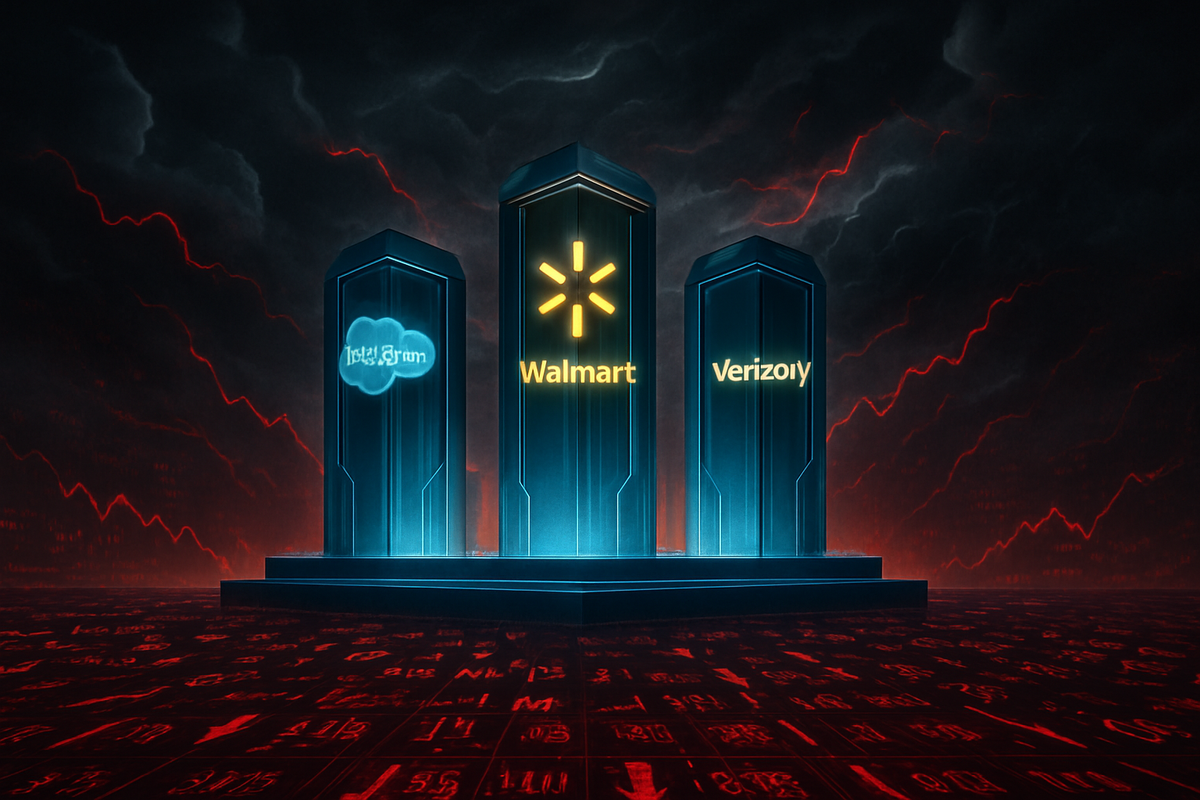
As of March 30, 2026, the global financial landscape is grappling with a "perfect storm" of geopolitical friction and inflationary spikes. Yet, beneath the surface of a volatile S&P 500, a massive wave of corporate capital is flowing back into the hands of investors. In a historic February that saw trade tensions and energy prices rattle consumer confidence, the titans of the American economy—Salesforce (NYSE: CRM), Walmart (NYSE: WMT), and Verizon (NYSE: VZ)—unleashed a combined $105 billion in share repurchase authorizations. This unprecedented surge in corporate buybacks is acting as a "psychological floor" for equity demand, preventing a broader market capitulation.
The magnitude of these repurchases suggests that corporate boards view the recent 6% market pullback as a buying opportunity rather than a systemic threat. By aggressive "EPS manufacturing," large-cap firms are attempting to shield their stock prices from the "Tariff Shock" and rising supply-side inflation that has characterized the first quarter of 2026. As institutional and retail investors have stepped back due to uncertainty, corporate treasuries have emerged as the market's "lender of last resort," providing a critical stabilizing force for the major indices.
The February Buyback Blitz: Salesforce, Walmart, and Verizon Take Charge
The momentum began in late January but hit a fever pitch in February 2026. Salesforce (NYSE: CRM) led the charge with a staggering $50 billion authorization. This move was not just a signal of intent; the enterprise software giant immediately followed up in early March by initiating a $25 billion Accelerated Share Repurchase (ASR) agreement—the largest of its kind in history. CEO Marc Benioff pitched the move as a vote of confidence in "Agentforce," the company’s AI-driven growth engine, even as some analysts raised eyebrows over the company taking on new debt to fund the program while cash reserves dipped.
Walmart (NYSE: WMT) followed suit on February 19, announcing a $30 billion buyback program to replace its existing $20 billion authorization. This move was strategically paired with the company’s 53rd consecutive annual dividend increase, a 5% bump to $0.99 per share. For Walmart, the buyback serves as a defensive moat; after issuing conservative guidance for the upcoming fiscal year that initially spooked investors, the massive commitment to repurchases helped stabilize the stock, signaling that its Walmart Connect advertising and omnichannel growth continue to generate robust free cash flow.
Verizon (NYSE: VZ) rounded out the trio with a $25 billion program detailed in February under the leadership of its new CEO, Dan Schulman. As part of a larger $55 billion capital return framework scheduled through 2028, Verizon is leveraging the completion of its Frontier acquisition to pivot back toward shareholder yield. Management expects the buyback to contribute significantly to a projected 4–5% earnings per share (EPS) growth for 2026, a bold target for a telecom giant traditionally characterized by steadier, low-growth metrics.
Initial market reactions to these announcements have been cautiously optimistic. While the broader S&P 500 has struggled to reclaim its all-time highs due to a 35% spike in oil prices following tensions in the Middle East, the shares of the "Big Three" buyback leaders have significantly outperformed their respective sector peers. This divergence highlights a growing trend in 2026: investors are gravitating toward "fortress balance sheets" that have the capacity to aggressively defend their own equity.
The Winners and Losers of the Share Repurchase Wave
The primary winners in this environment are undoubtedly existing long-term shareholders of these large-cap entities. By reducing the total share count, these companies are effectively increasing the ownership stake of remaining investors and boosting EPS even in a cooling revenue environment. For a company like Salesforce (NYSE: CRM), the $25 billion ASR provides an immediate boost to valuation metrics, potentially offsetting the "valuation compression" that often accompanies rising interest rates—which the Federal Reserve has currently held at a 3-4% range.
However, the "losers" or those at risk include smaller competitors and high-growth firms that lack the massive cash flows required to match these capital return programs. As capital flows toward the stability of buyback-heavy stocks, smaller caps in the Russell 2000 have faced a liquidity drain. Furthermore, critics point to the long-term risk of Salesforce and others using debt to fund these programs. If interest rates remain at their "hold" stance or drift higher due to the 3.8% inflation reported in February, the cost of servicing that buyback-linked debt could eat into future R&D budgets.
Within the retail sector, Walmart (NYSE: WMT)’s move puts immense pressure on rivals like Target (NYSE: TGT) and Amazon (NASDAQ: AMZN). By providing both a growing dividend and a massive buyback, Walmart is capturing the "yield-seeking" segment of the market that might otherwise flee to bonds. This effectively raises the "cost of equity" for its competitors, who may find it harder to attract investors without similar capital return promises, even if they need that cash to compete with Walmart's expanding logistics network.
A $1.2 Trillion Trend: Broader Significance and Historical Context
The surge in early 2026 fits into a broader industry trend where S&P 500 firms are projected to authorize a record $1.2 trillion in buybacks for the full year. This is a significant escalation from the buyback waves of the early 2020s and reflects a new corporate reality: with organic revenue growth slowing due to global "Tariff Shocks" and trade headwinds, corporations have turned to "financial engineering" to maintain the appearance of growth. Analysts estimate that nearly 4% of total S&P 500 earnings growth this quarter is purely a result of share count reduction.
Historically, this resembles the post-2018 tax cut environment, but with a crucial difference: the current wave is defensive. In 2018, buybacks were fueled by windfall cash from tax breaks; in 2026, they are being deployed to catch a falling knife. The "Tariff Shock" of January 20, 2026, which triggered a sharp market pullback, forced boards to choose between holding cash in a high-inflation environment or betting on themselves. Most have chosen the latter, viewing their own equity as a better inflation hedge than cash equivalents yielding 3%.
There are also significant regulatory implications to consider. The 1% excise tax on buybacks, implemented years ago, has clearly failed to deter corporate boards. In fact, there is growing chatter in Washington about increasing this tax to 4% or higher to encourage more domestic capital investment over financial returns. However, in the current fragile economic state, policy experts suggest that the administration is hesitant to move against the one force—corporate buybacks—that is currently keeping the retirement accounts of millions of Americans from a deeper drawdown.
What Comes Next: Strategic Pivots and Market Outlook
Looking ahead to the remainder of 2026, the market is closely watching whether other tech and consumer giants will follow the lead of Salesforce (NYSE: CRM) and Walmart (NYSE: WMT). If the "hold" stance of the Federal Reserve transitions into a rate hike to combat the 3.8% inflation spike, the era of debt-funded buybacks may come to an abrupt end. Companies will then have to rely solely on organic free cash flow, which could lead to a widening gap between the "cash-rich" titans and the "cash-poor" growth companies.
In the short term, the market remains in a state of "fragile stability." The massive authorizations in February provide a "buyer of last resort" that will likely persist through the second quarter. However, the potential for a "strategic pivot" is high. If consumer sentiment, which hit a low in March 2026, continues to plummet due to gasoline prices, companies like Walmart may be forced to choose between maintaining their buyback pace or reinvesting in price cuts to keep their customer base.
The long-term scenario hinges on whether these buybacks are seen as a sign of strength or a lack of imagination. If the AI revolution, spearheaded by platforms like Agentforce, fails to deliver the promised productivity gains by late 2026, the $50 billion Salesforce is spending today may be viewed in hindsight as a missed opportunity to invest in the next generation of software. Investors should prepare for a bifurcated market where "shareholder yield" becomes the primary metric for valuation.
Conclusion: The New Market Floor
The buyback boom of early 2026 marks a defining moment for the current economic cycle. Led by the historic $105 billion commitment from Salesforce (NYSE: CRM), Walmart (NYSE: WMT), and Verizon (NYSE: VZ), corporate America has sent a clear message: it will not allow market volatility or geopolitical shocks to derail equity valuations without a fight. These programs have successfully provided a floor for a market that was otherwise reeling from the "Tariff Shock" and a sudden spike in energy costs.
For investors, the key takeaway is that the "quality trade" is back in vogue. Companies with the balance sheet strength to retire shares and increase dividends are the current masters of the market. However, moving forward, the sustainability of this trend will depend on the Federal Reserve's next move and the persistence of inflationary pressures. If the cost of capital rises significantly, the "buyback floor" could eventually crack under the weight of debt-service obligations.
In the coming months, watch for the actual execution rates of these authorizations. An authorization is a promise, but an Accelerated Share Repurchase agreement, like the one executed by Salesforce, is a reality. As we move into the second quarter of 2026, the volume of actual shares being retired will be the ultimate barometer of corporate confidence in an increasingly uncertain world.
This content is intended for informational purposes only and is not financial advice