The American consumer is retreating. On March 30, 2026, the final reading of the University of Michigan Consumer Sentiment Index for the month was revised sharply downward to 53.3, its lowest level of the year and a stark reminder of the fragile state of the post-pandemic recovery. The revision from a preliminary mid-month estimate of 55.5 highlights a rapid deterioration in household optimism as a combination of military conflict in the Middle East and a subsequent spike in energy prices takes its toll on the national psyche.
This sudden pivot in sentiment marks a significant blow to the "soft landing" narrative that many economists had championed at the start of the year. With one-year inflation expectations jumping to 3.8%—the largest one-month increase in nearly a year—the Federal Reserve now faces a grueling dilemma: how to manage a potential stagflationary environment where growth is stalling while prices for essentials like gasoline and food continue to climb.
The downward revision of the March index was catalyzed by a series of seismic geopolitical shifts that began in late February. On February 28, 2026, military tensions involving the United States, Israel, and Iran escalated into a direct conflict, leading to the partial closure of the Strait of Hormuz. This critical maritime chokepoint, responsible for the passage of roughly 20% of the world’s oil supply, became a focal point of global anxiety, causing Brent crude oil to skyrocket 47% in less than a month to peak near $116 per barrel.
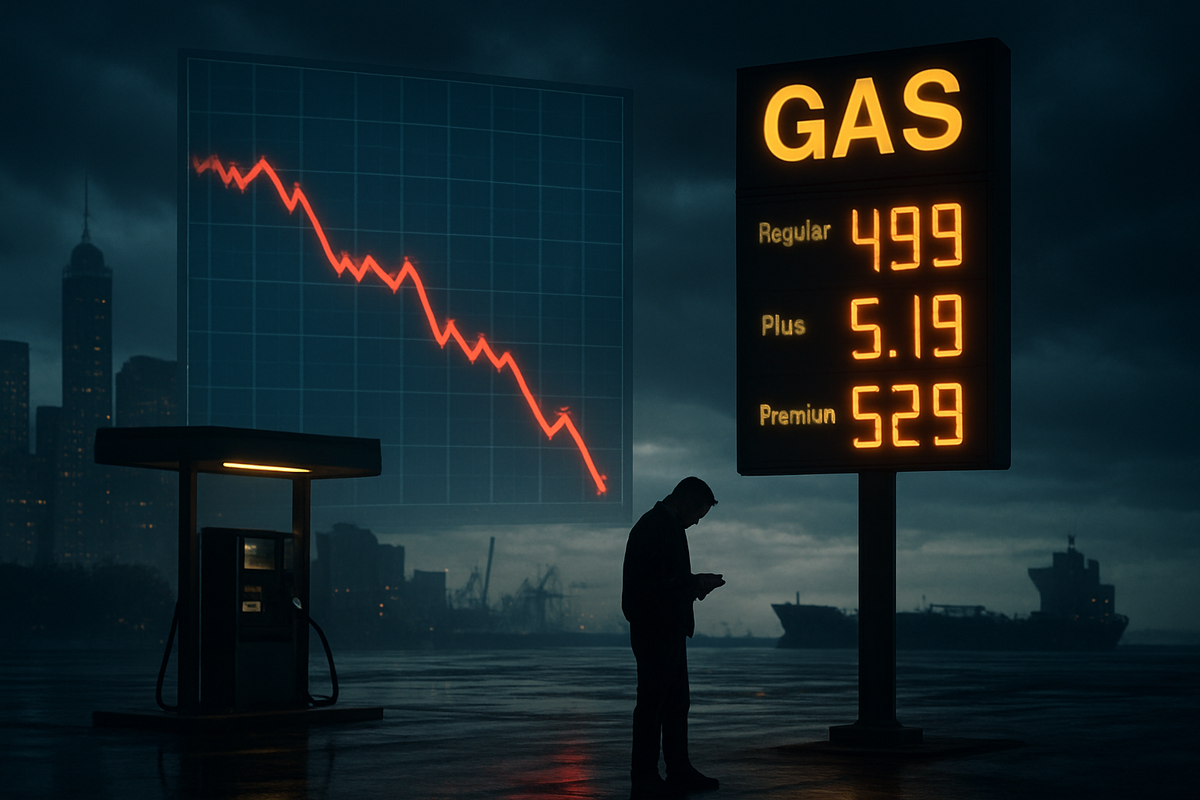
For the average American, the impact of these high-level maneuvers was felt almost instantly at the pump. According to AAA, the national average for a gallon of gasoline surged by 33% to reach $3.98 by mid-March, with some West Coast markets seeing prices well north of $5.00. The University of Michigan’s survey data revealed that consumer interviews conducted after the start of the conflict showed a 14% plunge in the short-term economic outlook. Household personal finance expectations similarly dropped by 10%, as the "pain at the pump" began to siphon discretionary income away from other areas of the economy.
The timeline leading to this low point was accelerated by already tepid retail data. In January 2026, retail sales had already dipped 0.2%, and by the time the February data was finalized in mid-March, growth was officially flat at 0.0%. This preceding weakness meant that the Middle East shock did not hit a robust economy, but rather one that was already showing signs of exhaustion. Major financial institutions reacted with swift pessimism; the S&P 500 underwent a 7.3% correction in the final weeks of March as investors priced in the risk of a domestic recession.
In this climate of heightened volatility, the "winners" and "losers" in the corporate world are being dictated by their exposure to energy costs and consumer discretionary spending. Energy giants like ExxonMobil (NYSE: XOM) and Chevron (NYSE: CVX) have seen their stock prices decouple from the broader market, as higher crude prices translate into record-breaking margins for their upstream operations. However, even these gains are tempered by the fear that a global slowdown could eventually crater demand, turning today's price spike into tomorrow's glut.
Conversely, the retail and transportation sectors are bearing the brunt of the sentiment crash. Big-box retailers such as Target (NYSE: TGT) and Walmart (NYSE: WMT) are facing a "K-shaped" consumer reality. While Walmart’s value proposition often provides a hedge during downturns, Target’s reliance on more discretionary categories like home goods and apparel makes it vulnerable as consumers tighten their belts. Indeed, the March data showed a 0.9% drop in furniture and home furnishing sales, a clear indicator that "wants" are being sacrificed for "needs."
The airline industry is perhaps in the most precarious position. Companies like Delta Air Lines (NYSE: DAL) and United Airlines (NASDAQ: UAL) are grappling with a double-edged sword: surging jet fuel costs and a consumer base that is increasingly likely to cancel travel plans in favor of saving cash. Historically, airlines have attempted to pass these costs on to travelers through fuel surcharges, but with sentiment at a yearly low, the price elasticity of the average traveler is being pushed to its limit, threatening the industry's profitability for the remainder of 2026.
The revision of the UMich index is more than just a data point; it represents a broader shift in the global economic order. The re-emergence of the Middle East as a primary driver of U.S. domestic inflation marks a departure from the supply-chain-driven inflation of the early 2020s. This is a classic "supply shock" that mirrors the oil crises of the 1970s, raising fears that the U.S. economy could enter a period of prolonged stagnation accompanied by high prices.
Furthermore, this event highlights a growing regulatory and policy challenge for the Biden administration and the Federal Reserve. With the 2026 mid-term elections approaching, the political pressure to address gasoline prices is immense. However, the Fed’s traditional tool—interest rate hikes—is designed to cool demand, not to open shipping lanes or lower the price of global commodities. If the Fed raises rates into a slowing economy to combat energy-driven inflation, they risk turning a controlled slowdown into a deep recession.
Historical comparisons to the 2008 and 2022 sentiment lows suggest that once confidence breaks below certain thresholds, it takes significant time and tangible "good news" to rebuild. In those previous instances, sentiment didn't recover until inflation was clearly trending back toward the 2% target. With 1-year inflation expectations now moving in the wrong direction (climbing to 3.8%), the psychological "anchoring" of inflation that the Fed has worked so hard to maintain is once again under threat.
Looking ahead, the short-term trajectory of the U.S. economy depends almost entirely on the de-escalation of tensions in the Middle East. If the Strait of Hormuz remains partially blocked through the second quarter, analysts suggest that $130 per barrel oil is a distinct possibility. In such a scenario, the University of Michigan index could test the all-time lows seen in June 2022. Companies will likely pivot toward aggressive cost-cutting measures and a renewed focus on "value" branding to entice a wary public.
In the long term, this crisis may accelerate the strategic shift toward energy independence and the adoption of electric vehicles. As consumers face $4.00 gasoline again, the value proposition for companies like Tesla (NASDAQ: TSLA) and Rivian (NASDAQ: RIVN) becomes more compelling, despite the high interest rate environment. However, the immediate challenge remains a "liquidity crunch" for the average household, which could lead to a significant pullback in credit card spending and a rise in delinquency rates for subprime borrowers by the end of the year.
The downward revision of the March 2026 consumer sentiment index to 53.3 is a sobering signal for the American economy. It encapsulates a moment where geopolitical risk, energy volatility, and inflation fears have converged to break the spirit of the U.S. consumer. The key takeaways are clear: the "soft landing" is in jeopardy, inflation expectations are unmooring, and the discretionary spending engine that drives two-thirds of the U.S. GDP is sputtering.
As we move into the second quarter, investors should keep a close watch on the weekly jobless claims and the next round of Consumer Price Index (CPI) data. Any sign that the sentiment slump is translating into significant layoffs would be the final confirmation that a recession has arrived. For now, the market remains in a defensive crouch, waiting to see if diplomacy can reopen the world's energy arteries before the domestic economy bleeds out.
This content is intended for informational purposes only and is not financial advice.