
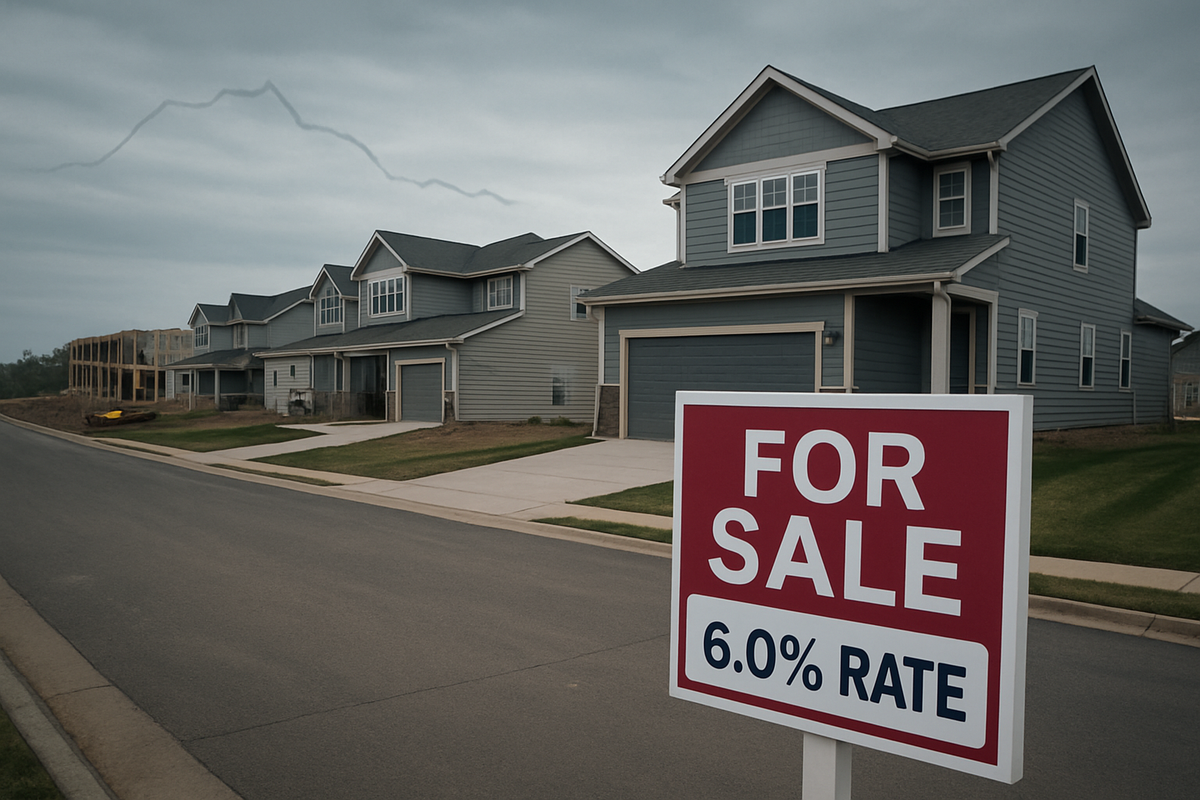
As the United States enters the final week of March 2026, the housing market finds itself at a critical juncture defined by a "Great Reset." After years of volatility, the National Association of Home Builders (NAHB) has released its March 2026 outlook, revealing a market struggling to gain momentum amidst an economic "speed bump." With 30-year fixed mortgage rates hovering stubbornly around the 6% mark and a significant slowdown in real GDP growth, the dream of homeownership remains a mathematical puzzle for many Americans, even as wage growth begins to outpace home price appreciation for the first time in years.
The immediate implications are a cooling of the post-2025 recovery as geopolitical tensions and "sticky" inflation dampen consumer confidence. While builders are seeing a slight uptick in foot traffic, the overall sentiment remains in contraction territory. For the broader market, this signifies a period of transition where the "lock-in effect" of low pandemic-era rates is finally beginning to erode, but the replacement environment of 6% interest is proving to be a difficult pill for the economy to swallow.
Navigating the March 2026 Stagnation
The NAHB/Wells Fargo Housing Market Index (HMI) for March 2026 edged up slightly to 38, up from 37 in February. While any improvement is welcomed by the industry, the score remains well below the key 50-point threshold that separates growth from contraction. This marks nearly two years of pessimistic readings from U.S. homebuilders. The primary culprit cited by NAHB Chief Economist Robert Dietz is the "speed bump" in the broader economy—a sharp deceleration in real GDP growth to 1.4% in the final months of 2025, compounded by a spike in energy prices following recent escalations in the Middle East.
Mortgage rates have settled into a new, higher "normal." As of mid-March 2026, the 30-year fixed-rate mortgage averaged 6.22%. While this is a significant improvement from the 7.5% peaks seen in early 2025, it is a move upward from the brief dip into the high 5% range seen in January. This "6% floor" has created a psychological barrier for buyers. Consequently, mortgage applications for new home purchases saw a modest 0.9% year-over-year increase in February but slipped 1% month-over-month as the reality of sustained high rates set in. To combat this, a staggering 64% of builders are still offering sales incentives, and 37% have resorted to direct price cuts to move inventory.
Winners and Losers in a Margin-Squeezed Market
The current environment has created a divergent landscape for the nation’s largest public homebuilders and financial institutions. Lennar (NYSE: LEN) has recently come under fire from analysts at Citigroup (NYSE: C) and Wells Fargo (NYSE: WFC) following a disappointing Q1 earnings miss. The company reported a 13% year-over-year decline in revenue, largely attributed to its heavy reliance on aggressive 14% incentives to hit its delivery targets. Lennar’s strategy of prioritizing volume over margins is being tested as the "speed bump" reduces the pool of qualified buyers.
D.R. Horton (NYSE: DHI) remains a "Hold" for many institutional investors, including Barclays (NYSE: BCS), which recently trimmed its price target to the $160 range. While D.R. Horton’s focus on absolute entry-level homes provides a natural hedge against affordability crises, the company is facing significant margin compression as land and labor costs remain elevated. Conversely, fintech-heavy lenders like Rocket Companies (NYSE: RKT) are emerging as potential "recovery plays." Analysts view Rocket as a primary beneficiary of the 6% rate environment; as millions of homeowners who took out loans at 7% or 8% in 2024 look to refinance, Rocket’s scalable tech platform is positioned to capture a surge in refinance volume that traditional banks may struggle to handle.
Broad Significance and Historical Precedents
The current state of the housing market in 2026 represents a shift away from the "emergency" conditions of 2023-2024 and toward a structured, albeit slow, realignment. Historically, a 6% mortgage rate was considered healthy, but following a decade of sub-4% rates, the adjustment period is taking longer than anticipated. This "Great Reset" is a direct result of the Federal Reserve's commitment to fighting Core PCE inflation, which remains stuck at 3.0%. At its March 2026 meeting, the Fed held rates steady, signaling that only one rate cut might be on the table for the remainder of the year.
This stagnation has massive ripple effects on the broader economy. With residential fixed investment slowing, the "multiplier effect" that housing usually provides for retail and manufacturing is diminished. We are seeing a shift where affordability is no longer driven by falling prices, but by rising wages. With wage growth projected at 3.5% in 2026 outpacing the 2.2% rise in home prices, the "affordability gap" is slowly closing. However, the barrier has shifted from monthly payment math to "upfront capital," with a third of March 2026 borrowers inquiring about down payment assistance or zero-down programs.
The Road Ahead: Strategic Pivots and Scenarios
In the short term, the housing market is expected to remain in this holding pattern until the "speed bump" in GDP growth is cleared. Builders will likely continue to pivot toward smaller, more efficient floor plans to maintain some semblance of affordability without sacrificing entire profit margins. The long-term outlook depends heavily on whether the Federal Reserve can navigate the current geopolitical energy shocks without tipping the economy into a full-scale recession. If inflation begins to trend toward the 2% target by late 2026, a move toward 5.5% mortgage rates could unlock a massive wave of pent-up demand.
A potential "bull case" scenario involves a sudden stabilization in energy prices, which would allow the Fed to be more aggressive with rate cuts in the fourth quarter. This would likely trigger a rally in homebuilder stocks and a surge in mortgage applications. Conversely, the "bear case" suggests that if the 6% rate environment persists alongside a softening labor market, we could see a more significant correction in home prices as builders are forced to move standing inventory at any cost.
Final Assessment: What Investors Should Watch
As we close out March 2026, the key takeaway is that the housing market has transitioned from a period of "shock" to a period of "endurance." The NAHB outlook confirms that while the worst of the pricing volatility may be over, the path to growth is obstructed by macroeconomic headwinds. Investors should pay close attention to the Q2 earnings calls of major builders like KB Home (NYSE: KBH) and D.R. Horton (NYSE: DHI) to see if margin compression is accelerating or stabilizing.
The most critical metrics to watch in the coming months will be the "traffic of prospective buyers" in the NAHB index and the spread between wage growth and home price appreciation. If the "speed bump" in the economy proves to be a temporary hurdle rather than a permanent roadblock, the housing market’s "Great Reset" could finally give way to a sustainable recovery. For now, however, the 6% mortgage rate remains the gatekeeper of the American dream.
This content is intended for informational purposes only and is not financial advice.