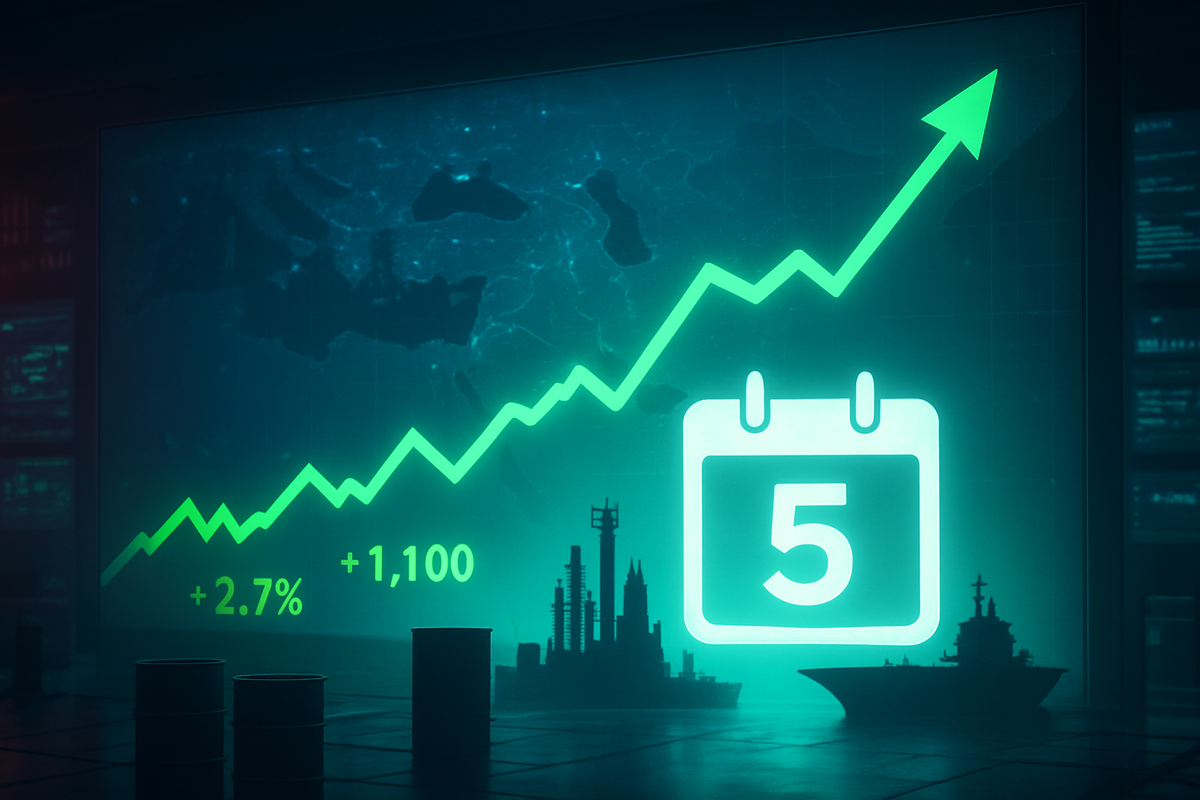
A wave of euphoria swept through global financial markets on Monday, March 23, 2026, as President Donald Trump announced a surprise five-day halt to planned military strikes on Iranian energy infrastructure. The announcement, delivered via Truth Social just as a 48-hour ultimatum was set to expire, dramatically shifted market sentiment from the brink of a total regional energy war to a state of cautious optimism. The news sparked a massive relief rally, with Dow Jones Industrial Average futures rocketing 1,100 points higher, while the S&P 500 and the Nasdaq Composite each posted gains of 2.7%.
The immediate implications of this tactical pause were felt most sharply in the energy pits, where the "war premium" on crude oil began to evaporate almost instantly. West Texas Intermediate (WTI) and Brent crude, which had been trading at multi-year highs due to the effective closure of the Strait of Hormuz, saw double-digit percentage drops within minutes of the President's post. For a market that had spent the weekend pricing in a "total war" scenario—including the potential obliteration of the Bushehr Nuclear Power Plant—the five-day window for "fruitful" talks represents a lifeline for global supply chains and a temporary ceiling on the inflationary pressures that have haunted the 2026 fiscal year.
The Truth Social Pivot: From Ultimatum to De-escalation
The dramatic rally on Monday was the culmination of an incredibly tense 72-hour period that began on Saturday, March 21. Following weeks of escalating conflict under "Operation Epic Fury," which saw the assassination of Iran’s Supreme Leader in late February, President Trump issued a final 48-hour ultimatum. He demanded that Tehran immediately and unconditionally reopen the Strait of Hormuz to international shipping or face the total destruction of its power grid and nuclear facilities. As the Monday deadline approached, investors braced for a global energy shock, with some analysts predicting oil could reach $150 per barrel if the strikes proceeded.
However, the narrative flipped mid-morning on Monday when the President posted that he would "hold fire" for five days to allow for a diplomatic breakthrough. This pause came as a shock to many in Washington, especially given that Iranian state media, via the Fars News Agency, initially denied that any direct negotiations were taking place. Despite the conflicting reports from Tehran, the market chose to believe the White House's assertion that "productive talks" were underway. The VIX, often referred to as the market's "fear gauge," plummeted from a two-week high of 30.15, signaling that the immediate threat of a catastrophic escalation had been deferred.
The timeline of this crisis has been one of the most volatile in modern history. Since the war began on February 28, 2026, the Strait of Hormuz—the world’s most vital energy chokepoint—has been a no-go zone, forcing major producers like Saudi Arabia and Kuwait to "shut in" production. The March 23 pause is the first sign of a potential cooling-off period since the conflict’s inception. While the U.S. Treasury had already attempted to ease pressure by "unsanctioning" 140 million barrels of Iranian oil on March 20, it was the cessation of kinetic military threats that finally broke the market's fever.
The role of key stakeholders during this rally cannot be overstated. Domestic energy producers and defense contractors have been the primary focus of trade since early March, but the pivot toward diplomacy has reintroduced the "risk-on" appetite for growth stocks. Institutional investors, who had moved heavily into cash and gold over the weekend, were seen aggressively re-entering the equity markets on Monday afternoon, fearing they might miss a bottom if the five-day pause leads to a more permanent ceasefire.
Sector Performance: Winners and Losers in a Thawing Conflict
The sudden de-escalation created a stark divergence in sector performance. The most immediate winners were the major technology and growth companies, which had been weighed down by the prospect of runaway energy-driven inflation. Apple (NASDAQ: AAPL), Microsoft (NASDAQ: MSFT), and NVIDIA (NASDAQ: NVDA) all saw significant gains as the 2.7% jump in the Nasdaq reflected a sigh of relief from investors who had feared that high energy costs would force the Federal Reserve into a more aggressive interest rate hiking cycle. These "Big Tech" firms benefit from the lower discount rates that accompany a reduction in geopolitical risk and inflation expectations.
Conversely, the energy sector faced a reality check. While the underlying supply of oil remains constrained, the removal of the immediate "strike premium" saw shares of ExxonMobil (NYSE: XOM) and Chevron (NYSE: CVX) trade lower relative to the broader market gains. Occidental Petroleum (NYSE: OXY) also saw its recent gains pared back as crude prices retreated from their $120 peaks. However, some analysts argue that a stabilized Middle East is actually a long-term net positive for these companies, as it reduces the risk of retaliatory strikes on their own regional infrastructure, such as the damage recently sustained by LNG facilities in Qatar.
The defense sector, which had seen a massive run-up since "Operation Epic Fury" began, saw a "sell the news" reaction. Giants like Lockheed Martin (NYSE: LMT), Northrop Grumman (NYSE: NOC), and RTX (NYSE: RTX) (formerly Raytheon) experienced a cooling of their recent parabolic moves. While the five-day pause does not end the war, it suggests that the peak "kinetic" phase might be transitioning into a diplomatic or proxy phase, leading some traders to lock in profits on these high-flying defense stocks.
A secondary but powerful winner in Monday's rally was the transportation sector. Airlines, in particular, saw some of their best intraday performance of the year. Delta Air Lines (NYSE: DAL) and United Airlines (NASDAQ: UAL) surged as the 11% drop in WTI crude directly translates to lower jet fuel costs and higher future margins. For an industry that was bracing for "war-time fuel surcharges," the Trump announcement provided a significant boost to their near-term earnings outlook.
Analyzing the Geopolitical Ripple Effects
This event fits into a broader trend of "Social Media Diplomacy" that has characterized the Trump administration's second term, where Truth Social posts act as the primary mover of global markets. Historically, this mirrors the 2020 tensions following the Soleimani strike, but the scale of the 2026 conflict—involving the closure of the Strait of Hormuz—is unprecedented. The wider significance of this five-day pause is that it prevents a "Gulf Blackout," a retaliatory strategy threatened by Tehran that would have targeted desalination and power plants across the UAE and Saudi Arabia.
The ripple effects on competitors and partners are profound. For example, China, a major consumer of Iranian oil, has been playing a quiet but critical role in the background. The potential for a diplomatic solution, even a temporary one, relieves pressure on Beijing to intervene or find alternative energy sources that would further tighten the global market. Domestically, the rally has also shifted the conversation around the Federal Reserve’s upcoming policy meeting. Before the pause, the market was bracing for the Fed to hold rates high to combat "war inflation"; now, there is renewed hope that a diplomatic resolution could allow for the rate cuts that were originally projected for late 2026.
Regulatory and policy implications are also at play. The U.S. Treasury's recent move to "unsanction" Iranian oil vessels was a desperate attempt to lower prices at the pump for American consumers. The success of this move, combined with the military pause, suggests a shift toward a "hybrid" strategy where economic carrots are being offered alongside military sticks. This approach is reminiscent of the "maximum pressure" campaigns of the past but with a much higher level of real-time volatility due to the active combat environment.
From a historical perspective, the 1,100-point Dow surge is one of the largest single-day futures moves in history. It underscores how sensitive the modern market has become to geopolitical headlines. The event serves as a reminder that in 2026, the primary driver of market volatility is no longer just corporate earnings or central bank policy, but the unpredictable nature of regional conflicts and the digital communication channels of world leaders.
The Five-Day Window: What Comes Next?
The market is now entering a critical "wait-and-see" period. The short-term possibility is a continued drift higher in equities as long as the five-day pause holds. However, the strategic pivot required by Iran to meet Trump's demand—opening the Strait of Hormuz—is a massive geopolitical hurdle. If Tehran fails to comply by the end of the week, the market could face a "gap down" on the following Monday that would erase all of today's gains. Investors must be prepared for extreme volatility as the deadline nears.
Strategic adaptations are already underway in the corporate world. Shipping giants and logistics firms are likely using this five-day window to reroute vessels or clear backlogs in anticipation of potential renewed hostilities. On the market side, hedge funds are expected to increase their hedging activities using options, as the "binary" nature of this conflict—either peace or total infrastructure war—makes traditional long-only strategies increasingly risky. The opportunity for a "peace dividend" rally is immense, but the challenge remains the lack of trust between the two warring parties.
Potential scenarios range from a full diplomatic breakthrough that sees oil return to the $70 range, to a catastrophic failure of talks that leads to the aforementioned "obliteration" of Iranian assets. Analysts suggest that the most likely outcome is a series of rolling pauses, where the five-day deadline is extended in exchange for minor concessions. This would keep markets in a state of perpetual "nervous optimism," where volatility remains high but the catastrophic "tail risk" is slowly priced out.
Summary and Investor Outlook
The massive relief rally of March 23, 2026, will be remembered as the day the markets looked into the abyss of a global energy war and saw a path back. The key takeaway for investors is that while the 1,100-point surge in the Dow and the 2.7% jump in the S&P 500 are historic, they are based on a fragile five-day promise. The immediate threat to energy infrastructure has receded, and the crash in oil prices has provided a much-needed breath of fresh air for the tech and transportation sectors.
Moving forward, the market is likely to remain highly sensitive to every syllable posted by the President or reported by Iranian state media. The significance of this event lies not just in the points gained, but in the precedent it sets for how the current administration uses military threats as a lever for economic and diplomatic outcomes. This "volatility as a tool" strategy means that traditional market fundamentals may take a backseat to geopolitical maneuvering for the foreseeable future.
In the coming months, investors should watch the status of the Strait of Hormuz and the progress of the "productive talks" mentioned by the White House. Any sign that the five-day pause is being ignored by either side will likely lead to a swift reversal of Monday’s gains. For now, the "relief rally" stands as a testament to the market's desperate desire for stability in an increasingly unpredictable world.
This content is intended for informational purposes only and is not financial advice