
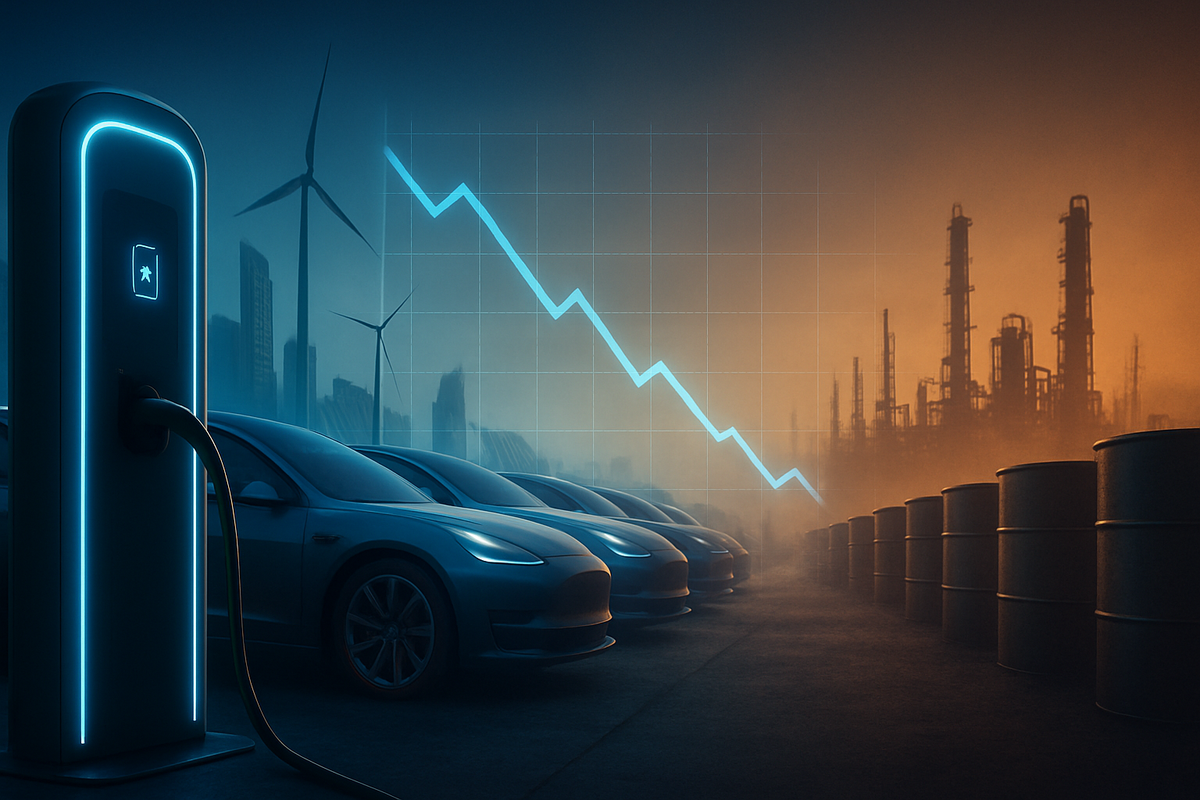
LONDON — As the global energy landscape undergoes its most significant structural shift in decades, the World Bank has issued a sobering forecast for the fossil fuel industry. According to the latest Commodity Markets Outlook, Brent crude is projected to hit a five-year low of $60 per barrel by the end of 2026. This downward trajectory is being driven by what economists describe as a "historic oil glut," fueled by an unprecedented surplus in production and a permanent erosion of demand caused by the rapid global adoption of electric vehicles (EVs).
The immediate implications of this forecast are already reverberating through the halls of Wall Street and beyond. With a projected surplus of 1.2 million barrels per day (mb/d) expected to persist through the year, the global economy is entering a period where oil prices may remain "lower for longer." While this provides a massive disinflationary tailwind for consumers and transportation-heavy industries, it signals a challenging era for traditional energy producers who have enjoyed years of high-margin windfalls.
A "Historic Glut" in the Making: The Road to $60
The path to $60 oil has been paved by a convergence of technological shifts and shifting geopolitical dynamics. The World Bank’s report, which gained significant traction in late 2024 and was further validated by early 2026 market data, highlights that the projected 1.2 mb/d surplus is a volume matched only twice before in history: during the 1998 price collapse and the 2020 COVID-19 lockdowns. However, unlike those previous events, this surplus is not the result of a temporary shock, but a structural change in how the world consumes energy.
The timeline leading to this moment began in earnest during the 2024-2025 period, as production from non-OPEC+ nations—most notably the United States, Brazil, Canada, and Guyana—surged to record levels. Simultaneously, the "China Factor" shifted from a primary driver of growth to a source of stagnation. For decades, China’s industrial expansion fueled global oil demand, but a cooling economy and a pivot toward high-tech manufacturing have essentially "flatlined" its crude requirements. The World Bank notes that China’s demand for gasoline is being displaced at an average rate of 0.45 mb/d annually, largely due to the sheer scale of its EV transition.
Initial market reactions to the $60 projection have been a mixture of relief for central banks and anxiety for the energy sector. OPEC+ members, led by Saudi Arabia and Russia, currently sit on roughly 7 million barrels per day of spare capacity. While this "buffer" has traditionally been used to stabilize prices during geopolitical crises, the World Bank argues that the current glut is so substantial that even significant regional conflicts in the Middle East have failed to push prices sustainably above the $90 mark.
Navigating the Divide: The Corporate Winners and Losers
The descent toward $60 oil creates a stark divide in the corporate world, distinguishing between those who profit from cheaper fuel and those whose margins are tied to the price of a barrel.
The Winners: Airlines and Logistics For major carriers like Delta Air Lines (NYSE: DAL), United Airlines (NASDAQ: UAL), and Southwest Airlines (NYSE: LUV), the forecast is a boon for profitability. Fuel typically accounts for 20% to 30% of an airline's operating expenses. With Brent crude trending toward $60, analysts expect Southwest Airlines to see an additional $400 million to $600 million in annual net income. Delta, which also operates its own refinery, stands to see a significant expansion in its operating margins, potentially fueling its "Delta Next" fleet modernization plans. Similarly, logistics giants like FedEx (NYSE: FDX) and UPS (NYSE: UPS) are expected to benefit from lower ground transportation costs, easing the pressure on their shipping rates.
The Losers: Oil Majors and the EV "TCO" Gap On the losing side, traditional oil majors such as ExxonMobil (NYSE: XOM) and Chevron (NYSE: CVX) are facing a margin squeeze. While both companies are exceptionally resilient due to their low-cost assets in Guyana—where break-even costs are between $25 and $35 per barrel—the $60 environment will likely curb the massive share buyback programs that investors have come to expect.
In a surprising twist, the EV sector also faces a unique challenge. While EVs are the cause of the oil demand decline, $60 oil makes internal combustion engine (ICE) vehicles cheaper to operate. For Tesla (NASDAQ: TSLA), lower gasoline prices reduce the "Total Cost of Ownership" (TCO) advantage that has historically driven its sales. Analysts warn that Tesla may be forced to continue aggressive price cutting to compete with increasingly efficient hybrid models from competitors like BYD (HKG: 1211), which has successfully utilized its plug-in hybrid (PHEV) lineup to capture budget-conscious consumers.
The China Shift and the EV Tipping Point
The wider significance of the World Bank's report lies in its confirmation that the world has passed a tipping point in energy transition. The rapid adoption of EVs, particularly in China where they now account for over 40% of new car sales, is no longer a "future possibility"—it is a present reality eroding the floor of the oil market. This shift fits into a broader trend of "de-oiling" the global economy, where technological efficiency in trucking (specifically LNG and electric heavy-duty vehicles) is permanently reducing the world’s crude intensity.
Regulatory and policy implications are also profound. Governments in Europe and North America continue to push for decarbonization, and a low-oil-price environment may tempt some policymakers to increase fuel taxes to maintain the momentum of the green transition. Historically, low oil prices have often led to a slowdown in alternative energy investment, but the World Bank suggests that the current momentum in EV manufacturing and renewable infrastructure is now too well-entrenched to be derailed by a $60 barrel.
What Lies Ahead: Strategic Pivots and Market Realities
In the short term, the market will likely see continued volatility as OPEC+ attempts to manage its massive spare capacity. The alliance faces a "diminishing efficacy" problem; every cut they make is quickly offset by rising production from Guyana and the U.S. Permian Basin. For investors, the long-term challenge will be identifying which energy companies can transition to "Energy Majors" by successfully integrating low-carbon power and hydrogen into their portfolios.
Strategically, oil-producing nations that have not diversified their economies face a precarious road ahead. Conversely, for the global consumer, $60 oil could act as a "stealth stimulus," lowering the cost of goods and services and potentially allowing central banks more room to maneuver on interest rates as energy-driven inflation remains subdued.
A New Era for Global Energy
The World Bank’s projection of $60 Brent crude by 2026 marks the end of the post-pandemic energy boom and the beginning of a structurally oversupplied market. The combination of a massive production surplus and the relentless growth of the electric vehicle market has fundamentally altered the supply-demand equation.
Moving forward, the market will be defined by efficiency and cost-leadership. Investors should keep a close watch on production levels in Guyana, which is on track to produce over 900,000 barrels per day by the end of 2026, as well as the pace of EV adoption in emerging markets beyond China. While the "Great Oil Glut" offers clear advantages for the transportation sector and global inflation, it serves as a stark reminder that the era of fossil fuel dominance is entering a twilight phase of lower prices and permanent demand destruction.
This content is intended for informational purposes only and is not financial advice.