
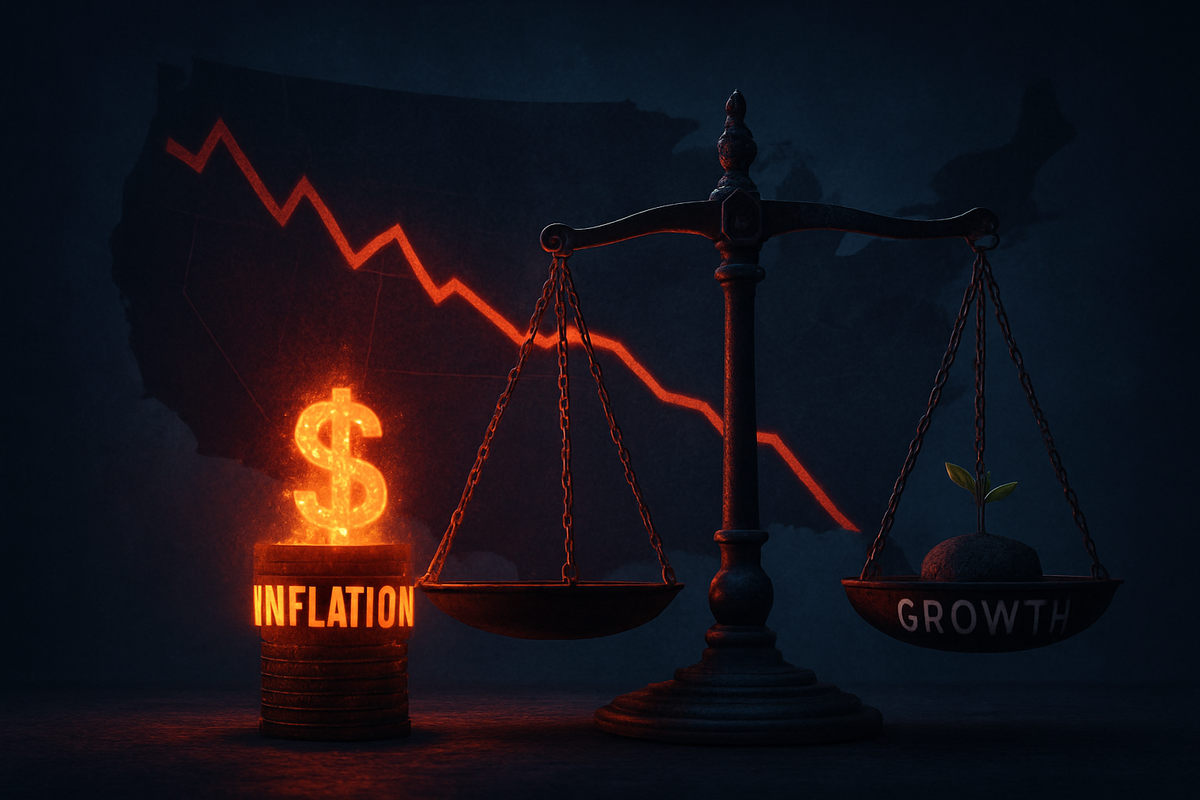
The dream of a "soft landing" for the United States economy appears to be evaporating as new data reveals a sharp deceleration in growth paired with stubbornly high price pressures. On March 13, 2026, the Bureau of Economic Analysis (BEA) released a sobering revision for the final quarter of 2025, slashing Real GDP growth to an annualized rate of just 0.7%. This figure, down from an initial estimate of 1.4%, marks the weakest performance for the American economy since the early pandemic recovery and signals a significant loss of momentum entering the new year.
The immediate implications for the market are profound. With growth stalling and core inflation gauges remaining well above the Federal Reserve’s 2% target, the specter of "stagflation"—a toxic mix of stagnant growth and high inflation—is no longer a theoretical risk but a present reality. Investors are now recalibrating their expectations for interest rate cuts, as the Federal Reserve finds itself caught between the need to stimulate a slowing economy and the mandate to suppress rising costs fueled by a recent global energy shock.
A Perfect Storm: The Path to 0.7% Growth
The dramatic downward revision to 0.7% GDP growth is the result of a "perfect storm" of domestic and geopolitical disruptions that hammered the economy in late 2025. The primary culprit was the historic 43-day partial federal government shutdown that paralyzed Washington throughout October and November. Analysts estimate that this political impasse alone shaved roughly 1.2 percentage points off the growth rate, as federal spending and investment plummeted by an eye-watering 16.7% during the quarter. The shutdown didn't just halt government services; it shattered consumer confidence and delayed critical infrastructure projects across the nation.
Beyond the halls of Congress, American consumers—the traditional engine of the U.S. economy—began to pull back significantly. Personal consumption growth was revised downward to 2%, a sharp decline from the 3.5% clip seen in the third quarter of 2025. This retrenchment reflects a growing "cost-of-living anxiety" as households grapple with high interest rates and the cumulative effect of years of elevated prices. Furthermore, trade headwinds worsened as exports fell by 3.3% annually, exacerbated by escalating trade tensions and a cooling global appetite for American goods.
Market reaction to the news has been swift and somber. Following the March 13 announcement, the major indices saw a flight to safety, with bond yields fluctuating as traders debated the Federal Reserve's next move. The mood was further darkened by the realization that while the Q4 data is backward-looking, the "Iran Shock" of late February 2026—a military strike that sent Brent crude oil prices soaring past $100 per barrel—has already rendered the start of 2026 even more volatile. The intersection of a domestic slowdown and a global energy crisis has left Wall Street searching for a silver lining that remains elusive.
Winners and Losers in a Slow-Growth, High-Cost Environment
The shift toward a stagflationary environment is creating a stark divide between corporate winners and losers. The financial sector is feeling the most immediate heat. Major institutions like Wells Fargo & Co. (NYSE: WFC), Citigroup Inc. (NYSE: C), and JPMorgan Chase & Co. (NYSE: JPM) are facing a double-edged sword: high interest rates usually boost margins, but a stagnant economy leads to a collapse in loan demand and rising credit delinquencies. JPMorgan Chase has already reported a surge in defensive hedging activity as its corporate clients prepare for a prolonged downturn.
Conversely, domestic energy producers have emerged as the clear beneficiaries of the geopolitical instability. With global supply chains threatened by the blockade of the Strait of Hormuz, companies with heavy domestic footprints, such as Occidental Petroleum Corp. (NYSE: OXY), have seen their valuations jump. Unlike global giants like Exxon Mobil Corp. (NYSE: XOM) or Chevron Corp. (NYSE: CVX), which must manage complex international logistics and potential asset evacuations in volatile regions, domestic-focused drillers are reaping the rewards of $100+ oil prices with lower operational risk.
The logistics and transportation sectors are struggling under the weight of surging fuel costs and rerouted trade paths. Shipping giants like A.P. Moller - Maersk (OTC: AMKBY) have been forced to divert vessels around the Cape of Good Hope to avoid Middle Eastern conflict zones, adding millions to voyage costs and further stoking inflationary pressure on imported goods. Airlines and discretionary retailers are also in the crosshairs, as the combination of fuel surcharges and reduced consumer spending power threatens to hollow out profit margins during what should be the spring travel and shopping surge.
The Fed’s Dual Mandate Dilemma
The current economic landscape represents a "worst-case scenario" for the Federal Reserve and its dual mandate of maximum employment and price stability. Usually, the Fed can combat slow growth by cutting rates or fight inflation by raising them. However, with GDP at a near-standstill (0.7%) and the Core Personal Consumption Expenditures (PCE) price index hitting a two-year high of 3.1% in early 2026, the Fed has no easy options. Cutting rates to jumpstart growth could cause inflation to spiral out of control, especially with oil prices at three-year highs.
This situation draws uncomfortable comparisons to the stagflation of the 1970s, where policy errors led to a decade of economic malaise. Unlike the post-pandemic inflation which was largely driven by supply chain "kinks," the early 2026 inflation appears more structural, rooted in high housing costs and service-sector resilience. The "higher-for-longer" interest rate strategy, which the Fed maintained throughout 2025, may have succeeded in cooling growth, but it has yet to fully break the back of core inflation, leaving the central bank in an increasingly precarious position.
The broader industry trend is one of "efficiency over expansion." Across the S&P 500, companies are pivoting away from aggressive growth strategies in favor of cost-reduction and automation. This is why the AI infrastructure sector remains a rare bright spot; firms that provide productivity-enhancing tools are seeing continued investment even as broader capital expenditures (CAPEX) fall. However, this shift toward automation may eventually threaten the "maximum employment" side of the Fed's mandate if the GDP slowdown leads to a wider cooling of the labor market.
What Comes Next: Scenarios for the Rest of 2026
As the Federal Reserve prepares for its March 17-18 meeting, all eyes are on Chair Jerome Powell. The most likely short-term scenario is a "hawkish hold," where the Fed keeps rates steady at the 3.5%–3.75% range but uses its communications to warn that cuts are not imminent. This approach aims to keep inflation expectations anchored while acknowledging the growth risks. However, if the March and April inflation prints reflect the full impact of the $100 oil spike, the Fed may be forced to consider a "shock" rate hike—a move that would almost certainly tip the U.S. into a formal recession.
In the long term, we may see a strategic pivot in how the U.S. manages its economic resilience. The 2025 government shutdown and the 2026 energy shock have highlighted the vulnerabilities of the domestic economy to political instability and foreign energy dependence. This could lead to a renewed push for "onshoring" critical industries and a faster transition toward domestic renewable energy sources to decouple the economy from the volatility of the Middle East. For investors, the "60/40" portfolio may face renewed scrutiny, as traditional hedges fail in a stagflationary regime.
Summary and Investor Outlook
The revision of Q4 GDP to 0.7% is a wake-up call that the era of easy post-pandemic growth is over. The U.S. economy is currently caught in a vice between the lagging effects of a massive government shutdown and the immediate pressure of a global energy crisis. For the Federal Reserve, the dual mandate has become a dual burden, as they struggle to find a path that protects both the value of the dollar and the health of the labor market.
Moving forward, investors should watch for three key indicators: the "shelter" component of the monthly CPI reports, which remains the stickiest part of inflation; the weekly initial jobless claims, which will signal if the GDP slowdown is finally hitting the workforce; and the stability of the Brent crude market. While the headlines are grim, opportunities remain in domestic energy and efficiency-focused technology. However, for the broader market, the coming months will be a test of endurance as the U.S. navigates its most complex economic challenge in decades.
This content is intended for informational purposes only and is not financial advice