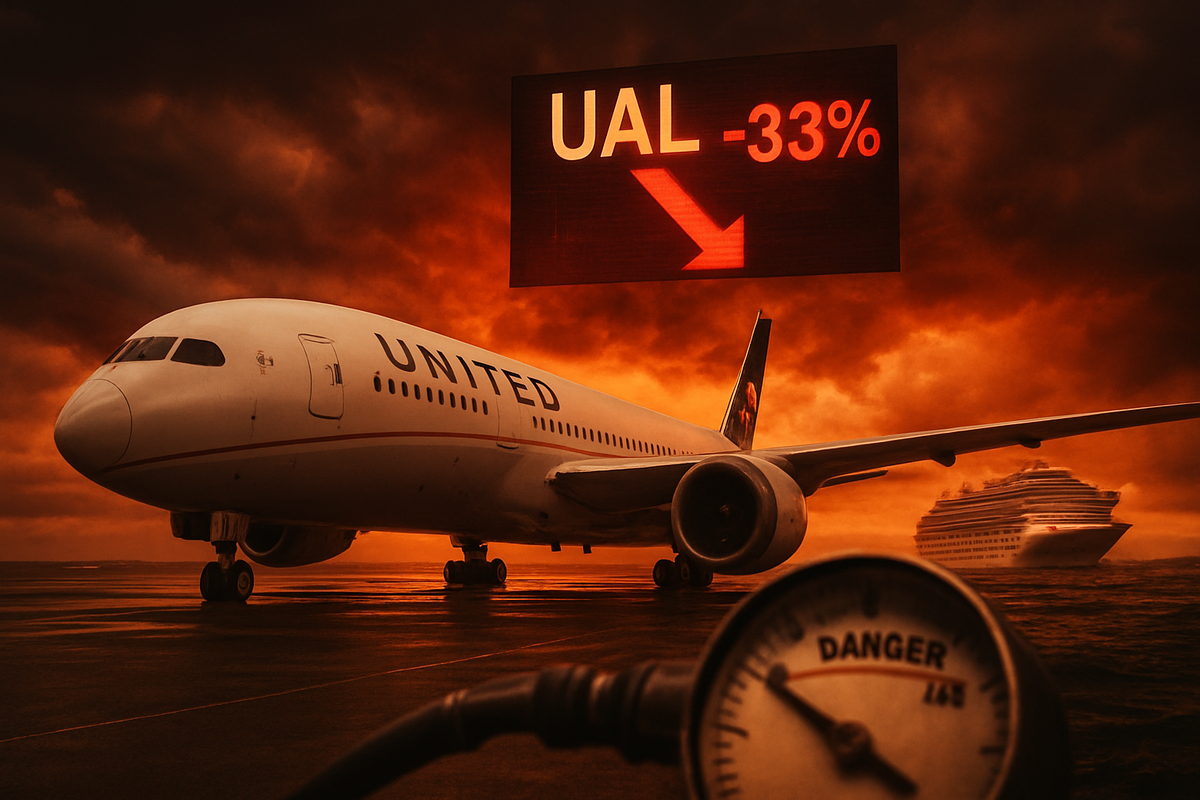
The global travel industry faced a brutal reckoning on March 12, 2026, as a perfect storm of geopolitical instability and skyrocketing energy costs sent shockwaves through the equity markets. The epicenter of the sell-off was United Airlines Holdings, Inc. (NASDAQ: UAL), which saw its share price crater by a staggering 33% in a single trading session. The collapse was triggered by Brent crude oil breaching the psychological $100-per-barrel threshold, a move that has effectively evaporated the profit margins of major carriers and cast a shadow over the broader consumer discretionary sector.
The carnage extended well beyond the tarmac. Carnival Corporation & plc (NYSE: CCL) shares tumbled 6%, while other major players in the transportation and leisure space saw similar, albeit less extreme, declines. As jet fuel prices surged nearly 60% in a week, investors scrambled to re-evaluate the viability of high-growth strategies in an environment defined by persistent inflation and runaway energy overheads.
A Perfect Storm: How $100 Oil Grounded United
The catalyst for the day’s historic decline was a dual blow: the rapid escalation of conflict in the Middle East, leading to the closure of the Strait of Hormuz, and United’s subsequent withdrawal of its 2026 financial guidance. By midday, Brent crude had decisively cleared the $100 mark, sending jet fuel spot prices to $3.95 per gallon—up from a February average of $2.50. For United, which maintains a strict zero-hedging policy on fuel, the move was catastrophic.
The timeline of the collapse began in the pre-market hours when analysts at several major banks slashed their price targets for UAL, citing a "liquidity pincer." United is currently in the midst of its ambitious "United Next" plan, which involves over $12 billion in capital expenditures for 2026 alone to take delivery of 124 new aircraft. With fuel costs typically accounting for 25% of operating expenses, the spike to $100 oil pushed that figure toward 40%. Market participants quickly realized that the airline’s projected 5-8% net margins for the year were not just under threat—they had likely vanished overnight. The 33% drop represents a massive "capitulation" as shareholders voiced fears that the company’s expansion plans are no longer sustainable without emergency financing or government intervention.
Winners, Losers, and the Resilience of the Cruise Line Floor
While the airline sector bore the brunt of the "Energy Black Monday," the impact across the travel landscape was uneven. United’s 33% plunge was significantly deeper than the 6% decline seen by Carnival Corporation & plc (NYSE: CCL). This divergence highlights a critical difference in business models: revenue visibility. Carnival had entered 2026 with nearly two-thirds of its capacity already booked at record-high prices during the 2025 "Wave Season." This "revenue floor" provides a cushion that airlines, which rely more on short-term bookings and are more sensitive to immediate airspace closures, simply do not have.
However, other airlines were not spared. American Airlines Group Inc. (NASDAQ: AAL) and JetBlue Airways Corp. (NASDAQ: JBLU) saw double-digit percentage drops as their unhedged positions left them equally exposed to the spot market. Conversely, Delta Air Lines, Inc. (NYSE: DAL) performed slightly better than its peers, benefiting from its ownership of the Trainer refinery, which offers a structural hedge against refining margins, though even Delta could not escape the gravity of the sector-wide sell-off. In the broader discretionary space, online travel giants like Expedia Group, Inc. (NASDAQ: EXPE) and Airbnb, Inc. (NASDAQ: ABNB) fell between 5% and 8% as investors anticipated that higher ticket prices—driven by emergency fuel surcharges—would eventually sap consumer demand for summer vacations.
Wider Significance: A Shift in the Transportation Paradigm
This event marks a significant turning point for the large-cap transportation and consumer discretionary sectors. For the past two years, the industry had banked on a "return to normalcy" with stable energy prices and robust post-pandemic demand. The surge to $100 oil has shattered that narrative. This move mirrors the energy shocks of 2008 and 2022, but with the added complication of high corporate debt levels following the industry's massive fleet renewal programs.
The broader implications are already rippling through the supply chain. Aerospace giants and maintenance providers are likely to see a slowdown in orders if carriers are forced to defer aircraft deliveries to preserve cash. Furthermore, the regulatory environment is expected to shift. With traditional fuel becoming a liability, there is renewed pressure on the Biden-Harris administration to fast-track subsidies for Sustainable Aviation Fuel (SAF). Historically, such price spikes have forced a consolidation in the industry; the question now is whether the smaller, low-cost carriers can survive a prolonged period of high energy costs that the industry leaders are currently struggling to navigate.
What’s Next: Strategic Pivots and Market Uncertainty
In the short term, the market will be watching for United’s potential "strategic pivot." This could involve a drastic reduction in flight frequencies, the grounding of older, less fuel-efficient aircraft, or even a pause in the "United Next" delivery schedule. Analysts also expect a flurry of fuel surcharge announcements across the industry as airlines attempt to pass costs onto consumers—a move that risks a "demand destruction" event if inflation remains sticky in other parts of the economy.
Long-term, the focus will shift toward balance sheet repair and fuel efficiency. If oil remains above $100 through the summer, we may see a resurgence in hedging strategies, which many airlines abandoned during the low-interest-rate era. For investors, the challenge will be identifying which companies have the liquidity to weather the storm. While the immediate reaction was panic, some opportunistic buyers are already eyeing the hotel and cruise sectors, betting that "revenge travel" sentiment is strong enough to withstand the price hikes, even if the airlines themselves remain grounded by their overhead.
The Bottom Line: A Wake-Up Call for Investors
The events of March 12, 2026, serve as a stark reminder of the travel sector's inherent fragility in the face of geopolitical and commodity volatility. The 33% plunge in United Airlines is more than just a bad day on the market; it is a fundamental re-rating of the risk associated with unhedged, high-capex business models in an uncertain world.
As we move forward, the market will be hyper-focused on monthly fuel price data and the resilience of consumer spending. The "United Next" vision is now under trial by fire, and the outcome will likely dictate the trajectory of the entire transportation sector for the remainder of the decade. For now, the message from the markets is clear: in a $100-oil world, growth is secondary to survival.
This content is intended for informational purposes only and is not financial advice.