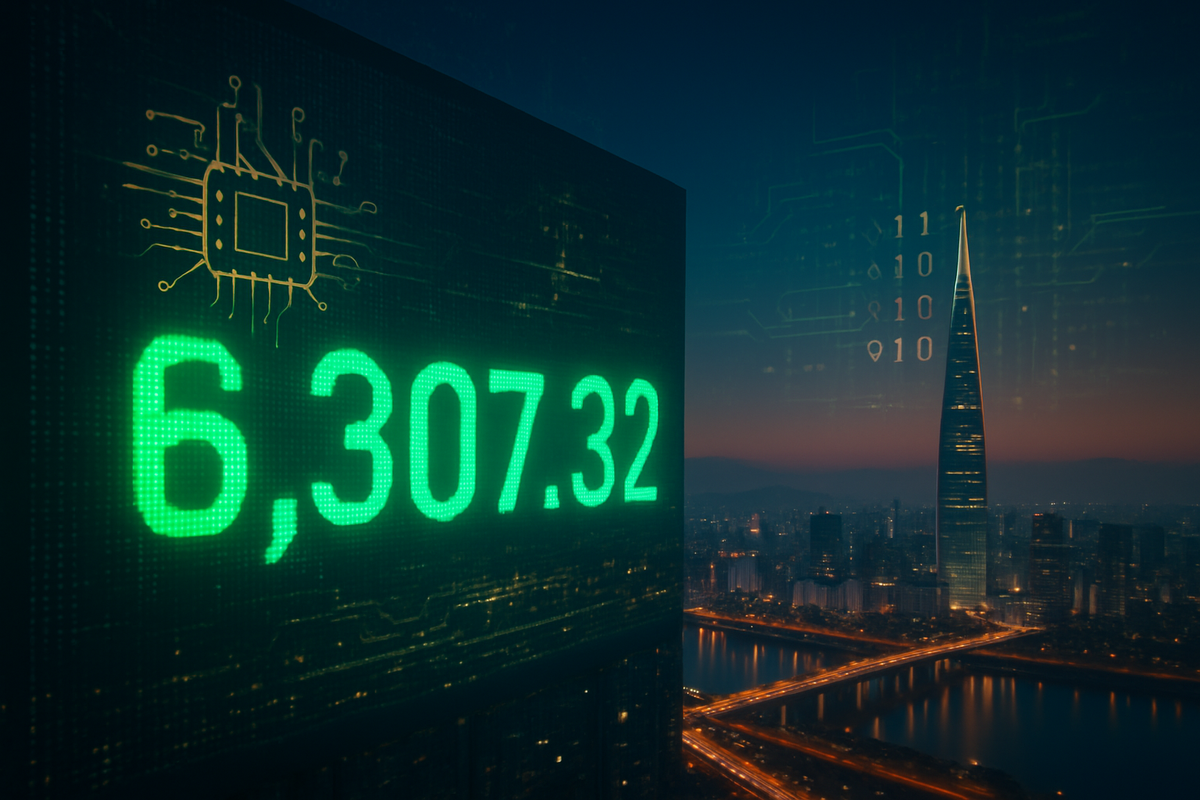
The South Korean stock market reached a historic milestone on Thursday, February 26, 2026, as the benchmark KOSPI index rocketed past the 6,300 level, marking an unprecedented era of growth for the nation's economy. The index closed at 6,307.32, a staggering 3.67% increase in a single session, coming just twenty-four hours after the market celebrated breaking the psychological 6,000-point barrier for the first time in history.
This explosive rally, which has seen the KOSPI gain over 45% in the past year alone, underscores South Korea's transition from a perceived "value trap" to a global epicenter of high-growth technology. The surge was primarily ignited by blowout quarterly results from U.S. chip giant Nvidia (NASDAQ: NVDA), which reinforced the insatiable global demand for artificial intelligence infrastructure and sent a tidal wave of capital into Seoul’s dominant semiconductor players.
The Two-Day Tear: How Seoul Conquered the 6,000s
The momentum began building during Wednesday's session, February 25, when the index first crossed 6,000 points amidst rumors of high-yield dividends and corporate restructuring plans. However, it was the overnight earnings report from Nvidia that provided the high-octane fuel needed to blast through 6,300 today. Nvidia’s guidance for its next-generation "Rubin" AI platform suggested that the world’s appetite for High Bandwidth Memory (HBM)—a sector South Korea effectively monopolizes—shows no signs of slowing through 2027.
The timeline of this ascent is nothing short of remarkable. Just two years ago, in early 2024, the KOSPI languished in the 2,500 to 2,700 range, plagued by the so-called "Korea Discount." The turning point arrived with the aggressive implementation of the "Corporate Value-up Program 2.0" in mid-2025, which mandated stricter governance and incentivized shareholder returns. Combined with the AI "supercycle," these reforms have transformed the KOSPI from a cyclical laggard into a momentum powerhouse. Today’s trading volume hit record highs as foreign institutional investors poured an estimated 2.4 trillion won into the market in a single afternoon.
Titans of the Ticker: Semiconductor Giants Lead the Charge
The day belonged to the heavyweights. Samsung Electronics (KRX: 005930), the crown jewel of the South Korean economy, saw its shares jump 7.1% to reach all-time highs. The gains reflect investor confidence in Samsung’s successful mass production of HBM4 chips, which are now being integrated into Nvidia’s latest AI accelerators. Analysts suggest that Samsung’s ability to pivot its foundry and memory divisions toward AI-centric architecture has finally silenced critics who questioned its agility during the 2024 transition period.
Not to be outdone, SK Hynix (KRX: 000660) surged 8.0%, cementing its status as the "AI memory king." Having secured a dominant share of the HBM3E market throughout 2025, SK Hynix is now the primary beneficiary of the premium margins associated with cutting-edge AI hardware. Other winners in the ecosystem include Hanmi Semiconductor (KRX: 042700), a critical supplier of thermal compression bonding equipment, which rose 5.4%. While the tech sector thrived, some traditional industrial and utility stocks lagged, highlighting a stark divergence between the "new economy" AI winners and legacy sectors struggling with rising energy costs.
Erasing the 'Korea Discount': A Paradigm Shift in Governance
The significance of the KOSPI hitting 6,300 extends far beyond a simple numbers game; it represents the structural dismantling of the "Korea Discount." For decades, South Korean stocks traded at lower valuations than their global peers due to poor corporate governance and low dividend payouts. The 45% gain over the past year is a testament to the success of regulatory shifts that began in 2024 and 2025. These policies forced "chaebols" (family-owned conglomerates) to prioritize minority shareholders and cancel treasury shares, effectively mirroring the "Value-up" successes seen in Japan’s Nikkei 225.
This event also marks a shift in global semiconductor geopolitics. As the U.S. and China continue their "chip wars," South Korea has positioned itself as the indispensable workshop of the AI revolution. The ripple effects are being felt by competitors in Taiwan and the United States, as Seoul’s massive investments in the Pyeongtaek and Yongin "mega-clusters" begin to bear fruit. The historical precedent for such a move is rare; it echoes the Nasdaq’s dot-com era growth but is backed by the tangible, massive cash flows of the 2026 AI infrastructure boom.
The Road Ahead: Sustainability vs. Overheating
As the KOSPI settles into its new 6,000+ reality, the immediate question for investors is whether this rally is sustainable. Short-term volatility is expected as some traders look to book profits after a nearly 4% daily jump. However, the long-term outlook remains bullish. Strategic pivots by South Korean firms into AI-driven automotive chips and edge computing suggest that the growth has multiple legs to stand on. The market is now looking toward 2027, with rumors of a "Korea-U.S. AI Alliance" trade pact potentially providing the next major catalyst.
Challenges do remain, however. Potential scenarios for a pullback include a sudden cooling in global AI capital expenditures or geopolitical tensions in the Taiwan Strait that could disrupt regional supply chains. Additionally, the Bank of Korea may feel pressured to tighten monetary policy if the stock market’s wealth effect begins to fuel domestic inflation. Investors should watch for the upcoming "Value-up Index" rebalancing in June, which will likely dictate the next wave of institutional capital flows.
A New Frontier for the Korean Market
The KOSPI’s leap to 6,307.32 is a watershed moment, signaling that South Korea has finally escaped the shadow of its historical undervaluation. The convergence of Nvidia's visionary hardware dominance and the technical prowess of Samsung and SK Hynix has created a perfect storm for wealth creation in Seoul. With a 45% annual return, the KOSPI is no longer just a barometer for global trade; it is a leading indicator for the future of human intelligence.
As we move forward into the remainder of 2026, investors should keep a close eye on HBM4 yield rates and the continued evolution of corporate governance reforms. While the "easy money" of the initial rebound may have been made, the "AI supercycle" suggests that South Korea's journey into the 6,000s may just be the beginning of a much larger story. For now, the "Miracle on the Han River" has found its second act in the silicon and code of the 21st century.
This content is intended for informational purposes only and is not financial advice.