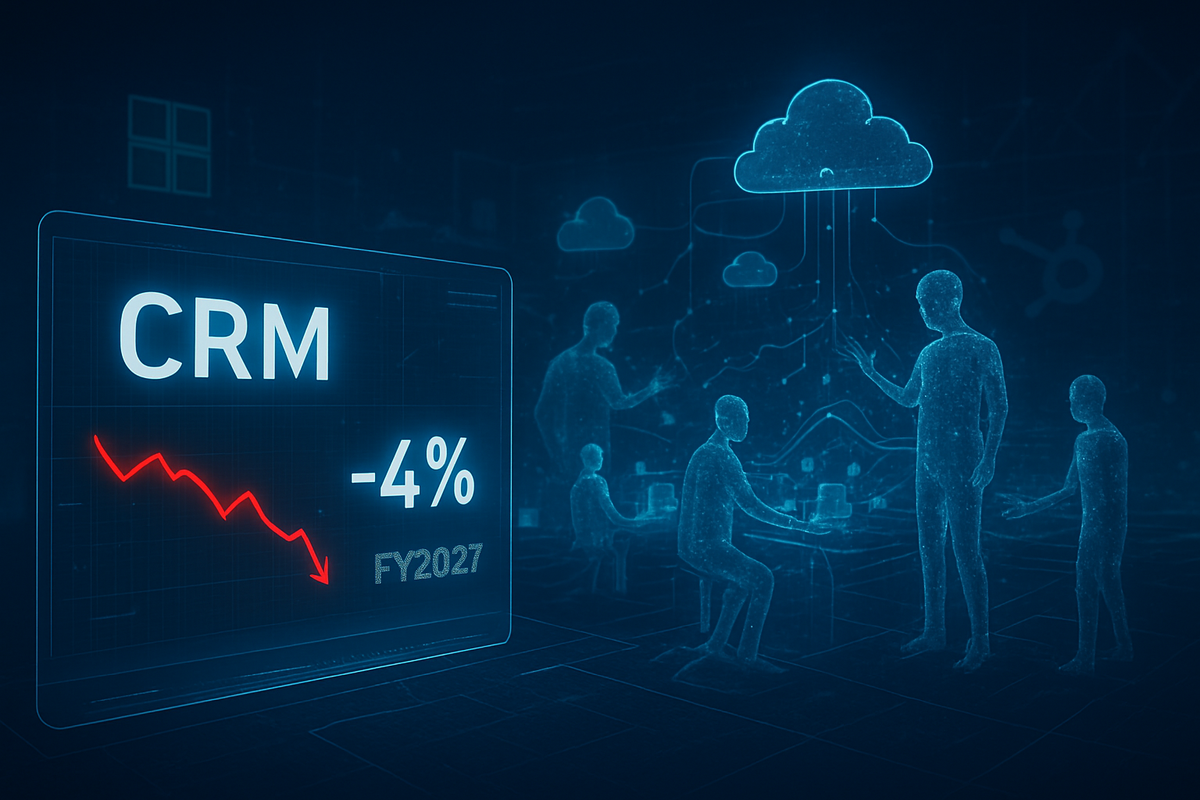
The enterprise software landscape faced a sharp reality check on Wednesday as Salesforce (NYSE: CRM) saw its shares slide 4% in after-hours trading following its fiscal 2026 year-end earnings release. While the company posted a solid beat on the bottom line, it was the forward-looking guidance for fiscal year 2027 that left investors cold. Salesforce projected total revenue of approximately $46 billion for the upcoming year—a figure that, while meeting consensus estimates, failed to ignite the "AI-driven re-acceleration" that many on Wall Street had been banking on.
The cautious outlook from the cloud pioneer comes at a pivotal moment for the tech industry. As the "Copilot" era of 2024 and 2025 gives way to the "Agentic" era of 2026, investors are increasingly scrutinizing whether legacy software giants can maintain their dominance. Despite CEO Marc Benioff’s full-throated defense of Salesforce’s new "Agentforce" platform, the market remains wary that the transition to autonomous AI workers might cannibalize the company’s traditional seat-based revenue model.
Agentforce Takes Center Stage Amid Conservative Forecasts
During the earnings call on February 25, 2026, Salesforce leadership laid out a vision for what Benioff termed the "Agentic Enterprise." This new paradigm shifts the focus from human employees using software tools to autonomous AI agents performing entire business processes—from lead qualification to customer support—with minimal human intervention. Benioff highlighted that "Agentforce" and the company's "Data 360" foundation had already grown to reach over $1.5 billion in annual recurring revenue by the end of FY2026, a triple-digit increase year-over-year.
However, the excitement over these early "agentic" wins was overshadowed by the conservative $46 billion revenue target for FY2027. This represents roughly 11% growth, a steady but uninspired pace for a company that once consistently delivered 20% to 30% gains. Analysts noted that while Salesforce is successfully pivoting its technology, the financial realization of this shift is taking longer than expected. The timeline of the "Agentforce" rollout, which began in earnest at Dreamforce 2024 and expanded through 2025, has hit a friction point: enterprise customers are piloting the technology, but they are also seeking to optimize their overall software spend.
Initial market reaction was swift, with the stock falling to its lowest level since the autumn of 2025. Investors are particularly concerned about "seat count contraction"—a growing trend where companies reduce the number of human licenses they purchase as AI agents begin to handle higher volumes of work. While Salesforce is attempting to offset this by introducing "Agentic Work Units" (AWUs) and consumption-based pricing, the unpredictability of this new model is creating a "wait-and-see" attitude among institutional shareholders.
The AI Arms Race: Emerging Winners and Legacy Losers
The 4% dip in Salesforce stock has highlighted a growing divergence in the SaaS (Software as a Service) sector. While Salesforce remains the incumbent "gorilla," it is facing a multi-front war. Microsoft (NASDAQ: MSFT) has emerged as a formidable "trojan horse" competitor, with its "Copilot for Sales" and "Agent 365" tools living directly inside the Office suite, often bypassing the need for users to log into a traditional CRM dashboard.
On the other end of the spectrum, specialized AI-first startups are beginning to chip away at Salesforce’s core business. Sierra, the "digital worker" startup founded by former Salesforce co-CEO Bret Taylor, has seen explosive growth by offering agents that act as autonomous "operators" rather than just assistants. Meanwhile, "composable" CRM challengers like Attio and research-heavy agents like Clay are gaining traction among high-growth tech firms that find Salesforce's administrative complexity—the so-called "Salesforce Tax"—increasingly burdensome in an automated world.
Even long-time rival HubSpot (NYSE: HUBS) is capitalizing on the shift, marketing its "Breeze AI" as a faster, more cost-effective way for mid-market companies to deploy agentic workflows. As these competitors move from experimental pilots to core production, the concern for Salesforce is no longer just about who has the better AI, but whose AI is easier to deploy and cheaper to maintain. If an AI agent can perform 80% of a human sales rep’s work for a fraction of the cost, the traditional "per-user, per-month" pricing that built the Salesforce empire is under existential threat.
The 'SaaS-pocalypse' and the Post-Copilot Shift
The current market volatility surrounding Salesforce reflects a broader industry trend that some analysts are calling the "SaaS-pocalypse" of 2026. This refers to the structural repricing of software companies as the market realizes that AI agents are not just "add-ons," but are actually replacements for the traditional user interface. For nearly two decades, the growth of the enterprise software market was tied to the growth of white-collar headcounts. In the "agentic" era, that correlation is breaking.
Historically, Salesforce has been the master of the "land and expand" strategy, acquiring companies like Slack, Tableau, and MuleSoft to own every aspect of the enterprise workflow. However, the current shift toward agentic AI favors companies with the cleanest data and the most flexible architectures. Salesforce’s "Data Cloud" (now Data 360) is its primary defense against this trend, as AI agents are only as good as the data they can access. By positioning itself as the "trust layer" for these agents, Salesforce is betting that enterprises will value security and compliance over the agility of smaller startups.
This strategy mirrors the historical transition from on-premise software to the cloud that Salesforce itself led in the early 2000s. Just as Oracle (NYSE: ORCL) and SAP (NYSE: SAP) had to reinvent themselves to survive the cloud era, Salesforce is now the legacy incumbent needing to disrupt its own business model before its competitors do it for them. The regulatory landscape also plays a role, as Salesforce’s "Atlas Reasoning Engine" and "Agent Script" are designed to provide the audit trails and guardrails that large, regulated enterprises demand—a "moat" that many smaller AI startups have yet to build.
Navigating the FY2027 Roadmap
Looking ahead, the success of Salesforce’s FY2027 will depend on its ability to prove that its "Agentic Work Units" can replace the revenue lost to seat contraction. In the short term, the company is likely to focus on high-value "digital workers" for customer service and sales operations, where the ROI is most easily measured. Strategically, we may see Salesforce engage in another round of aggressive acquisitions, potentially targeting AI-native data infrastructure firms to further bolster its Data 360 platform.
There is also a significant possibility of a "re-acceleration" in the second half of 2026 if the current wave of Agentforce pilots converts into large-scale production contracts. If Salesforce can demonstrate that one "Agent" license generates more revenue than the five "Human" licenses it replaces, the stock could see a massive re-rating. Conversely, if enterprises use AI agents to consolidate their software stacks and reduce overall spend, Salesforce may be forced to accept a future as a slower-growing, high-margin utility rather than a high-growth innovator.
A Crucial Turning Point for the CRM King
The reaction to the February 25 earnings release serves as a stark reminder that in the AI era, "meeting estimates" is no longer enough for the market leaders. Investors are demanding proof of transformative growth, not just incremental improvements. Salesforce’s slide is a reflection of the uncertainty that haunts the entire SaaS sector: Can the giants of the last twenty years become the giants of the next twenty?
The key takeaways for investors over the coming months will be the "Agentic Work Unit" adoption rates and the churn levels in the core Sales and Service Clouds. While Marc Benioff’s vision of the "Agentic Enterprise" is technologically sound, the financial transition remains a high-wire act. Investors should watch closely for any signs of a "middle-market exodus" to simpler AI tools, as well as the progress of Microsoft’s deep integration of agents into the Office 365 ecosystem. For now, Salesforce remains the king of CRM, but it is a king defending a kingdom whose borders are being rapidly redrawn by autonomous code.
This content is intended for informational purposes only and is not financial advice.