
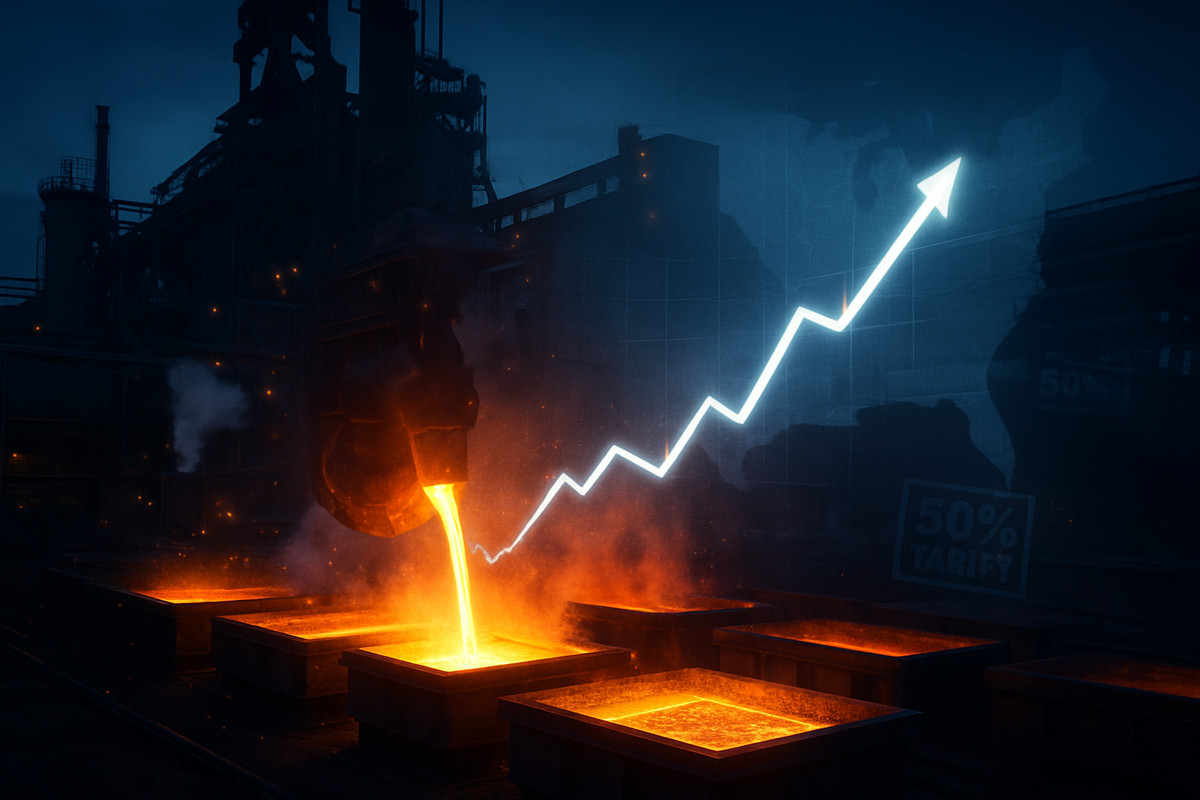
The U.S. aluminum market reached a historic inflection point this week as the regional surcharge for domestic delivery, known as the Midwest Premium, surged to an unprecedented $2,182 per metric tonne. This spike, which translates to a cost of over $1 per pound for the first time in history, has effectively decoupled U.S. domestic prices from global benchmarks. American manufacturers are now facing an "all-in" price exceeding $5,340 per tonne, nearly 70% higher than the prices paid by international competitors sourcing metal from the London Metal Exchange (LME).
The dramatic price divergence is the direct result of a "perfect storm" of aggressive trade protections and a shrinking domestic industrial base. With Section 232 import tariffs now standing at a robust 50%, the U.S. has effectively built a "price wall" that isolates its domestic market. This decoupling is creating a stark divide in the industrial economy: while domestic primary producers are seeing record margins, downstream manufacturers in the automotive and packaging sectors are struggling to manage a massive surge in raw material costs that threatens to erode their global competitiveness.
The Policy Wall and the Scarcity Milestone
The current crisis traces its roots to a series of aggressive trade maneuvers that culminated in the "Bessent Pivot" of early 2026. Treasury Secretary Scott Bessent recently signaled that while the administration might consider rolling back certain tariffs on finished goods to ease consumer inflation, the 50% Section 232 duties on primary metal are likely to remain a permanent fixture. This "bifurcated" strategy aims to protect what remains of the U.S. smelting industry while forcing downstream manufacturers to absorb the costs of raw materials. The $2,182 Midwest Premium milestone more than doubles the previous record set during the 2022 supply chain crisis, signaling that the U.S. is now operating in a "scarcity mindset."
The supply-side constraints have been further exacerbated by the permanent loss of domestic smelting capacity. In a move that underscored the changing face of American industry, Century Aluminum (CENX) recently finalized the sale of its idled Hawesville, Kentucky, smelter to the digital infrastructure firm TeraWulf Inc. (WULF). Instead of producing aluminum, the massive 480 MW power infrastructure at the site—once the heartbeat of one of the nation’s largest smelters—will now fuel AI data centers. This transition highlights a critical vulnerability: the U.S. is increasingly choosing "data over dust," leaving domestic manufacturers reliant on a shrinking pool of local metal and heavily taxed imports.
Market participants describe the current environment as a "forced isolation" of the U.S. aluminum trade. The exhaustion of domestic inventories, combined with the 15% global "stacking" tariff under Section 122, has left buyers with no choice but to pay the record premium. Initial industry reactions have been polarized, with primary producers hailing the protectionist measures as essential for national security, while major industrial consumers warn of a looming "manufacturing exodus" if the price chasm between the U.S. and the rest of the world remains this wide.
Corporate Winners and Downstream Casualties
The primary beneficiary of this price decoupling has been Alcoa Corporation (AA), which has seen its shares surge more than 65% in the months leading up to early 2026. Alcoa’s ability to command high regional premiums while maintaining a vertically integrated supply chain has allowed it to offset rising energy and logistics costs. For Alcoa, the record Midwest Premium is not just a surcharge but a significant profit driver that bolsters its 2026 guidance, particularly as it focuses on its high-capacity "green" smelting projects and its bauxite-to-aluminum value chain.
Similarly, Century Aluminum (CENX) has managed to turn a strategic retreat from high-cost facilities into a market win. While the sale of the Hawesville smelter marked the end of an era, the company’s pivot toward modernized, power-secured sites—such as its joint venture for a new smelter in Oklahoma—has been well-received by investors. By retaining a minority stake in the TeraWulf data center project, Century is monetizing its energy assets, effectively diversifying its revenue stream away from pure metal production and toward the high-margin AI infrastructure boom.
Conversely, the automotive and packaging sectors are bearing the brunt of the "price wall." Ford Motor Company (F) has emerged as a high-profile victim, with analysts estimating a $1.5 billion to $3 billion hit to its adjusted EBIT due to the aluminum surge. Ford’s heavy reliance on high-grade aluminum for its F-150 truck bodies makes it uniquely vulnerable; the tariffs have added an estimated $400 in direct material costs per vehicle. In the packaging sector, Ball Corporation (BALL) has managed the crisis more effectively by aggressively pursuing local sourcing and passing through price increases of 25% to 30% to consumers, though the overall inflationary pressure on "the aluminum can" remains a major headwind for the beverage industry.
Decoupling and the "Power-First" Industrial Shift
This event signifies a broader trend toward the regionalization of global commodities. For decades, the LME benchmark served as the universal price for aluminum, but the current $2,182 Midwest Premium proves that geography and trade policy now matter more than global supply-and-demand fundamentals. This "decoupling" is a template for other critical minerals, where the U.S. is prioritizing domestic supply security over global price efficiency. The ripple effects are already being felt by competitors in Europe and Asia, who now enjoy a significant cost advantage in manufacturing aluminum-intensive goods for export to neutral third-party markets.
The historical precedent for this shift can be found in the 2018-2022 period, but the 2026 crisis is different in its permanence. The repurposing of the Hawesville smelter into a data center represents a structural change in how energy is valued. In the past, low-cost power was the lifeblood of the aluminum industry; today, that same power is often more valuable when sold to the tech sector. This "power-first" industrial logic suggests that even if tariffs were lowered, the U.S. might never return to its former status as a major aluminum producer because the underlying energy assets have been permanently redirected toward the digital economy.
Policy-wise, the "Bessent Pivot" indicates that the U.S. government is willing to sacrifice downstream margins to protect upstream raw material security. This creates a regulatory environment where companies like Ford and Ball Corporation must choose between domestic manufacturing at a massive cost disadvantage or shifting production of finished goods overseas to bypass the primary metal tariffs—a move that would ironically run counter to the administration's "made in America" goals.
The Road Ahead: Strategic Pivots and Scenarios
In the short term, U.S. manufacturers will likely focus on "lightweighting" and increasing recycled content to bypass the need for primary, tariff-heavy aluminum. Companies that fail to adapt their sourcing strategies will find themselves increasingly uncompetitive. For investors, the iPath Series B Bloomberg Aluminum Subindex Total Return ETN (JJU) serves as a cautionary tale; because it tracks LME-linked futures, it has failed to capture the $2,182 Midwest Premium, leading to significant underperformance relative to physical domestic costs. This tracking error highlights the danger of using global financial instruments to hedge local industrial risks in a decoupled market.
Longer-term, the U.S. may see a surge in "secondary" aluminum production—recycling existing scrap—as a way to circumvent the trade barriers on primary metal. We may also see more joint ventures between industrial firms and energy providers to secure dedicated power for new, highly efficient "green" smelters. However, the success of these projects depends on whether the 50% tariffs remain in place long enough to justify the multi-billion-dollar investments required to bring new smelting capacity online.
A New Era of Resource Nationalism
The surge in the US Midwest Premium to record highs is more than just a market fluctuation; it is a signal of a new era of resource nationalism. The decoupling of domestic prices from global benchmarks reflects a deliberate policy choice to prioritize the survival of the primary aluminum industry at the expense of downstream manufacturing and consumer prices. Moving forward, the "all-in" price of $5,340 per tonne will serve as a baseline for the high cost of doing business within the U.S. "price wall."
Investors should watch for two key developments in the coming months: first, any official confirmation of the "Bessent Pivot" regarding tariff exemptions for finished goods, which could provide relief to the automotive sector; and second, the progress of Century Aluminum’s new Oklahoma smelter. If the U.S. cannot successfully bring new, efficient capacity online, the record premiums seen today may become a permanent tax on American industry, forcing a fundamental realignment of the nation's manufacturing sector.
This content is intended for informational purposes only and is not financial advice.