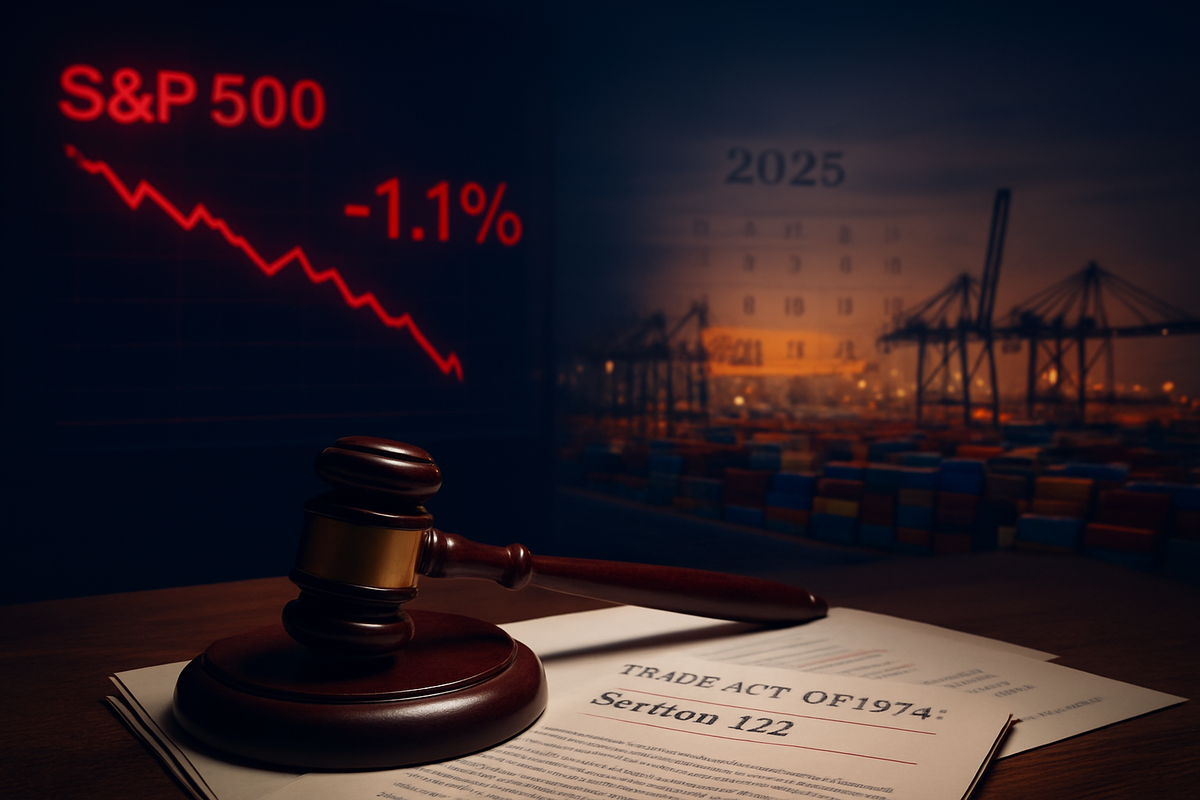
In a dramatic shift that has sent shockwaves through global markets, President Trump has announced a new 15% global tariff surcharge, invoking the seldom-used Section 122 of the Trade Act of 1974. The move, announced late yesterday, serves as an aggressive "legal bridge" following a landmark Supreme Court ruling that stripped the executive branch of its long-standing power to impose broad tariffs under the International Emergency Economic Powers Act (IEEPA). By pivoting to Section 122, the administration has capped the immediate tariff rate at the statutory maximum of 15%, but the transition has introduced a "new layer of uncertainty" for American businesses already grappling with volatile supply chains.
The reaction on Wall Street was immediate and defensive. The S&P 500 (^GSPC) fell 1.1% in early trading as investors processed the implications of a mandatory 150-day expiration date for these new duties. Unlike previous trade actions that could remain in place indefinitely under "national emergency" declarations, Section 122 requires an affirmative act of Congress to extend the tariffs beyond five months. This ticking clock has left multinational corporations and domestic retailers in a state of strategic limbo, unsure whether to absorb the costs or pass them on to consumers before a potential July expiration.
The Death of IEEPA and the Birth of the "Balance-of-Payments" Crisis
The catalysts for this week's announcement were two-fold: a legal defeat and a statutory pivot. On February 20, 2026, the U.S. Supreme Court ruled 6-3 in Learning Resources, Inc. v. Trump that the President cannot use IEEPA to impose general trade tariffs. The Court applied the "major questions doctrine," asserting that the power to tax and set duties is a core Congressional authority that requires explicit, rather than broad and vague, delegation. This ruling effectively nullified the administration's previous "Liberation Day" tariffs, which had reached as high as 45% on certain Chinese imports.
Faced with the total collapse of his trade agenda, President Trump invoked Section 122, citing a "large and serious balance-of-payments deficit" as the necessary statutory trigger. This provision allows for a temporary surcharge of up to 15% for a period of 150 days to protect the U.S. dollar and stabilize the national investment position. The administration justified the move by pointing to a $1.2 trillion goods trade deficit, framing the 15% flat rate as a necessary measure to prevent a "currency catastrophe."
The timeline is now the market's primary concern. Under the law, these tariffs will expire on July 24, 2026, unless Congress votes to extend them. This sets the stage for a high-stakes legislative showdown in early summer. Industry groups, led by the U.S. Chamber of Commerce, have already begun lobbying against an extension, while domestic manufacturing advocates argue the 15% floor is essential for a "level playing field." The shift from an "indefinite emergency" to a "150-day window" has fundamentally changed the risk calculus for every firm involved in trans-pacific or trans-atlantic trade.
Retail Giants and Tech Titans: Navigating the 15% Surcharge
The move to a uniform 15% global rate creates a complex web of winners and losers. For companies like Apple Inc. (NASDAQ: AAPL), the news is a double-edged sword. While the 15% rate is lower than the previous IEEPA-driven threats of 40% on Chinese electronics, the "temporary" nature of Section 122 makes long-term supply chain planning nearly impossible. Apple’s high-margin hardware could absorb the 15% temporarily, but the uncertainty may delay major capital expenditures in new assembly facilities outside of China.
Retailers with thin margins are among the hardest hit by the suddenness of the shift. Walmart Inc. (NYSE: WMT) and Target Corporation (NYSE: TGT) saw their shares dip 2.4% and 3.1%, respectively, following the announcement. These companies rely on high-volume, low-cost imports that are often contracted months in advance. A 15% surcharge that might disappear in 150 days leaves them with a difficult choice: raise prices now and risk alienating consumers, or eat the costs and see Q1 and Q2 earnings crater.
On the other side of the ledger, domestic industrial players like United States Steel Corporation (NYSE: X) and Nucor Corporation (NYSE: NUE) may see a temporary reprieve from foreign competition, though the 15% cap is significantly lower than the specialized Section 232 duties they have enjoyed in the past. Furthermore, some emerging market exporters in countries like India or Brazil may actually benefit; because they are now subject to the same 15% flat rate as China—which previously faced much higher targeted duties—their products have become relatively more competitive on the American shelf overnight.
A Fundamental Shift in Executive Trade Authority
The significance of this event extends far beyond the 15% price hike; it represents a fundamental reordering of how trade policy is conducted in Washington. For decades, the executive branch has utilized "national security" and "emergency" declarations to bypass Congress on trade. The Supreme Court's ruling against the use of IEEPA has effectively closed that door, forcing the White House to rely on the more restrictive and time-bound Section 122.
This pivot signals a return to a "Major Questions" era, where the judiciary is increasingly skeptical of executive overreach in economic matters. By using the "balance-of-payments" justification, the administration is testing a legal theory that has not been truly scrutinized since the Nixon era. Critics argue that in a world of floating exchange rates, the concept of a "payments crisis" is an archaic relic of the gold-standard era. If the courts or Congress challenge this justification, the 15% surcharge could face the same fate as the IEEPA tariffs before it.
The ripple effects are already being felt globally. Traditional allies in the European Union and the United Kingdom, who were previously exempted or faced lower rates under various bilateral agreements, now find themselves under the 15% umbrella. This "one-size-fits-all" approach has strained diplomatic relations, with the EU already threatening retaliatory tariffs on American agricultural exports. The global trade environment has shifted from targeted surgical strikes to a blunt, uniform barrier, increasing the risk of a synchronized global economic slowdown.
The 150-Day Standoff: What Comes Next?
As the 150-day clock begins to tick toward July 24, the primary question for the market is whether Congress has the appetite—or the political unity—to extend the 15% surcharge. In the short term, businesses are expected to adopt a "wait and see" approach, potentially holding back on inventory builds until the legislative path becomes clearer. This could lead to localized shortages in consumer electronics and apparel by early summer.
If Congress fails to act, the tariffs will vanish automatically, potentially triggering a massive surge in imports as companies rush to restock before any further executive actions are taken. Conversely, if the administration successfully pressures Congress into a permanent 15% global baseline, it would represent the most significant permanent change to U.S. trade policy since the implementation of the Smoot-Hawley Act in 1930. Investors should watch for a "strategic pivot" toward domestic sourcing, though such moves are unlikely to be completed within the current 150-day window.
The emerging challenge for the S&P 500 will be the "rolling uncertainty." Even if Section 122 remains in place, the constant threat of expiration or legal challenge makes it difficult for analysts to model corporate earnings for the second half of 2026. Market opportunities may emerge in "tariff-exempt" services and domestic-focused small caps, but for the broader market, the prevailing sentiment is one of cautious apprehension.
Final Assessment: A Market in Search of Stability
The invocation of Section 122 marks a watershed moment in American economic policy. By moving away from the IEEPA framework, the Trump administration has technically complied with the Supreme Court's mandate but has simultaneously introduced a level of legislative risk that hasn't been seen in decades. The 15% global surcharge is a significant burden, but the "new layer of uncertainty" regarding its longevity is what truly haunts the C-suite.
Moving forward, the market is likely to remain in a sideways pattern, sensitive to every headline regarding Congressional sentiment or further judicial filings. The key takeaway for investors is that the era of "unilateral executive trade wars" is over, replaced by a more complex, three-branch struggle for control over the nation's borders and its pocketbooks.
In the coming months, watch for the "July Cliff"—the date when the 150-day window expires. The volatility surrounding that deadline will be the ultimate test of whether the U.S. economy can handle a permanent shift toward protectionism or if the statutory hurdles of the Trade Act of 1974 will eventually force a return to the status quo. For now, the global trade machine is running on a 150-day battery, and no one is quite sure who has the charger.
This content is intended for informational purposes only and is not financial advice.