
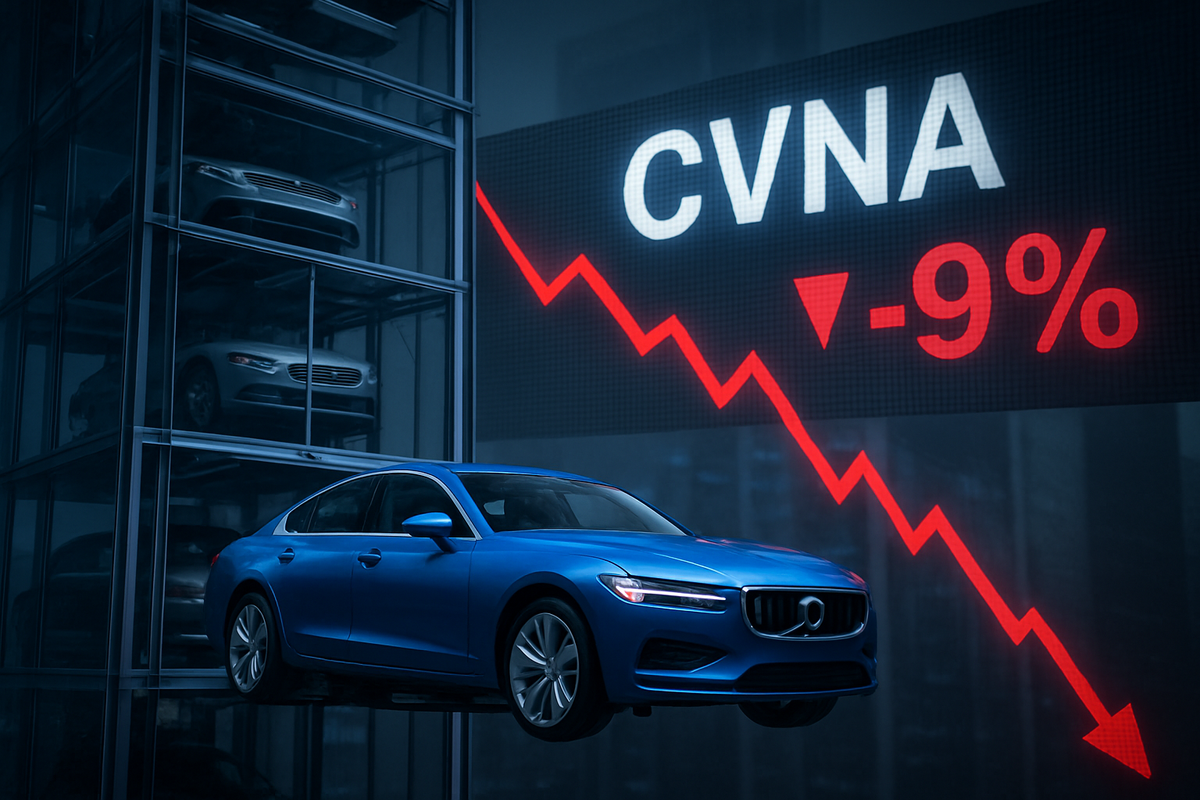
PHOENIX, AZ — Shares of Carvana Co. (NYSE: CVNA) tumbled over 9% on Thursday, February 19, 2026, as the market reacted to a fourth-quarter earnings report that delivered a confusing mix of record-breaking top-line growth and disappointing operational efficiency. Despite reporting its highest-ever net income, the online used-car giant saw its stock price pummeled after missing key profitability metrics on a per-vehicle basis, raising alarms about the sustainability of its business model in a cooling used-car market.
The sharp sell-off reflects a growing skepticism among Wall Street analysts regarding the "quality" of Carvana's earnings. While the company reported a massive $5.60 billion in revenue for the final quarter of 2025—easily surpassing consensus estimates—investors zeroed in on the Gross Profit per Unit (GPU), which fell significantly short of expectations. This core metric, which measures how much profit the company squeezes out of every vehicle sold, dropped to approximately $3,076, missing the target of $3,198 that analysts had baked into their models.
The Illusion of Record Profits
On paper, Carvana’s fourth-quarter results looked like a triumph. The company announced a record net income of $951 million, a figure that would typically send a stock soaring. However, the fine print revealed a different story. Of that total, roughly $650 million was attributed to a one-time non-cash tax benefit involving the release of a valuation allowance on deferred tax assets. Stripping away this accounting maneuver, the operational reality was less rosy.
Adjusted EBITDA, a favorite metric for the company’s management, landed at $511 million. While this was a record for any fourth quarter in the company’s history, it failed to meet the $536 million forecast by Wall Street. The primary culprit was the compression of retail margins. CEO Ernie Garcia III cited "growing pains" associated with scaling new production sites, which led to higher-than-anticipated reconditioning costs. Additionally, an unexpected uptick in used-car depreciation rates late in the year further squeezed the profit margins on the company’s inventory.
The timeline leading up to this earnings call was already fraught with tension. In late January 2026, Carvana was the target of a scathing report from Gotham City Research, which alleged the company had inflated its earnings through complex transactions with related parties. Although Carvana denied the claims, the report cast a long shadow over the February earnings release, leaving investors more inclined to sell on any sign of operational weakness.
Winners and Losers in the Shifting Used-Car Landscape
The fallout from Carvana's report sent ripples across the entire automotive retail sector. CarMax, Inc. (NYSE: KMX), Carvana’s largest direct competitor, saw its shares dip 3% in sympathy as investors worried that the margin compression seen at Carvana might be an industry-wide contagion. Traditional dealership groups like AutoNation, Inc. (NYSE: AN) and Lithia Motors, Inc. (NYSE: LAD) also faced scrutiny, though some analysts suggest these legacy players might actually emerge as winners. With their diversified revenue streams from parts, service, and new car sales, traditional dealers are better insulated against the volatility of used-car prices than pure-play digital retailers.
For Carvana, the immediate "losers" are the growth-oriented investors who had driven the stock’s rally throughout 2025. The 9% drop marks a significant reversal of momentum. Conversely, the "winners" appear to be the short-sellers and critics who have long argued that Carvana’s logistics-heavy model is too fragile to maintain high margins during periods of inventory depreciation.
A Market Cooling: The Wider Significance
The disappointment in Carvana's GPU signals a broader shift in the used-vehicle market. For much of the past year, supply chain stabilizations had led to a normalization of car prices, but the Q4 data suggests that the "sweet spot" of high demand and high prices is firmly in the rearview mirror. Carvana’s struggle to control reconditioning costs at new sites highlights the immense difficulty of scaling a national logistics network while maintaining the lean efficiency of a tech company.
Furthermore, this event fits into a larger narrative of "quality over quantity" in the 2026 market. Investors are no longer satisfied with breakneck revenue growth if it comes at the expense of unit economics. The end of Carvana’s "Payment-In-Kind" (PIK) interest period is also looming. For years, the company was able to pay interest on its massive debt with more debt; transitioning to cash interest payments in 2026 will require a level of operational discipline the company has yet to prove it can maintain consistently.
The Road Ahead: Efficiency vs. Growth
Looking forward, Carvana faces a critical strategic pivot. The era of aggressive geographic expansion may need to take a backseat to operational refinement. Short-term, the company must find a way to lower its reconditioning and shipping costs, which ballooned as it tried to move more units through its "vending machine" network. Management has hinted at further automation in their inspection centers, but these capital expenditures could further pressure cash flow in the near term.
The long-term survival of the Carvana model depends on its ability to prove that its digital-first approach can be more profitable than the traditional dealership model at scale. If the margin compression continues into the first half of 2026, the company may be forced to raise additional capital or further restructure its debt, especially as the transition to cash interest payments begins to drain liquidity.
A Reality Check for the E-Commerce Disruptor
The takeaway from Carvana’s 9% slide is clear: the market has lost its appetite for growth at any cost. While the headline "record profits" was technically true, the underlying erosion of the Gross Profit per Unit suggests a company still struggling to master the physical complexities of the used-car trade. The $3,076 GPU figure will likely serve as a benchmark for the company’s performance over the next several quarters.
Moving forward, investors should watch for Carvana's ability to manage its inventory age and its success in integrating new production sites. The battle between the disruptive potential of online car buying and the harsh realities of automotive logistics is far from over, but for now, the bears have regained the upper hand.
This content is intended for informational purposes only and is not financial advice.