
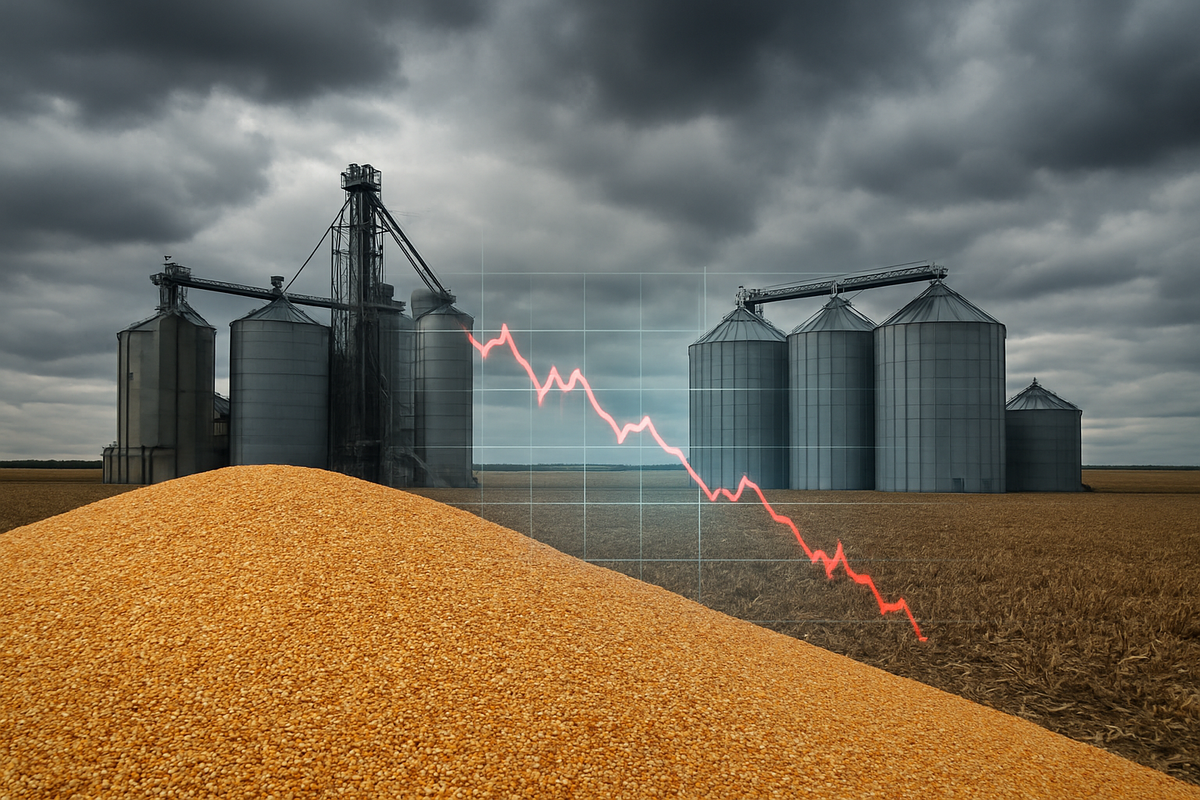
The agricultural world is still reeling from the "major shock" delivered by the U.S. Department of Agriculture (USDA) in its January 2026 Crop Production report. Released earlier this month, the data confirmed what many feared but few expected: a massive supply glut that has fundamentally reset the price floor for the 2026 trading year. By reporting a record-breaking national yield of 186.5 bushels per acre and a total production of 17.021 billion bushels, the USDA has effectively ended any lingering hopes for a supply-driven price rally in the near term.
The immediate implications for the market have been nothing short of devastating for grain producers. Following the report's release on January 12, 2026, corn futures on the CME Group Inc. (NASDAQ: CME) plummeted over 5%, with the March contract settling near $4.21 per bushel—a level that places significant financial strain on Midwestern farmers whose break-even costs have risen alongside inflation. As we close out January, the market remains gripped by a "paradox of plenty," where historic productivity has led to a burdensome surplus that is currently weighing down the entire agricultural sector.
The January Surprise: A Deep Dive into the Record Numbers
The path to this record-shattering report began during the 2025 growing season, which defied expectations of late-summer heat damage. As the combines rolled through the Corn Belt, early harvest reports hinted at high yields, but the final numbers released this January exceeded even the most aggressive trade estimates. The jump to 186.5 bushels per acre represents a monumental leap in agricultural productivity, driven by advancements in precision agriculture and favorable late-season weather that perfectly timed the grain-fill period.
This record yield pushed total U.S. production to an unprecedented 17.021 billion bushels, marking the first time the country has ever cleared the 17-billion-bushel threshold. The supply pressure was further compounded by the USDA’s December 1 Grain Stocks report, which revealed a staggering 13.3 billion bushels currently in storage. This massive overhang indicates that farmers have been aggressively holding grain, hoping for better pricing that may now never materialize.
The market’s initial reaction was a "bearish wall" that left traders scrambling. On the day of the release, the supply avalanche triggered a 5.38% drop in March corn futures. Stakeholders ranging from commodity hedge funds to local co-op elevators were blindsided by the upward revision in ending stocks, which rose to 2.227 billion bushels—the highest level in seven years. This "carryover" stock ensures that even if the 2026 planting season faces minor weather issues, the market will remain well-supplied for the foreseeable future.
Corporate Winners and Losers in a Low-Price Environment
In the wake of this supply surge, the financial landscape for public companies in the agricultural space has fractured into distinct groups of winners and losers. Among the primary beneficiaries is Tyson Foods, Inc. (NYSE: TSN). As one of the world's largest meat processors, Tyson stands to gain significantly from record-low input costs. Lower corn prices translate directly into cheaper feed for poultry and pork segments, providing a much-needed boost to margins that had been squeezed by labor costs and logistical hurdles in previous years.
Similarly, Bunge Global SA (NYSE: BG) has navigated the volatility with remarkable success. Following its recent merger with Viterra, Bunge has leveraged its expanded global footprint to move massive volumes of grain. Even when prices are low, the sheer volume of 17 billion bushels of corn moving through the global supply chain generates substantial origination and transportation fees. Bunge’s stock hit a 52-week high in mid-January as investors bet on the company’s ability to thrive in a "high-volume, low-margin" environment.
Conversely, the equipment and input sectors are facing a difficult road ahead. Deere & Co (NYSE: DE) has already signaled a cautious outlook for 2026, with net income projections falling toward $4 billion. With corn prices languishing, farmers are increasingly likely to defer purchases of new tractors and combines, opting instead to maintain existing fleets. Archer-Daniels-Midland Co (NYSE: ADM) is also under pressure; while it benefits from high volumes, the company is facing tighter oilseed crush margins and has recently announced a $750 million cost-cutting initiative to weather the stagnation caused by the supply glut.
Industry Significance and the "Paradox of Plenty"
This event marks a significant turning point in the broader agricultural industry, highlighting the "paradox of plenty." For years, the industry focused on "feeding the world" through technological innovation and yield optimization. Now, the success of those efforts has created a structural surplus that threatens the financial viability of the very producers who achieved it. The rise in the stocks-to-use ratio to 13.6%—the highest since 2018—suggests that the market is entering a "buyer's market" cycle that could last for several years.
Historically, periods of extreme surplus like this have led to major policy shifts. We may see a renewed push for higher ethanol mandates or an expansion of the Sustainable Aviation Fuel (SAF) industry to absorb the excess corn. Companies like CF Industries Holdings, Inc. (NYSE: CF) are already positioning themselves for this shift, partnering with ethanol producers on low-carbon ammonia projects to capitalize on the growing demand for green fuels. This report likely accelerates the transition of corn from primarily a food and feed source to a critical industrial feedstock.
Furthermore, the ripple effects are being felt globally. With U.S. corn priced so competitively, major competitors like Brazil and Argentina may find themselves squeezed out of key export markets. This could lead to trade tensions or a shift in planting intentions globally as the world adjusts to a U.S. "super-crop."
Looking Ahead: Strategic Pivots and Market Recovery
In the short term, the market will be looking for a "demand spark" to clear the 2.227 billion bushels of ending stocks. This could come in the form of a surge in Chinese export orders or a domestic push for increased livestock production. However, until that demand materializes, the $4.00 to $4.30 per bushel range for corn may become the new reality. Farmers will need to pivot their strategies toward aggressive cost management and potentially diversify their 2026 acreage into other crops like soybeans or specialty grains if the price ratio favors them.
Longer term, the 17-billion-bushel harvest of 2026 will likely be remembered as the moment when "Big Data" and precision farming truly hit their stride. The challenge now for the industry is no longer productivity, but demand creation. We should watch for increased M&A activity in the mid-stream and downstream sectors as companies look to consolidate and find new ways to utilize this massive resource. The focus for investors will shift toward companies that can innovate in the "bio-economy" space, converting surplus carbohydrates into high-value chemicals and fuels.
A New Era for the Corn Market
The January 2026 USDA report has fundamentally reshaped the agricultural landscape. By confirming a record yield of 186.5 bushels per acre and a burdensome 2.227 billion bushels in ending stocks, the government has set the stage for a period of low prices and high volatility. While this is a windfall for consumers and livestock producers like Tyson Foods, it presents a stark challenge for the American farmer and equipment giants like John Deere.
Moving forward, the market is no longer wondering if we can grow enough to feed the world—it is wondering what to do with the surplus. Investors should keep a close eye on export numbers and any movement in energy policy that could increase domestic corn consumption. As we move deeper into 2026, the theme of the year will undoubtedly be "utilization." The corn is in the bins; now the world just has to find a way to use it.
This content is intended for informational purposes only and is not financial advice.