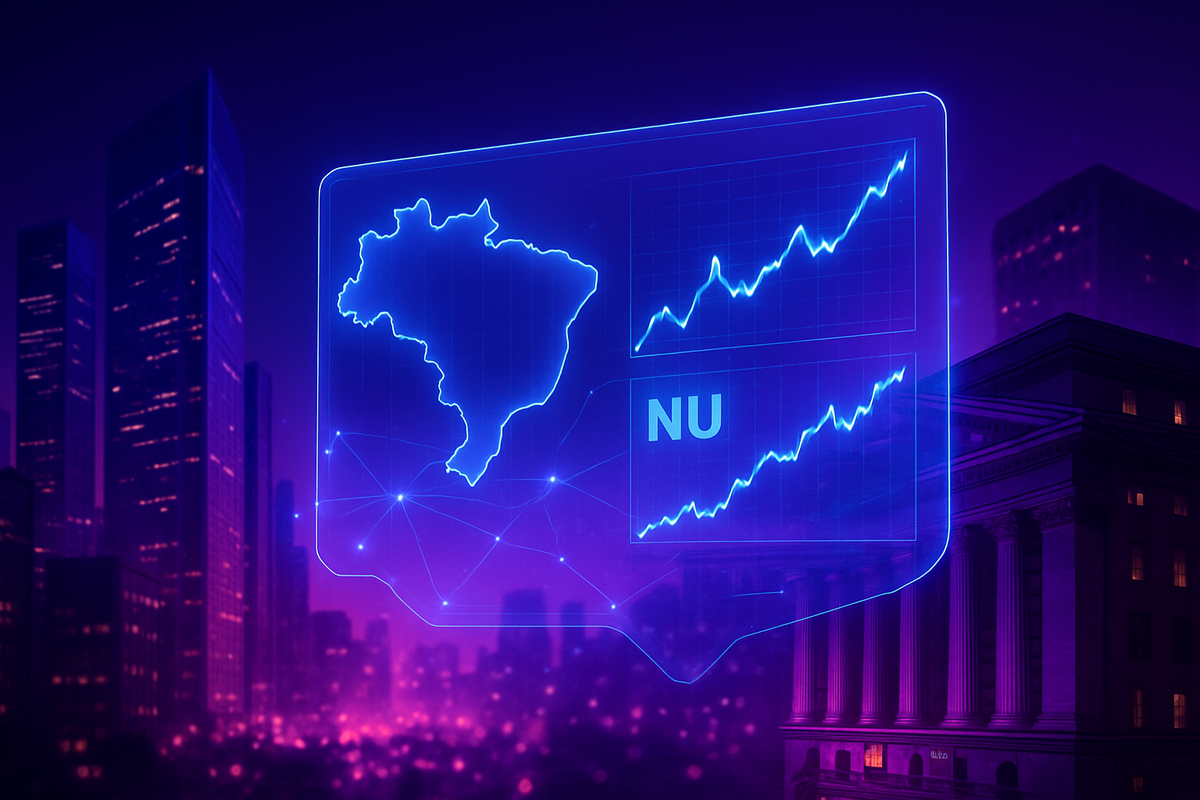
As of late January 2026, a seismic shift in the global financial hierarchy has reached a fever pitch. On the New York Stock Exchange, a new generation of Latin American financial institutions is no longer just "disrupting" the status quo—they are redefining it. Leading this charge is Nu Holdings (NYSE: NU), the parent company of digital banking titan Nubank, which has officially cemented its status as one of the world's most valuable financial institutions. With a market capitalization hovering near $81 billion, Nubank has achieved a historic "valuation parity" with traditional incumbents, signaling that the era of digital-first dominance in emerging markets is no longer a forecast, but a realized reality.
The surge in interest is not limited to fintech upstarts. US institutional investors, fueled by a pivot in domestic monetary policy and a search for high-alpha growth, have aggressively increased their exposure to the Brazilian banking sector. This "Brazilian Renaissance" on the NYSE has transformed once-overlooked tickers into the crown jewels of emerging market portfolios. From the high-yielding dividends of traditional giants to the hyper-growth metrics of digital neobanks, the migration of capital to South America reflects a growing consensus: Brazil has become the global laboratory for the future of retail banking.
The Ascent to $81 Billion: A Timeline of Disruption
The current frenzy surrounding Nu Holdings is the result of a meticulously executed three-year expansion plan that culminated in a blockbuster 2025 performance. By the end of Q3 2025, Nubank reported record-breaking quarterly revenue of $4.2 billion—a staggering 39% increase year-over-year. More importantly for the skeptical eyes of Wall Street, the company proved its profitability was not a fluke, posting a net income of $783 million for the same period and an annualized Return on Equity (ROE) of 31%. This profitability, achieved while maintaining a "cost to serve" below $0.80 per customer, has made it the gold standard for efficiency in the global banking sector.
The journey to this milestone was paved by aggressive diversification. While Brazil remains its fortress with over 107 million customers—covering more than 60% of the country’s adult population—the real catalyst for the recent stock rally has been the "Mexican Miracle." Throughout 2025, Nubank’s expansion into Mexico saw exponential growth, reaching 13 million customers by early 2026. This was mirrored by a rapid ascent in Colombia, which has grown even faster than the Mexican market in its initial stages. Key stakeholders, including long-term backers like Berkshire Hathaway, have seen their patience rewarded as the company successfully transitioned from a "purple credit card" provider into a multi-product ecosystem offering insurance, investments, and even telecommunications services.
Initial market reactions to this growth were cautious in early 2024, but by the mid-2025 "SELIC pivot"—where Brazilian interest rates began to stabilize alongside a softening US dollar—the floodgates opened. US investors, seeking to escape the low-yield environment of a cooling domestic economy, began utilizing "carry trades" to capitalize on the high interest rates in Brazil while betting on the capital appreciation of its tech-forward banks.
The Winners and Losers of the Digital Convergence
In this high-stakes reshuffling, the "winners" circle extends beyond just the digital natives. Itaú Unibanco (NYSE: ITUB), the largest bank in Latin America by assets, has proven remarkably resilient. By launching its "One Itaú" super-app in 2025 and closing hundreds of physical branches to boost its efficiency ratio, Itaú has maintained a robust ROE of 23%. Investors have treated ITUB as a "stability play," valuing its massive capital base and deep corporate ties even as it fights for retail market share against Nubank.
Conversely, Banco Bradesco (NYSE: BBD) emerged as the "recovery darling" of 2025. After a difficult 2023 marred by credit quality issues, Bradesco’s stock soared 77% over the last year. By 2026, it has doubled its dividend payouts, attracting value investors who see it as a high-yield play in a stabilizing credit environment. However, the "losers" in this environment are the secondary fintechs that failed to achieve sufficient scale. Companies like PagSeguro (NYSE: PAGS) and StoneCo (NYSE: STNE), while still profitable and dominating the small-business merchant space, have been relegated to "value utility" status. They have largely lost the battle for the "mass consumer" wallet to the duopoly of Nubank and Mercado Pago, the fintech arm of MercadoLibre (NASDAQ: MELI), which ended 2025 with 72 million active users and an $11 billion credit portfolio.
A Blueprint for Global Emerging Markets
The wider significance of this trend cannot be overstated. The rise of Brazilian banks on the NYSE fits into a broader global narrative of "Digital Arbitrage." Investors are betting that the digital transformation of the 200 million-strong Brazilian population (and the broader Latin American region) provides a higher growth ceiling than the mature, saturated banking markets of the US or Europe. This shift is further bolstered by "nearshoring"—the relocation of US supply chains to Mexico—which has turned Latin American banks into the "picks and shovels" play for the region's industrial boom.
Historically, this era resembles the rapid scaling of Asian "Super Apps" in the mid-2010s, but with a crucial difference: Brazilian regulators have been pioneers in fostering competition. The Central Bank of Brazil’s "Pix" instant-payment system and its "Open Finance" framework have acted as catalysts, lowering the barriers to entry and allowing companies like Nu Holdings to scale without the heavy infrastructure costs of the past. This regulatory environment has created a blueprint that other emerging markets are now attempting to replicate.
The Horizon: AI-Agentic Banking and the Mexican Frontier
Looking ahead to the remainder of 2026 and into 2027, the focus will shift from "customer acquisition" to "AI-driven monetization." The next strategic pivot for Nu Holdings and its peers is the integration of "agentic banking"—using artificial intelligence to act as a proactive financial concierge for users. This technology is expected to automate personal finance for millions, managing everything from automated debt refinancing to optimized investment portfolios, further driving up the Average Revenue Per Active Customer (ARPAC), which already crossed $13.40 in late 2025.
In the short term, the market will be hyper-focused on the "Mexico battle." As Nubank and Mercado Pago fight for dominance in a market that remains heavily reliant on cash, the winner will likely dictate the next leg of the sector's valuation growth. Challenges remain, including potential regulatory pushback as these "neobanks" become "too big to fail" and the inherent volatility of Latin American politics. However, the primary scenario for 2026 remains one of consolidation and continued capital inflow from the North.
Investor Takeaway: A Permanent Shift in the Financial Guard
The rise of Nu Holdings and the revitalization of traditional Brazilian giants on the NYSE represent a permanent shift in the global financial guard. The key takeaway for 2026 is that the "fintech" label is officially dead; these are simply "banks" that happen to have better technology and lower costs than their predecessors. The market is moving toward a future where "valuation parity" between digital upstarts and 100-year-old incumbents is the baseline.
Investors should watch for three things in the coming months: the pace of credit expansion in Mexico, any signs of cooling in Brazil's consumer spending, and the potential for a fresh wave of M&A as the "Value Winners" like StoneCo or PagSeguro become attractive targets for larger players looking to consolidate the SME market. For now, the spotlight remains firmly on Brazil, where the banking revolution is being televised—and traded—in real-time on Wall Street.
This content is intended for informational purposes only and is not financial advice.