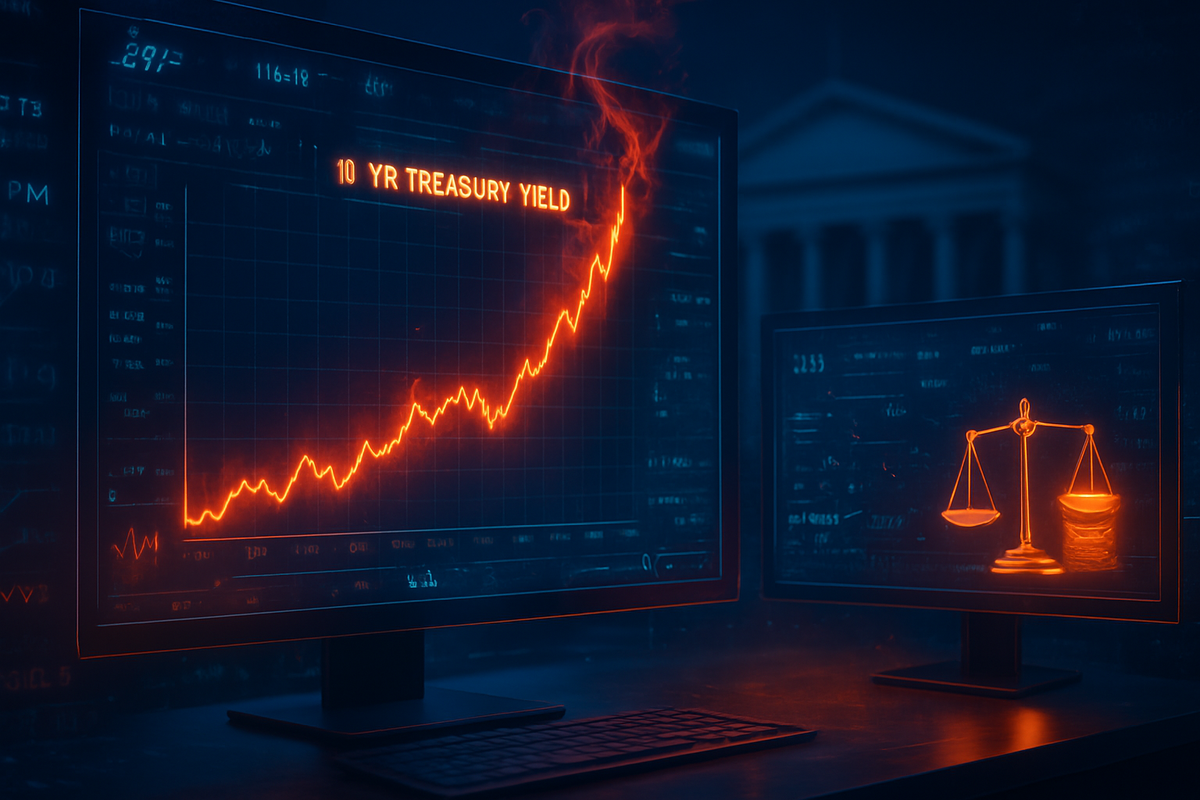
The new year has arrived with a jolt for the fixed-income markets, as a massive sell-off in U.S. Treasury bonds sent yields surging to their highest levels in months. As of January 2, 2026, the benchmark 10-year Treasury yield has spiked toward 4.35%, a sharp climb from the 4.14% level seen just weeks ago at the close of 2025. This sudden "yield shock" is being fueled by a combination of resilient labor market data and growing concerns over the long-term fiscal trajectory of the United States, effectively dampening investor hopes for a series of aggressive interest rate cuts by the Federal Reserve in the coming months.
The immediate implications are being felt across the global financial landscape. As bond prices fall—moving inversely to yields—investors are repricing risk across all asset classes. The "higher-for-longer" narrative, which many hoped had been retired in late 2025, has returned with a vengeance. Markets are now grappling with the reality that the Federal Reserve may remain on hold for much of the first half of 2026, as a "perfect storm" of fiscal stimulus and leadership transitions at the central bank creates a volatile environment for debt and equity alike.
The Return of the Bond Vigilantes
The primary catalyst for this early 2026 rout is the market’s delayed reaction to the fiscal path set by the "One Big Beautiful Bill Act" (OBBBA), which was signed into law in mid-2025. While the bill introduced popular tax deductions and extended previous cuts, it has significantly widened the federal deficit. "Bond vigilantes"—investors who sell bonds to protest inflationary fiscal policies—have re-emerged, demanding higher premiums to hold long-term U.S. debt. They fear that the massive fiscal injection will keep consumer demand sticky and inflation hovering near the 3% mark, well above the Fed's 2% target.
Timeline-wise, the sell-off began in the final trading sessions of December and accelerated as the calendar turned to 2026. Initial market reactions were exacerbated by reports of increased long-term debt issuance from the Treasury Department to fund the OBBBA’s provisions. This surge in supply, coupled with a lack of buyers at lower yields, created a vacuum that pushed the 10-year yield through key technical resistance levels. Stakeholders, from institutional pension funds to retail bondholders, are now reassessing their portfolios as the risk-free rate of return undergoes a rapid upward adjustment.
The labor market is the other half of this equation. While some indicators suggest a cooling economy—with the unemployment rate creeping up to 4.6%—the most recent jobless claims data remains historically low at 199,000. This "low-hire, low-fire" paradox suggests that the labor market is not "cracking" as many had feared. For the Federal Reserve, this resilience provides the necessary cover to maintain restrictive rates. Market participants are now bracing for the official December Employment Situation report due on January 9, which many expect will confirm that the labor market is still too tight for the Fed to comfortably pivot to easing.
Winners and Losers in a High-Yield World
The banking sector is emerging as one of the few potential beneficiaries of this environment. Major financial institutions like JPMorgan Chase & Co. (NYSE: JPM) and Bank of America Corp. (NYSE: BAC) often see their net interest margins (NIM) expand when long-term yields rise. As the yield curve steepens, these banks can charge more for mortgages and commercial loans while keeping deposit rates relatively stable. Furthermore, investment banking divisions at JPM and BAC are anticipating a windfall from a projected $900 billion in corporate debt issuance in 2026, as technology firms rush to fund AI infrastructure before rates climb even higher.
Conversely, the technology and growth sectors are facing significant headwinds. Apple Inc. (NASDAQ: AAPL) and Tesla, Inc. (NASDAQ: TSLA) are particularly sensitive to rising yields because their high valuations are based on the present value of future cash flows, which are discounted more heavily when rates rise. Apple, with a P/E ratio near 36x, faces "multiple compression" as investors demand higher returns from equities to compete with the 4.3% "risk-free" return from Treasuries. Tesla faces an even steeper challenge; higher yields translate directly to higher auto loan rates, which could stifle demand for its electric vehicles just as the company ramps up capital expenditure for its "Optimus" robotics and "Robotaxi" initiatives.
The real estate sector is also under pressure, with Real Estate Investment Trusts (REITs) like Prologis, Inc. (NYSE: PLD) facing a dual threat. As "bond proxies," REITs typically see their share prices fall when Treasury yields rise. Prologis faces a $2.4 billion debt maturity wall in 2026, and the prospect of refinancing that debt at 4.5% instead of its current 3% average rate is weighing on its Funds From Operations (FFO). While PLD benefits from the structural demand for logistics space driven by the AI boom, the rising cost of capital remains a significant hurdle for the entire real estate industry.
A Shifting Policy Landscape and Historical Echoes
This event fits into a broader trend of "fiscal dominance," where government spending levels are beginning to dictate market conditions more than central bank policy. The 2026 bond sell-off bears striking similarities to the "Taper Tantrum" of 2013 and the "Bond Rout" of 1994, where sudden shifts in rate expectations led to violent market corrections. However, the current situation is complicated by the impending leadership change at the Federal Reserve. Fed Chair Jerome Powell is set to depart in May 2026, and the market is on edge regarding his successor.
The potential for a more politically influenced or "dovish" successor to Powell has introduced a "political risk premium" into bond yields. Investors are concerned that a new Chair might be less inclined to fight inflation aggressively, leading to higher long-term inflation expectations. This uncertainty is rippling through global markets, affecting currency valuations and international trade. Regulatory bodies are also watching closely, as the higher rate environment could expose vulnerabilities in the commercial real estate sector, where nearly $1 trillion in debt is set to mature this year.
Historically, periods of high fiscal deficits combined with a resilient labor market have forced the Fed into a "higher-for-longer" stance that eventually leads to a "hard landing." While the current administration argues that the OBBBA will drive long-term productivity, the immediate market reaction suggests that the "bond vigilantes" are not yet convinced. The ripple effects are being felt by competitors and partners of the major tech and bank players, as the cost of capital becomes the defining metric for corporate success in 2026.
The Path Ahead: Scenarios for 2026
In the short term, all eyes are on the Federal Open Market Committee (FOMC) meeting scheduled for January 27-28. The probability of a rate cut at this meeting has plummeted to just 15%, according to the CME FedWatch Tool. Most analysts now expect the Fed to hold steady, using the meeting to signal a "wait-and-see" approach. The announcement of the next Fed Chair nominee, expected later this month, will likely be the next major volatility event. A nominee perceived as a "hawk" could stabilize the bond market, while a "dove" might trigger further selling as inflation fears mount.
Longer-term, corporations will need to engage in strategic pivots to adapt to a 4%+ yield environment. We may see a slowdown in share buybacks as companies like Apple prioritize debt repayment or internal investment over returning capital to shareholders. For Tesla, the challenge will be maintaining its growth trajectory in a high-rate environment, potentially requiring a more conservative approach to its ambitious robotics timeline. Market opportunities may emerge in "value" sectors that have been neglected during the low-rate era, such as energy and basic materials, which tend to perform better during periods of sticky inflation.
The most likely scenario for the remainder of 2026 is a "slow-motion" easing cycle. Consensus forecasts from firms like Goldman Sachs suggest only two to three quarter-point cuts for the entire year, bringing the federal funds rate to a terminal range of 3.00%–3.25%. This is a far cry from the aggressive cuts many had priced in just months ago. Investors should be prepared for continued volatility as the market adjusts to this "new normal" of higher rates and persistent fiscal expansion.
Summary and Investor Outlook
The start of 2026 has served as a wake-up call for an overly optimistic market. The surge in Treasury yields to 4.35% reflects a complex interplay of fiscal stimulus, labor market resilience, and central bank uncertainty. Key takeaways include the re-emergence of the "bond vigilantes," the divergent fortunes of the banking and tech sectors, and the looming shadow of the Federal Reserve leadership transition. While banks like JPM and BAC may find a silver lining in higher margins, tech giants like AAPL and TSLA must navigate a more restrictive financial landscape.
Moving forward, the market will likely remain in a state of flux until there is more clarity on the Fed’s new leadership and the actual inflationary impact of the OBBBA. The "higher-for-longer" theme is no longer a ghost of the past but a defining characteristic of the 2026 economic outlook. Investors should watch for the January 9 jobs report and the Fed Chair nomination as the next critical signposts for market direction. In this environment, quality, cash flow, and balance sheet strength will be the primary drivers of outperformance.
This content is intended for informational purposes only and is not financial advice