
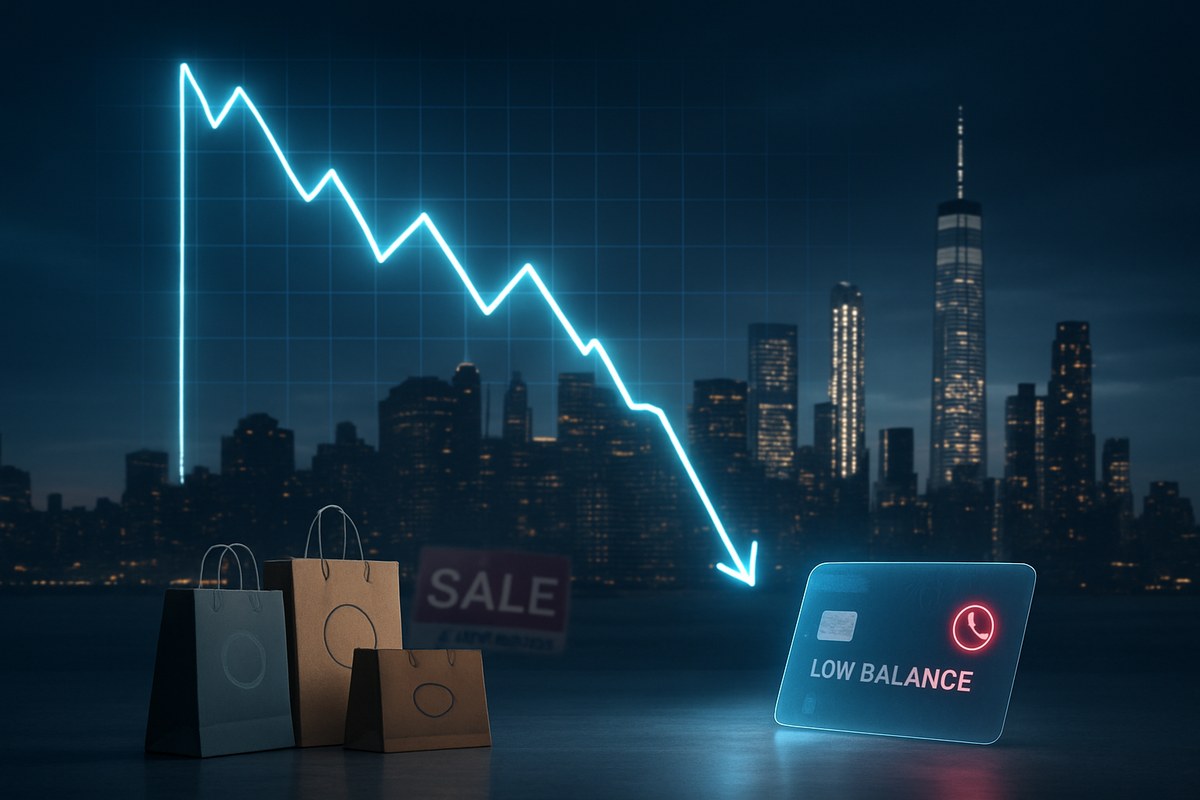
WASHINGTON D.C. — As the calendar flips to 2026, the American economic engine is showing signs of a significant and unexpected sputter. While top-line growth figures initially suggested a resilient recovery following the federal government shutdown of late 2025, a deeper dive into recent Bureau of Economic Analysis (BEA) data reveals a troubling "downward revision" in the underlying health of the U.S. consumer. A surprising contraction in retail sales during the critical December holiday window, coupled with a massive gap between production and income, has sparked fears that the U.S. economy may be entering a period of prolonged stagnation or "stagflation" in early 2026.
The immediate implications are stark: the consumer, who has been the bedrock of post-pandemic growth, appears to be finally succumbing to the "double squeeze" of sticky inflation and new trade protectionism. With the personal saving rate falling to 4.2% and a historic downward revision of 911,000 jobs to previous labor counts, the "wealth effect" that fueled 2025’s mid-year rally has largely evaporated. Market analysts are now scrambling to adjust 2026 GDP forecasts, with many lowering expectations to a meager 1.6% as the "spending hangover" from a debt-fueled holiday season begins to set in.
A Statistical Mirage: The Q3 GDP vs. GDI Divide
The current economic anxiety stems from a delayed BEA report released on December 23, 2025. Due to a 43-day federal government shutdown that paralyzed data collection from October to mid-November, the "initial estimate" for Q3 2025 GDP arrived much later than usual. While the headline figure of 4.3% annual growth initially cheered markets, the joy was short-lived. Economists quickly pointed to a massive discrepancy: Real Gross Domestic Income (GDI) grew by only 2.4%. Historically, when GDP (what we produce) significantly outpaces GDI (what we earn), the GDP figure is almost always revised downward to meet the lower income reality.
The timeline leading to this moment was marked by extreme volatility. After a robust Q2 2025 where GDP was revised upward to 3.8%, the government shutdown created a "data vacuum." During this period, the implementation of "Liberation Day" tariffs began to ripple through supply chains, driving up the costs of imported electronics and apparel. By the time the government reopened in mid-November, the damage was evident in the high-frequency data. Initial market reactions were muted by the holiday spirit, but the "January 1 Reality Check" has been harsh, as late-December retail data showed a 0.1% contraction in the control group sales—the weakest performance in nearly a year.
Winners and Losers in the K-Shaped Chill
The surprising reduction in consumer spending has not hit all players equally, reinforcing a "K-shaped" economic divide. Among the primary losers is Target Corp. (NYSE: TGT), which recently reported a nearly 20% drop in quarterly profit. Management warned that middle-income shoppers are facing an "affordability crisis," abandoning discretionary categories like home décor in favor of absolute essentials. Similarly, home improvement giants like The Home Depot (NYSE: HD) and Lowe's Companies (NYSE: LOW) have signaled a "stalled demand" for big-ticket renovations as high interest rates and economic uncertainty lead homeowners to delay non-essential projects. Even Kohl’s Corp. (NYSE: KSS) has struggled, reporting a 5% revenue decline as its core demographic trades down to deeper discount options.
Conversely, the "trade-down" effect has created clear winners. The TJX Companies (NYSE: TJX) has seen exceptional traffic as consumers hunt for designer brands at off-price rates. Dollar General (NYSE: DG) has also raised its 2026 guidance, noting a surprising influx of high-income households (earning over $100,000) seeking to stretch their monthly budgets. Meanwhile, tech giants like Amazon.com, Inc. (NASDAQ: AMZN) remain resilient, not because of e-commerce—which saw a 4.4% unit volume drop during Cyber Week—but because of high-margin cloud and advertising segments. Similarly, Apple Inc. (NASDAQ: AAPL) is leaning into its "Apple Intelligence" subscription models to provide a floor for earnings even as hardware replacement cycles lengthen. Walmart Inc. (NYSE: WMT) occupies a middle ground; while it continues to gain market share, it issued a cautious 2026 outlook, citing tariff-related margin pressure and a "spending hangover."
The Wider Significance: Tariffs, Debt, and the Fed's Dilemma
This downward revision is more than just a statistical quirk; it represents a fundamental shift in the global economic order. The introduction of broad-based tariffs has kept the Personal Consumption Expenditures (PCE) price index stuck at 2.9%, well above the Federal Reserve's 2% target. This "sticky inflation" prevents the Fed from aggressively cutting rates to stimulate the cooling economy. The situation mirrors the "stagflation" episodes of the 1970s, where stagnant growth and high prices created a policy trap for central bankers.
Furthermore, the "surprising" drop in holiday spending highlights a growing debt crisis. Much of the 2025 spending was fueled by "Buy Now, Pay Later" (BNPL) services, which have reached record levels. As these balances come due in early 2026, the ripple effect on consumer liquidity could be devastating for retailers. This event fits into a broader trend of "protectionist drag," where the benefits of domestic manufacturing incentives are being offset by the immediate costs of trade barriers, leading to a "hollowing out" of the middle-market retail sector.
What Comes Next: The Q2 2026 "Debt Cliff"
In the short term, all eyes are on the BEA’s "Updated Estimate" scheduled for January 22, 2026. Most analysts expect a significant downward revision to the Q3 headline number, potentially bringing it closer to the 2.4% GDI figure. This could trigger a strategic pivot for many consumer-facing companies, moving away from growth-oriented investments toward cost-cutting and "Agentic Commerce"—using AI to lock in consumers through automated subscription models and inventory management.
The long-term concern is the "Q2 2026 cliff." As the BNPL debt from the 2025 holiday season matures and the full weight of the 911,000-job downward labor revision hits consumer confidence, the risk of a technical recession in the first half of 2026 is rising. Market opportunities may emerge in defensive sectors like utilities and consumer staples, but the discretionary retail sector faces a period of painful consolidation. Investors should watch for whether the Federal Reserve prioritizes growth or inflation in its March 2026 meeting, as that decision will define the market's trajectory for the rest of the year.
Summary and Investor Outlook
The downward revision of US GDP data and the surprising contraction in consumer spending mark a pivotal moment for the 2026 economy. The "GDP Mirage" of late 2025 has been unmasked, revealing a consumer base that is over-leveraged, under-employed relative to previous estimates, and squeezed by persistent inflation. The primary takeaway is that the "resilient consumer" narrative is officially dead; in its place is a cautious, value-driven shopper who is forcing a massive realignment in the retail and tech sectors.
Moving forward, the market is likely to remain volatile as it digests the "true" growth rate of the U.S. economy. Investors should prioritize companies with strong balance sheets and high-margin service revenue—like Amazon and Apple—over those reliant on discretionary physical goods. The coming months will be a test of whether the U.S. can navigate a "soft landing" amidst trade wars and debt cycles, or if the early 2026 slowdown is the precursor to a more significant economic contraction.
This content is intended for informational purposes only and is not financial advice