
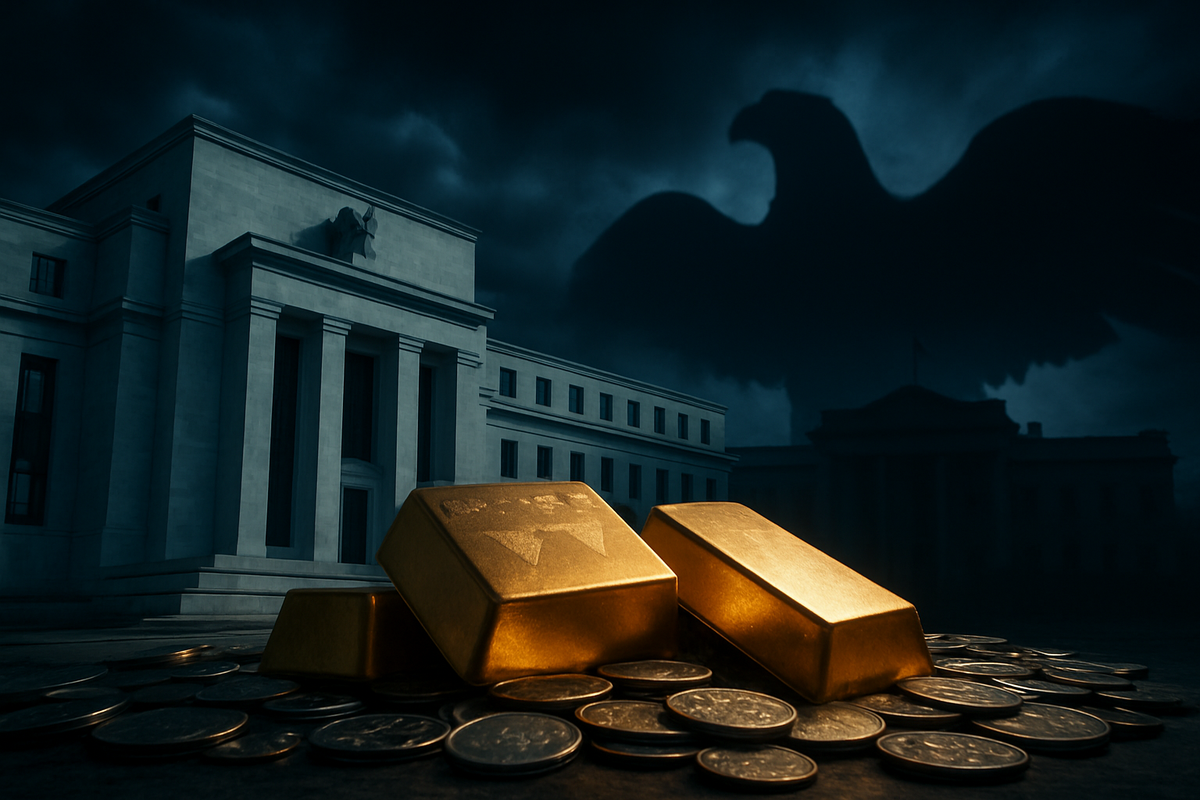
In a week that has shaken the foundations of American monetary policy, President Donald Trump has adopted a surprisingly restrained tone toward Federal Reserve Chair Jerome Powell, temporarily cooling a historic surge in precious metals. The shift comes just days after the Department of Justice (DOJ) launched an unprecedented criminal investigation into the Fed Chair, an event that sent gold and silver to all-time highs as investors braced for a full-scale constitutional crisis. While Trump’s recent comments—stating he has "no plans to fire" Powell—have provided a reprieve for the U.S. dollar, the underlying tension continues to reshape the global financial landscape.
The immediate relief in the markets masks a deeper, more permanent shift in investor sentiment. As of January 15, 2026, the traditional view of the Federal Reserve as an insulated, apolitical entity is under its greatest stress in decades. For precious metals, this political theater has transformed bullion from a simple inflation hedge into what analysts are calling the "ultimate neutral reserve asset," a status reinforced by central banks worldwide who are increasingly wary of the political volatility tethered to the Greenback.
The Investigation and the Pivot: A Timeline of Turmoil
The current crisis ignited on Friday, January 9, 2026, when grand jury subpoenas were served to the Federal Reserve's Board of Governors. The DOJ, under the direction of U.S. Attorney Jeanine Pirro, is investigating whether Jerome Powell misled Congress during June 2025 testimony regarding a $2.5 billion renovation of the Fed’s Washington D.C. headquarters. The project, which allegedly spiraled $600 million over budget, has been characterized by the administration as a symbol of "bureaucratic waste," while Powell has denounced the probe as a "pretext" for political intimidation.
In a defiant video statement released on Sunday, January 11, Powell defended the central bank’s independence, asserting that the investigation was an attempt to force aggressive interest rate cuts. The market reaction was swift and violent. By Monday morning, spot gold had shattered previous records, peaking at $4,642.72 per ounce, while silver rocketed toward $93.57 per ounce. The "safe-haven" trade was no longer about inflation; it was a flight from the risk of a compromised central bank.
However, the atmosphere shifted on January 14, 2026. During a speech in Detroit, President Trump softened his rhetoric, backing away from earlier calls to immediately remove Powell. "He's under investigation, we'll see what happens, but I’m not looking to fire him today," Trump told reporters. This subtle pivot—likely aimed at stabilizing a wavering stock market—triggered a sharp pullback in metals. Today, January 15, gold has retreated to approximately $4,594.66, while silver has corrected to $87.88, as the immediate threat of a leadership vacuum at the Fed appears to have subsided.
Market Winners and the Institutional Squeeze
The volatility of early 2026 has created a distinct set of winners in the equities market, particularly among the "Big Miners." Newmont Corporation (NYSE: NEM) has seen its shares trade at record levels near $114, as its massive operational scale allows it to capture the highest margins in its history. Similarly, Barrick Gold (NYSE: GOLD) has surged over 180% from its 2024 lows, with analysts suggesting the stock remains fundamentally undervalued even at current metal prices. Streaming giant Wheaton Precious Metals (NYSE: WPM) has also hit all-time highs, benefiting from high-margin silver contracts that are now yielding record cash flows.
Conversely, the banking sector is grappling with a fractured reality. While JPMorgan Chase (NYSE: JPM) and Goldman Sachs (NYSE: GS) reported robust Q4 2025 earnings driven by a "trading boom" in volatile metal and FX markets, their stock prices have struggled to sustain gains. Investors are increasingly concerned about the broader economic implications of a politicized Fed.
More concerning are the "institutional shorts." Banks like Bank of America (NYSE: BAC) and Citigroup (NYSE: C) have faced intense pressure due to rumored massive "paper" short positions in the silver market. As silver prices spiked earlier this week, these institutions were reportedly forced into a "short-covering panic," which only added fuel to the rally. While the January 15 pullback offers these banks some breathing room, the cost of maintaining these positions in a high-volatility environment remains a significant drag on their balance sheets.
The New Monetary Order: Gold as the Neutral Reserve
The broader significance of the Trump-Powell clash extends far beyond the Beltway. In a historic milestone reached this month, gold has officially overtaken U.S. Treasuries as the world’s largest foreign reserve asset by value, totaling roughly $4 trillion. This shift represents a fundamental "de-dollarization" strategy by central banks in China, Russia, Turkey, and India. These nations are no longer viewing gold as a mere commodity, but as a "neutral reserve asset" that is immune to U.S. domestic political cycles or the "weaponization" of the financial system.
This trend has been exacerbated by external factors, most notably China’s decision on January 1, 2026, to implement strict export licensing for silver. By choking off 60% of the global supply of a metal essential for the green energy transition and AI hardware, Beijing has weaponized "real assets" in response to U.S. financial pressure. This move, combined with the DOJ’s pressure on the Fed, has convinced many global macro funds that the "neutrality" of the U.S. dollar is a thing of the past.
The regulatory implications are also profound. If the DOJ investigation successfully creates a path for the Executive Branch to exert more direct control over interest rate decisions, the "Fed Premium"—the trust that kept the dollar stable for decades—may vanish permanently. Historical comparisons are being drawn to the 1970s, but with a modern twist: the current crisis is not just about policy errors, but about the very structure of the institutions that govern money.
Looking Ahead: The Battle for the Fed's Soul
The short-term outlook depends heavily on the next steps of the DOJ investigation and Jerome Powell’s response. Powell’s term as Chair officially ends in May 2026, though his term as a Governor continues until 2028. If the administration continues its "softer tone," we may see a period of consolidation in precious metals as the market waits for a formal successor to be named. However, any sign that the DOJ is moving toward an actual indictment would likely reignite the rally in gold and silver, potentially pushing them to psychological barriers of $5,000 and $100, respectively.
Strategic pivots are already underway in the private sector. Major corporations are reportedly increasing their physical bullion holdings to hedge against potential currency volatility. We are entering an era where "monetary independence" is no longer a given, and market participants must adapt to a world where the Federal Reserve is a political actor rather than a neutral referee. The emergence of a "bifurcated" global reserve system—one based on the Dollar and the other on a basket of "neutral" commodities—is no longer a fringe theory; it is becoming the baseline scenario for 2027 and beyond.
Wrap-Up: What Investors Should Watch
The events of early January 2026 have fundamentally altered the risk calculus for global investors. While President Trump’s recent moderation has taken the "top" off the immediate panic, the underlying erosion of Federal Reserve independence remains the primary driver for long-term precious metals demand. The key takeaway is that gold and silver have decoupled from traditional metrics like real yields and are now trading as proxies for "institutional trust."
Moving forward, the market will be hyper-sensitive to any news regarding the DOJ’s grand jury findings and the selection process for the next Fed Chair. Investors should also keep a close eye on the physical silver market, where supply remains critically tight following China's export restrictions. As the "ultimate neutral reserve asset," gold is likely to remain in a long-term bull market so long as the political future of the American central bank remains in question.
In the coming months, watch for the Q1 earnings reports of the major miners and the "stress tests" of the big banks' short positions. The "softening" of the political tone may be a welcome reprieve, but in the halls of the Federal Reserve and the vaults of central banks worldwide, the alarm bells are still ringing.
This content is intended for informational purposes only and is not financial advice.