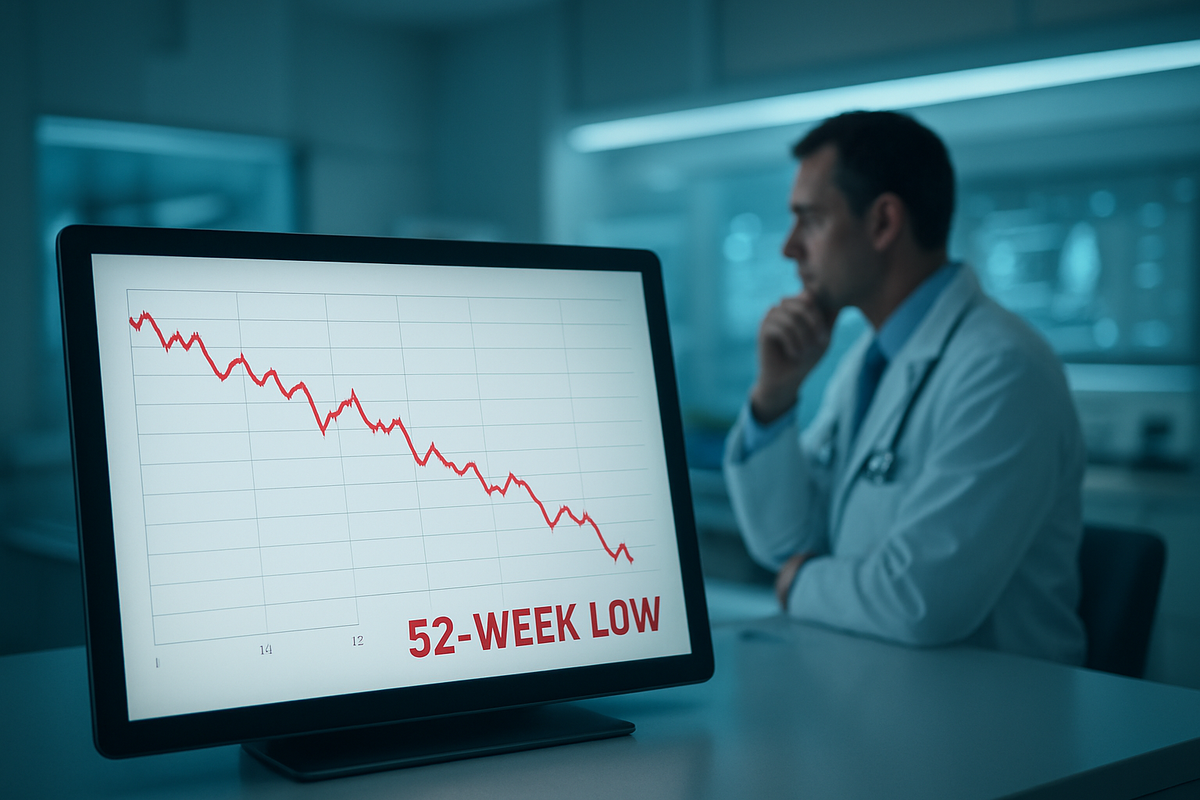
The digital health landscape faced a sobering milestone this week as shares of Doximity, Inc. (NYSE: DOCS), the leading professional network for physicians, plummeted to a new 52-week low. On January 12, 2026, the stock touched $43.21, marking a dramatic retreat from its February 2025 peak of $85.21. This decline reflects a broader recalibration within the healthcare technology sector, where the initial euphoria surrounding artificial intelligence (AI) has been tempered by the harsh realities of hospital budget constraints and shifting federal regulations.
The sell-off signals a pivot in investor sentiment from valuing "growth at all costs" to demanding sustainable, predictable returns. For Doximity, a company that once enjoyed a "bulletproof" reputation among healthcare SaaS providers, the slide to a 52-week low underscores the challenges of maintaining hyper-growth in a market increasingly crowded by Big Tech entrants and complicated by new Medicare reimbursement models.
The Descent from the Peak: A Timeline of Volatility
Doximity’s current valuation crisis is a stark contrast to its performance just one year ago. In early 2025, the company was the "AI darling" of the healthcare sector, with its stock price surging on the successful rollout of "DoxGPT" and its "AI Scribe" tool, which promised to eliminate the administrative burden of "pajama time" for doctors. However, the momentum began to stall in May 2025, following the release of the company’s fiscal year 2025 results. While the numbers beat estimates, management’s fiscal 2026 revenue guidance of $619 million to $631 million fell significantly short of Wall Street’s expectations, triggering a 17% single-day drop from which the stock never fully recovered.
The decline accelerated through the second half of 2025 as structural issues emerged. In late 2025, Doximity leadership cautioned that revenue recognition was being pulled forward due to early adoption of new AI products, leading to a "flatter" growth trajectory for the remainder of the fiscal year. This lack of sequential growth spooked institutional investors who had priced the stock for perfection. Furthermore, the implementation of stricter data-sharing policies by major platforms like Meta and Google in early 2025 forced Doximity’s core pharmaceutical advertising clients to reassess their digital spending, leading to a period of "market fluidity" that hampered Doximity’s high-margin marketing solutions.
By the time the markets opened in January 2026, a combination of tax-loss harvesting and a cautious outlook for the upcoming fiscal 2027 guidance pushed the stock to its current low. The market, once enamored with Doximity’s 60% EBITDA margins, has now shifted its focus to the company’s slowing top-line growth and the potential for margin compression as it invests heavily to defend its turf against generalist AI competitors.
Winners and Losers in the Digital Health Shakeout
The downturn for Doximity has created a ripple effect across the digital health ecosystem, distinguishing between those with "must-have" infrastructure and those with "nice-to-have" features. Veeva Systems (NYSE: VEEV) has emerged as a relative winner, maintaining a more stable trajectory with its 52-week low holding near $201.54. Investors have viewed Veeva’s transition to its "Vault CRM" and its expansion into R&D cloud solutions as a safer, more "blue-chip" bet compared to the volatility of Doximity’s advertising-heavy model.
Conversely, Teladoc Health (NYSE: TDOC) continues to be the primary loser in the sector's reorganization. Trading near a multi-year low of $6.35 in late 2025, Teladoc has struggled to find its footing despite a leadership change and a pivot toward "operational discipline." The decline in Doximity’s share price suggests that even the highest-quality names in the space are not immune to the sector-wide re-rating. Meanwhile, Phreesia (NYSE: PHR) has shown resilience by reaching profitability in late 2025, yet it remains vulnerable to the same advertising headwinds that have plagued Doximity, as pharmaceutical companies tighten their belts.
The ultimate winners may be the "Big Tech" giants, including OpenAI and Google, whose direct entry into healthcare AI tools has created a permanent valuation overhang for specialized platforms. As these companies offer generalized AI solutions that can be integrated into existing hospital workflows, specialized players like Doximity are forced to spend more on research and development to maintain their competitive edge, a dynamic that typically favors the player with the deepest pockets.
Wider Significance: Policy Shifts and AI Maturity
The decline of Doximity is not merely a story of one company’s stock performance; it is a bellwether for the "Year of ROI" in healthcare tech. By 2026, the industry has moved past the pilot phase of AI. Hospital administrators are now demanding clear evidence of return on investment before renewing high-priced software contracts. This shift has been exacerbated by the Centers for Medicare & Medicaid Services (CMS) and its launch of the Wasteful and Inappropriate Service Reduction (WISeR) Model in mid-2025. This policy change introduced AI-driven prior authorization rules that caused many hospital systems to pause their technology budgets as they reassessed reimbursement risks.
Furthermore, the broader regulatory environment is becoming more complex. While the Prescription Digital Therapeutics (PDT) Act has provided some tailwinds for software-based treatments, the tightening of health-data privacy rules has made the "monetization of the physician" more difficult. Doximity’s struggle to maintain its 52-week highs reflects a historical precedent seen in other SaaS sectors: once a market reaches a certain level of maturity and regulatory scrutiny, the "scarcity premium" for its leading stocks inevitably fades.
What Comes Next: Strategic Pivots and Market Scenarios
Looking ahead, Doximity must navigate a critical transition period. In the short term, the market will be laser-focused on the company’s initial fiscal year 2027 guidance, expected in mid-2026. To regain investor confidence, Doximity likely needs to demonstrate that its AI Scribe and DoxGPT tools are not just retaining users but driving incremental revenue that can offset the slowdown in traditional digital advertising. A strategic pivot toward more integrated clinical workflow tools—moving beyond just "social networking for doctors"—may be required to justify a higher valuation multiple.
Potential scenarios for the remainder of 2026 include a period of consolidation, where Doximity could become an attractive acquisition target for a larger healthcare conglomerate or a private equity firm looking to capitalize on its high cash flow and dominant market share among U.S. physicians. Alternatively, if the company can successfully navigate the CMS WISeR Model's implications and prove that its AI tools significantly reduce clinician burnout, a "relief rally" could be in the cards by the third quarter of 2026.
Wrap-Up: A New Chapter for Health-Tech Investors
The fall of Doximity (NYSE: DOCS) to a 52-week low is a defining moment for the digital health sector in 2026. It marks the end of the "AI honeymoon" and the beginning of a more disciplined era where fundamental metrics like sequential revenue growth and regulatory adaptability take center stage. For investors, the key takeaway is that even the most profitable and dominant platforms are subject to the gravity of macro-policy shifts and the relentless competition of the AI arms race.
Moving forward, the market will likely remain volatile as it digests the full impact of the CMS policy changes and the evolution of healthcare data privacy. Investors should keep a close watch on physician engagement metrics and the adoption rates of ambient scribing technologies. While Doximity remains a powerhouse with enviable margins, its journey back to its 2025 highs will require more than just technological innovation—it will require a clear demonstration of indispensable value in an increasingly cost-conscious healthcare economy.
This content is intended for informational purposes only and is not financial advice.