
HSINCHU, Taiwan, Aug. 11, 2026 (GLOBE NEWSWIRE) -- Calcium ions inside cells trigger a wide range of physiological responses, and cells must control their levels with precision to avoid excessive or insufficient flows. A research team led by Professor Yun-Wei Chiang (江昀緯) in the Department of Chemistry at National Tsing Hua University (NTHU) in Taiwan has found that calcium channels in the cell membrane are not simply "open" or "closed." Instead, two nanoscale molecular clasps control them — one determining when the channel opens, the other regulating how much calcium flows through. The findings were recently published in the Proceedings of the National Academy of Sciences (PNAS).
Calcium ions act as signaling molecules inside cells, Chiang explained, playing a role in stress responses, growth and survival. A calcium channel therefore functions much like the gates of a reservoir — controlling not only when it opens, but also how much flows through, to keep the cell running smoothly.
The team found that as the surrounding environment becomes more acidic, the attraction between positively and negatively charged regions inside the protein weakens, which loosens the "salt bridges" that act as molecular clasps and allows calcium to pass through. This is the first time a research team has shown how two salt bridges divide the work to import proteins into living cell membranes, proving that this mechanism indeed functions within a cellular environment.
Chiang chose BsYetJ, a membrane protein from the bacterium Bacillus subtilis, as a model because it is evolutionarily related to TMBIM, a family of six membrane proteins in human cells whose structures remain unsolved.
Chiang has studied BsYetJ for 12 years. In 2020, his team discovered that the protein adopts a different structure in a cell membrane than it does after being removed and crystallized. It took nearly six additional years to trace this structural difference back to the two key salt bridges identified in the current study.
To demonstrate that the two clasps indeed serve distinct functions, the team built its own single-channel current measurement system from scratch, beginning with the circuit boards, to detect the faint electrical signals generated as calcium ions passes through BsYetJ. Because the signals were so weak, Chiang said, out of ten consecutive days of experiments, usable data could oftentimes only be obtained from one single day.
The team then used double electron–electron resonance (DEER) spectroscopy — a technique available at NTHU that functions like a nanoscale ruler — to measure distance changes inside the protein. Combined with computer simulations, this enabled them to reconstruct the three-dimensional structures of the channel's open and closed states.
Finally, using an in-house nanodisc-based delivery strategy, the team inserted BsYetJ into living cell membranes and tracked calcium changes with fluorescence imaging, confirming that the dual-clasp mechanism seen in artificial membranes also operates in living cells. The technique, the team says, could extend to other membrane proteins that are difficult to study directly in cells, including how drugs or protein mutations affect cellular function.
Chiang cautioned that because the study examined a bacterial protein, it cannot be assumed that human TMBIM proteins use exactly the same mechanism. The hierarchical electrostatic regulation his team uncovered, however, could provide an important foundation for understanding related human proteins.
Chiang's team is comprised of individuals from NTHU’s Department of Chemistry, including Chu-Chun Cheng (鄭竹鈞), a postdoctoral researcher; Yun-Shan Wang (王云珊), a second-year master's student; Chieh-Chin Li (李介勤), who earned his Ph.D. in the department and is now a postdoctoral researcher at Weill Cornell Medicine in the United States; and Assistant Professor Chun-Wei Lin (林竣偉).
Chiang, whose research spans physical chemistry and biophysics, has received the Ta-You Wu Memorial Award from Taiwan's National Science and Technology Council (NSTC), the Distinguished Young Chemist Award from the Chemical Society of Taiwan, and a Distinguished Young Investigator Award from the Biophysical Society of Taiwan, R.O.C. The study was funded through the NSTC's Vanguard research program.
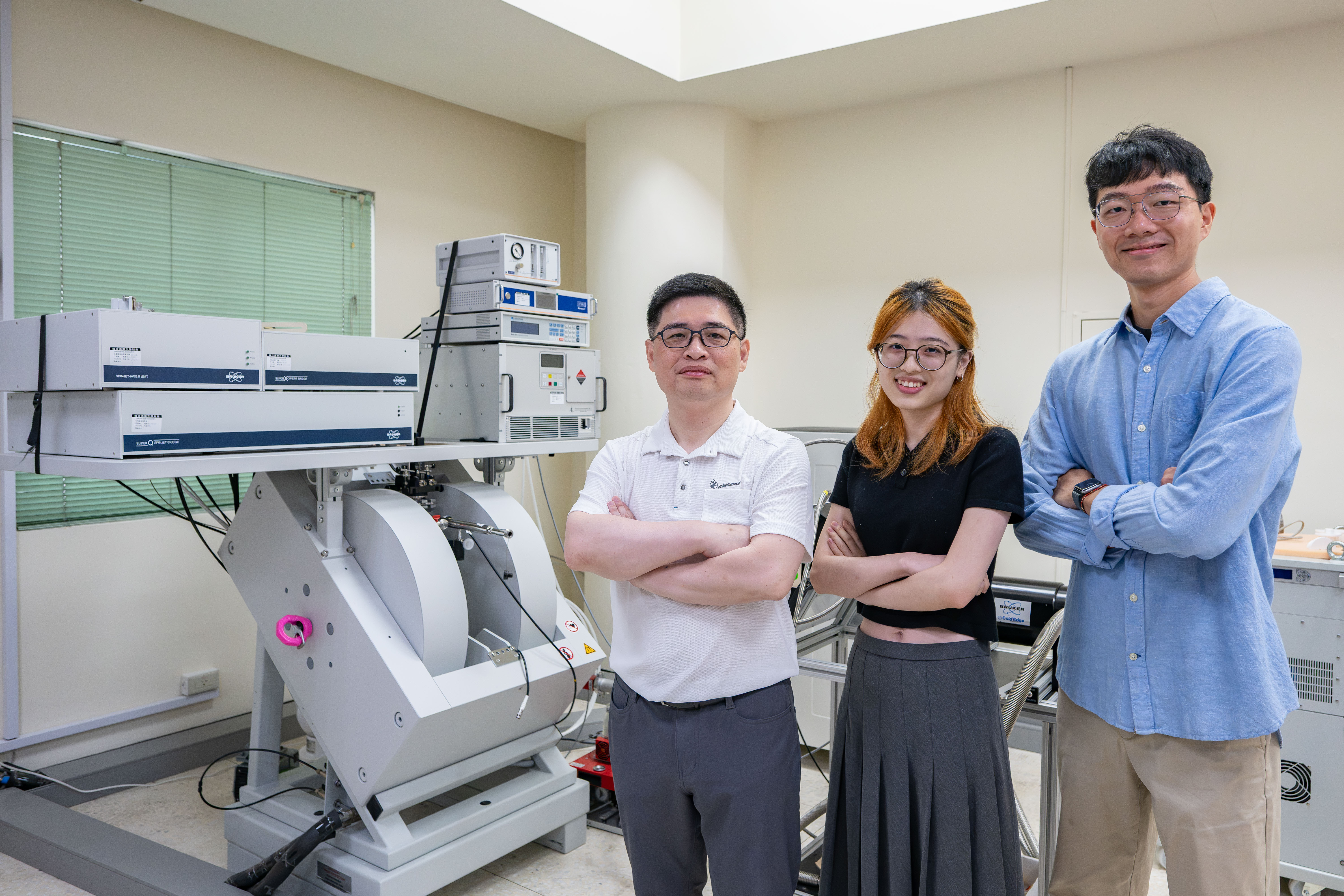
Professor Yun-Wei Chiang (江昀緯, left) of NTHU's Department of Chemistry led the team that uncovered the cell's dual-gate mechanism. At center is Yun-Shan Wang (王云珊), a second-year master's student; at right is postdoctoral researcher Chu-Chun Cheng (鄭竹鈞). (Photo: National Tsing Hua University)
Contact:
Yi-Yeh Chen
NTHU
(886)3-5162374
yiyeh@mx.nthu.edu.tw
A photo accompanying this announcement is available at https://www.globenewswire.com/NewsRoom/AttachmentNg/7aae4ec3-fd83-48ef-87a6-1e3b28fde0db