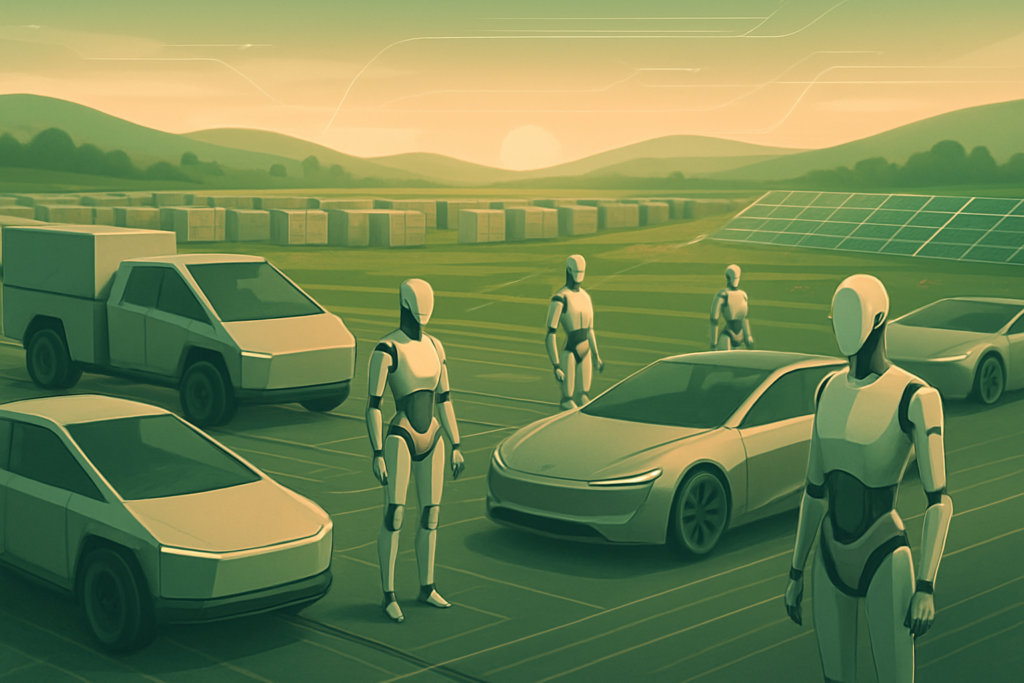
As of March 20, 2026, Tesla, Inc. (NASDAQ: TSLA) stands at a critical crossroads in its evolution. No longer viewed strictly through the lens of a traditional automaker, Tesla has transitioned into what CEO Elon Musk describes as a "Physical AI and Robotics" powerhouse. While the broader electric vehicle (EV) market has matured into a hyper-competitive, lower-margin landscape, Tesla is attempting to break away from the pack by betting its future on autonomous software, humanoid robotics, and utility-scale energy storage. Today, the company remains one of the most polarizing and heavily traded stocks in the world, serving as a bellwether for the future of artificial intelligence and sustainable energy.
Historical Background
Founded in 2003 by Martin Eberhard and Marc Tarpenning, with Elon Musk leading the Series A investment in 2004, Tesla’s journey began with the high-end Roadster in 2008. The company’s "Master Plan" was clear: build a low-volume, expensive car to fund a medium-volume, mid-price car (Model S and Model X), which would eventually fund a high-volume, affordable car (Model 3 and Model Y).
The 2010 IPO marked a turning point, but the "production hell" of 2017-2019 during the Model 3 ramp nearly bankrupted the firm. Tesla emerged from that crisis to become the most valuable automaker in history, reaching a $1 trillion market cap in 2021. However, the period between 2024 and early 2025 saw a painful recalibration as global EV demand cooled, forcing the company to pivot from pure volume growth to its current focus on autonomy (FSD) and robotics (Optimus).
Business Model
Tesla’s revenue model has diversified significantly over the last decade. It currently operates across three primary segments:
- Automotive: Sale and leasing of the Model S, 3, X, Y, Cybertruck, and the newly rolling-off-the-line Cybercab.
- Energy Generation and Storage: Sale of Megapack (utility-scale) and Powerwall (residential) systems. This segment has become the "growth engine" of 2025-2026, delivering high-margin recurring revenue.
- Services and Other: This includes the Supercharger network—now the global standard—along with insurance, maintenance, and high-margin software subscriptions like Full Self-Driving (FSD).
By March 2026, Tesla has moved away from selling FSD as a one-time $12,000 fee, transitioning to a $99/month subscription model to maximize recurring software revenue and data collection from its 8.4-billion-mile fleet.
Stock Performance Overview
Tesla’s stock performance has been a roller coaster for long-term investors:
- 10-Year View: Since March 2016, the stock has seen astronomical gains, split-adjusted, as it moved from a niche manufacturer to a global leader.
- 5-Year View: The 2021-2026 period was characterized by extreme volatility. After peaking in late 2021, the stock suffered during the 2024 "EV winter" but recovered sharply in late 2025 on the back of Optimus Gen 2 demonstrations and the Cybercab unveiling.
- 1-Year View: Over the last 12 months, TSLA has climbed from the mid-$200s to its current range of $380-$400. While it remains below its 2025 high of $498, it has outperformed many legacy auto peers who have struggled with the transition to software-defined vehicles.
Financial Performance
In the fiscal year ending December 2025, Tesla reported total revenue of approximately $94.8 billion. While this was a slight 3% decline year-over-year—the first such decline in company history—the internal composition of that revenue shifted.
- Margins: Automotive gross margins (excluding credits) hovered around 17%, pressured by price cuts in China and the U.S.
- Energy Storage: The star of the balance sheet, the Energy segment generated $12.8 billion in 2025 with gross margins approaching 30%.
- Cash Flow: Despite a massive $20 billion capital expenditure guidance for 2026—aimed at AI training clusters and Optimus production—Tesla maintains a robust cash position, though net income fell to $3.8 billion in 2025 due to R&D intensity.
Leadership and Management
Elon Musk remains the dominant force and visionary behind Tesla, though his attention is split between SpaceX, X (formerly Twitter), and xAI. This "key person risk" remains a central theme for institutional investors. The board, chaired by Robyn Denholm, has faced scrutiny over executive compensation and governance, particularly following the 2024-2025 legal battles over Musk's pay package.
Operationally, the leadership team has matured, with executives like Vaibhav Taneja (CFO) and Tom Zhu (Senior VP, Automotive) playing critical roles in maintaining the company’s manufacturing efficiencies as Musk focuses on the high-level AI roadmap.
Products, Services, and Innovations
Tesla’s 2026 product lineup reflects its "AI-first" philosophy:
- Cybercab: The dedicated Robotaxi unveiled in late 2024. The first production units began rolling off the line at Giga Texas in February 2026.
- Cybertruck: Now in its second full year of mass production, the $59,900 variant released in early 2026 is currently sold out through the end of the year.
- Optimus (Gen 2/3): Humanoid robots are currently being used internally at Tesla factories to sort battery cells. A dedicated Gen 3 production line in Fremont is slated for 2027 commercialization.
- FSD (Supervised) v14: The latest iteration of Tesla’s neural-net-based driving software, which now handles complex urban navigation with significantly fewer interventions than the 2024 versions.
Competitive Landscape
Tesla faces a two-front war. In the automotive sector, Chinese giant BYD continues to rival Tesla in global volume, leveraging a more vertically integrated battery supply chain. In the premium segment, Xiaomi and Huawei-backed ventures have gained significant traction in Asia.
Conversely, in the AI and Robotics space, Tesla’s competition includes Waymo (Alphabet) in the autonomous driving sector and Boston Dynamics in the humanoid robotics field. Tesla’s competitive edge lies in its "real-world AI" advantage—the ability to train models on billions of miles of actual driving data from its consumer fleet, something no other rival can currently match.
Industry and Market Trends
The "EV hype cycle" of 2020-2022 has been replaced by a "pragmatic transition." Hybrid vehicles saw a resurgence in 2024-2025, slowing the adoption of pure BEVs (Battery Electric Vehicles). Furthermore, the cost of capital remains high compared to the previous decade, forcing companies to prove profitability rather than just growth. Tesla has adapted by focusing on "Unboxed" manufacturing—a modular assembly process designed to reduce factory footprint and costs by 40% for its next-generation vehicles.
Risks and Challenges
- Regulatory Scrutiny: Tesla faces a critical March 2026 deadline for FSD data submission to the NHTSA. Any adverse ruling could delay the deployment of unsupervised Robotaxis.
- Capex Intensity: The $20 billion investment in 2026 is a massive bet. If the transition to AI revenue doesn't materialize as fast as expected, margins could face further compression.
- Geopolitical Tension: With a significant portion of production and demand based in China, Tesla is vulnerable to shifting trade policies and tariffs between Washington and Beijing.
Opportunities and Catalysts
- The "Model 2": Anticipation for a sub-$30,000 compact vehicle (Project Redwood) remains the biggest near-term catalyst for the stock, with production expected to start in late 2026.
- FSD Licensing: Musk has hinted at ongoing discussions with a "major OEM" to license Tesla’s FSD software. A signed deal would transform Tesla into a high-margin software provider for the entire industry.
- Energy Scaling: The Shanghai Megafactory is now at full capacity, positioning Tesla to dominate the global utility-scale storage market as grids shift to renewables.
Investor Sentiment and Analyst Coverage
Investor sentiment is split into two camps. Wall Street "Bulls," such as Wedbush, maintain price targets as high as $600, viewing Tesla as the world’s most advanced AI company. "Bears" point to the 2025 revenue decline and high valuation (currently trading at a forward P/E significantly higher than legacy auto) as evidence of a "bubble" in AI expectations, with some price targets as low as $125. Retail sentiment remains high, buoyed by Musk’s social media presence and the "halo effect" of the Cybertruck.
Regulatory, Policy, and Geopolitical Factors
Tesla’s growth is inextricably linked to government policy. In the U.S., the Inflation Reduction Act (IRA) continues to provide tailwinds for battery manufacturing and storage. However, the 2026 geopolitical climate is fraught, with new EU tariffs on Chinese-made EVs affecting Tesla’s Giga Shanghai exports. Investors are also closely watching AI safety legislation, which could impose new reporting requirements on the development of Optimus and FSD.
Conclusion
Tesla in 2026 is no longer a simple story of selling cars; it is a complex bet on the convergence of energy, autonomous transport, and artificial intelligence. The company’s ability to sustain its premium valuation depends on whether it can successfully transition from a high-volume hardware manufacturer to a high-margin AI platform. While 2025 was a year of financial consolidation and "growing pains," the looming launch of the next-gen vehicle platform and the expansion of the Robotaxi fleet suggest that Tesla’s most ambitious chapter is only just beginning. Investors should watch the March NHTSA rulings and the Q3 "Model 2" production updates as the key indicators of the stock's direction for the remainder of the decade.
This content is intended for informational purposes only and is not financial advice.