
Post-Acute Transition Care Coordination Platform Market is transitioning from optional workflow software to core hospital infrastructure. As healthcare systems move deeper into value-based care models, digital coordination platforms will become indispensable.
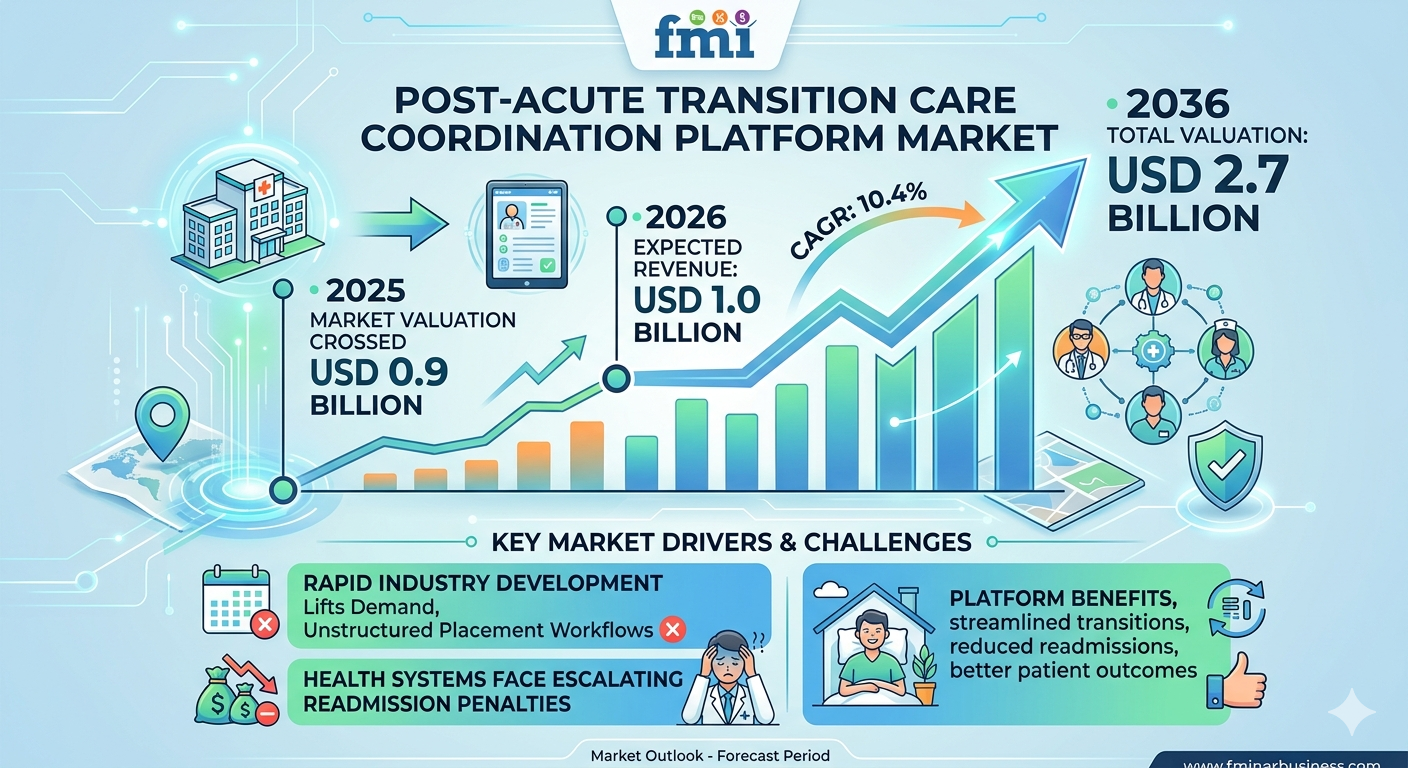
NEWARK, DE / ACCESS Newswire / April 7, 2026 / The global post-acute transition care coordination platform market is undergoing rapid transformation as healthcare systems prioritize faster patient discharge and reduced readmissions. According to Future Market Insights (FMI), the market is valued at USD 1.0 billion in 2026 and is forecast to reach USD 2.7 billion by 2036, expanding at a CAGR of 10.4% over the forecast period.
Market Overview & Size Outlook
The market has evolved from a niche IT solution into a mission-critical operational platform for hospitals. Rising patient volumes, bed shortages, and strict reimbursement penalties are pushing providers to digitize discharge workflows.
2025 Market Size: USD 0.9 billion
2026 Market Size: USD 1.0 billion
2036 Forecast: USD 2.7 billion
CAGR (2026-2036): 10.4%
Incremental Opportunity: USD 1.7 billion
Healthcare providers increasingly view these platforms not as software costs, but as direct revenue protection tools that reduce length of stay and avoid Medicare penalties.
Request Sample Report: Get detailed market forecasts, competitive benchmarking, and pricing trends: https://www.futuremarketinsights.com/reports/sample/rep-gb-32592
Key Demand Drivers
Readmission Penalties & Value-Based Care:Hospitals face financial penalties for avoidable readmissions, making structured patient transitions a top priority.
Bed Capacity Constraints:Once hospital occupancy exceeds ~85%, manual discharge coordination becomes unviable, accelerating adoption of automated referral broadcasting.
Interoperability Mandates (TEFCA, FHIR): Regulatory frameworks are enabling secure, standardized data exchange across hospitals, SNFs, and home care providers.
Workforce Efficiency Pressures: Nurses and case managers demand tools that reduce administrative burden and eliminate redundant documentation.
Supply Chain & Ecosystem (Who Supplies Whom)
The ecosystem is highly interconnected, with platform vendors acting as digital intermediaries:
Platform Providers → Hospitals: Core buyers; deploy systems for discharge planning and referral management
Hospitals → SNFs / Rehab / Home Care: Send structured patient data and placement requests
Platform Vendors → Post-Acute Facilities: Provide access to referral networks without heavy IT infrastructure
Integration Layer: APIs connect EMRs, transport services, and payer systems
Vendors with pre-connected provider networks hold a structural advantage, as network density directly impacts placement speed.
Pricing Trends
Subscription-based SaaS models dominate, especially for cloud deployments
Pricing linked to: Number of beds / discharge volume/Network size (connected facilities)/Advanced analytics and AI modules
Hospitals increasingly subsidize platform access for SNFs to ensure network participation
ROI measured through:/Reduction in inpatient days/Faster placement times/Avoided readmission penalties
Segment Analysis
By Deployment
Cloud: 62.0% share (dominant due to scalability and interoperability)
On-premise and hybrid models declining due to integration complexity
By Module
Referral Management: 29.0% share Core engine enabling real-time facility matching and broadcasting
By Care Setting
Hospitals: 46.0% share Primary adopters due to financial accountability for readmissions
By End User
Providers: 58.0% share Driven by clinical workflow demands rather than payer incentives
By Transition Type
Hospital-to-SNF: 34.0% share Highest documentation complexity and volume
Regional Analysis
North America
Dominant revenue contributor
Strong adoption driven by Medicare penalties and interoperability mandates
United States CAGR: 10.2%
Western Europe
Fastest-growing region due to national data-sharing mandates
Netherlands: 11.3% (highest globally)
Germany: 11.1% (driven by hospital digitization funding)
Asia-Pacific
Growth driven by aging populations and hospital congestion
Australia: 10.7%
Japan: 9.2% (slower due to strict data privacy laws)
Competitive Landscape
The market remains fragmented, with competition driven by network scale, interoperability, and EMR integration depth.
Leading Players
WellSky
PointClickCare
Aidin
Dina
Bamboo Health
Oracle Health
Trella Health
Competitive Insights
WellSky (CarePort) leads due to its extensive pre-connected provider network
Oracle Health benefits from proximity to hospital EMR infrastructure
Trella Health (Repisodic) differentiates through performance analytics at referral stage
Startups face high barriers due to complex EMR integrations and compliance requirements
Key Trends Shaping the Market
AI-powered predictive placement: Identifying high-risk patients early
Real-time bed visibility: Across fragmented post-acute networks
Transport integration APIs: Coordinating discharge logistics end-to-end
Specialty care routing: Dialysis, ventilator, and high-acuity patient matching
Data-driven referral optimization: Improving acceptance rates
Risks & Challenges
Fragmented IT systems across independent nursing facilities
Continued reliance on fax-based workflows in smaller centers
Alert fatigue among receiving facilities due to poor filtering
Data privacy regulations limiting cloud deployment in certain regions
Vendor lock-in concerns due to proprietary data ecosystems
Investment Opportunities
Expansion of cloud-native interoperability platforms
Development of AI-driven referral optimization engines
Integration with remote monitoring and home healthcare ecosystems
Regional platform rollouts in Europe and Asia-Pacific
Solutions targeting behavioral health and complex care transitions
For a comprehensive understanding of the latest formulation trends and to explore the full strategic insights, please visit the official report page: https://www.futuremarketinsights.com/reports/post-acute-transition-care-coordination-platform-market
Future Outlook
The market is transitioning from optional workflow software to core hospital infrastructure. As healthcare systems move deeper into value-based care models, digital coordination platforms will become indispensable.
Over the next decade, competitive advantage will shift toward vendors that can:
Build dense, active provider networks
Deliver real-time interoperability at scale
Provide actionable analytics tied to financial outcomes
Hospitals that fail to adopt these platforms risk longer patient stays, higher operational costs, and reduced reimbursement, making digital transition coordination a strategic imperative rather than a technology upgrade.
Explore More Related Studies Published by FMI Research:
Homecare Medical Devices Market: https://www.futuremarketinsights.com/reports/homecare-medical-devices-market
Homecare Dermatology Energy-based Devices Market: https://www.futuremarketinsights.com/reports/homecare-dermatology-energy-based-devices-market
Medical Cart Battery Market: https://www.futuremarketinsights.com/reports/medical-cart-battery-market
Medical Device Cyber Risk Quantification Market: https://www.futuremarketinsights.com/reports/medical-device-cyber-risk-quantification-market
About Future Market Insights (FMI)
Future Market Insights (FMI) is a leading provider of market intelligence and consulting services, serving clients in over 150 countries. Headquartered in Delaware, USA, with a global delivery center in India and offices in the UK and UAE, FMI delivers actionable insights to businesses across industries including automotive, technology, consumer products, manufacturing, energy, and chemicals.
An ESOMAR-certified research organization, FMI provides custom and syndicated market reports and consulting services, supporting both Fortune 1,000 companies and SMEs. Its team of 300+ experienced analysts ensures credible, data-driven insights to help clients navigate global markets and identify growth opportunities.
For Press & Corporate Inquiries
Rahul Singh
AVP - Marketing and Growth Strategy
Future Market Insights, Inc.
+91 8600020075
For Sales - sales@futuremarketinsights.com
For Media - Rahul.singh@futuremarketinsights.com
For web - https://www.futuremarketinsights.com/
SOURCE: Future Market Insights, Inc.
View the original press release on ACCESS Newswire