CHANTILLY, VA / ACCESS Newswire / November 25, 2026 / Industrial AI projects often begin with a model: Can it detect a defect, recognize an abnormal condition, or classify an event? A successful demonstration answers that first question. Production deployment raises several more.
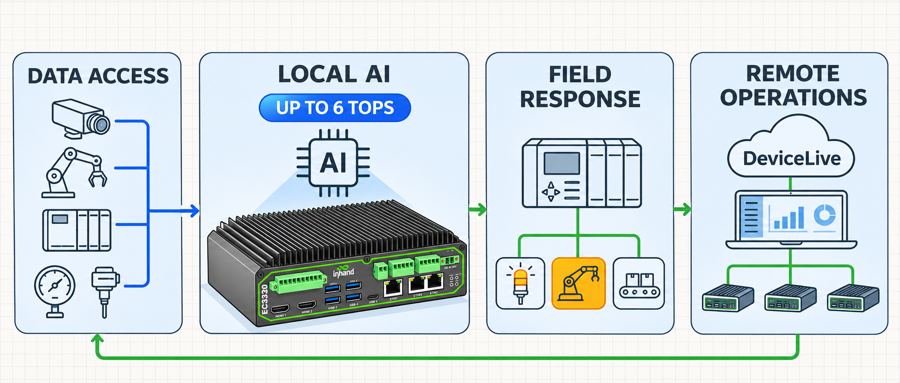
The data may be spread across PLCs, sensors, cameras, meters, and control systems that use different protocols. Inference results may need to return to a controller or plant system, not remain in an isolated dashboard. Once the application expands beyond one machine, teams also need a consistent way to configure devices, update software, review logs, and maintain the deployment.
This is why TOPS alone is not a useful measure of industrial AI readiness. Compute capacity matters, but only within a larger operating path that connects field data, local processing, site workflows, and long-term management.
The InHand Networks EC3320 AI Edge Computer is designed around that broader path. Its value is not a single specification. It is the combination of industrial data access, scalable local AI computing, field connectivity, and remote application management in one Linux-based platform.
Challenge 1: Reaching data across mixed industrial equipment
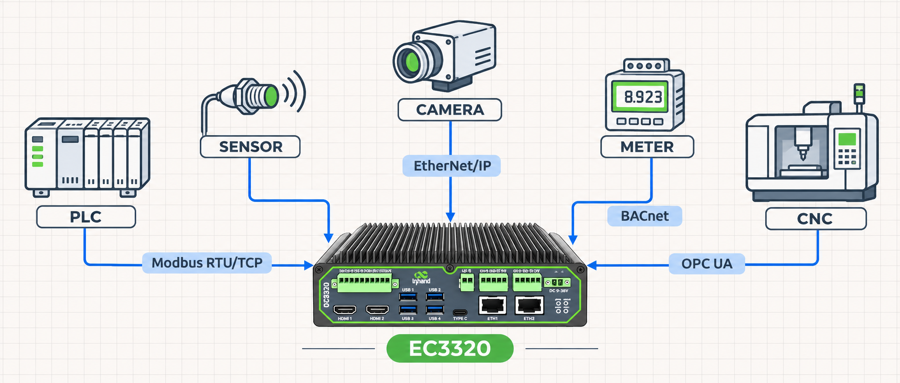
Industrial sites rarely begin with a clean, standardized data environment. Newer equipment may provide Ethernet-based access, while installed machines still depend on serial communication. Production, energy, and building systems may also use different protocols even when they operate at the same site.
This fragmentation can slow an AI project before inference begins. Teams first have to locate the required data, understand its context, and create a reliable path from the equipment to the application. A model that works with a prepared dataset in the lab may still be difficult to integrate with the live production environment.
EC3320 addresses this integration layer through support for protocols including Modbus RTU/TCP, EtherNet/IP, OPC UA, DNP3.0, BACnet, and CNC. Ethernet, serial, CAN, and digital I/O connections give system integrators several ways to connect supported field equipment.
The practical value is a common edge point where operational data can be collected and prepared for local applications. Instead of treating data acquisition as a separate afterthought, teams can design it as part of the AI architecture from the beginning. Compatibility still needs to be validated against the specific equipment and protocol implementation used in each project.
Challenge 2: Turning local inference into an operational workflow
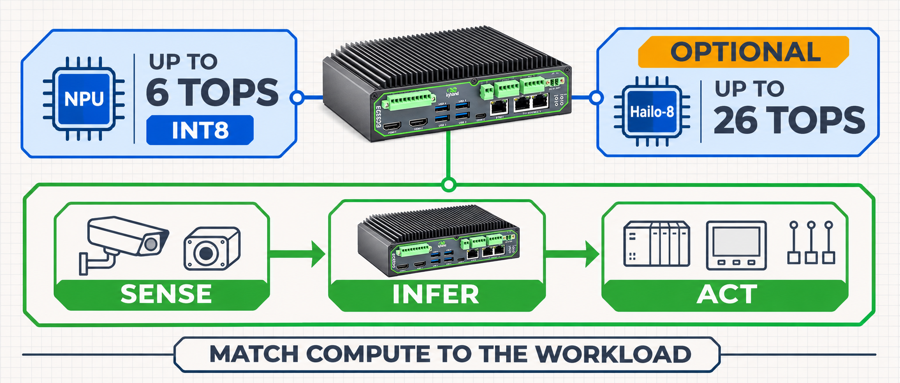
Local AI is often discussed as a hardware-performance problem. In practice, workload fit matters more than the largest available TOPS figure.
TOPS describes a level of compute capacity. It does not predict the accuracy, latency, or throughput of a particular application. Those outcomes also depend on the model, input resolution, data quality, framework, optimization, and the way the application interacts with other systems.
EC3320 provides an integrated NPU rated at up to 6 TOPS for INT8 workloads. Applications that need additional acceleration can use an optional Hailo-8 M.2 module, expanding the specified capability to up to 26 TOPS. This gives project teams a way to select compute resources around the intended workload rather than treating every deployment as identical.
Processing data locally is only part of the job. The result must reach the system that can use it. Depending on the application, that may mean passing an event to a controller, changing a digital output, updating a local interface, or sending selected information to a supervisory platform.
EC3320 combines local computing with industrial interfaces, allowing a supported application to collect data, run inference, and pass the result into a wider operational workflow. This creates a clearer path between observing a condition and acting on it. Machine control and safety functions still require project-specific engineering and validation.
Challenge 3: Operating AI across more than one site
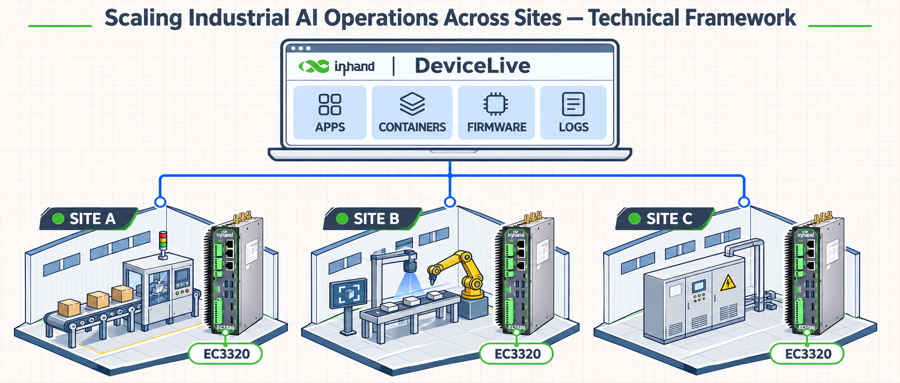
A proof of concept can often be maintained manually. That approach becomes difficult when the same application is deployed across multiple machines, production lines, or remote facilities.
At that stage, the questions change. Are configurations consistent? Which application version is running on each device? Can teams collect logs, distribute updates, or investigate an issue without visiting every site? How should the deployment be maintained as firmware and application requirements change?
EC3320 runs Linux and supports edge application and container management. Through InHand DeviceLive, teams can manage cloud-based parameter configuration, containers, applications, and firmware. Local and remote logs, firmware upgrades, and remote access provide additional tools for ongoing operations.
This management layer helps turn a successful single-site application into a repeatable deployment model. Rather than rebuilding the operating process for every new location, teams can use a common platform for device and application maintenance. Model-dependent 5G NR and LTE Cat.6 options, dual-SIM switchover, and link detection can also support sites that require cellular connectivity.
The hardware is designed for protected industrial installations, with a fanless metal enclosure, DIN-rail or wall mounting, 9 to 36 V DC input, and a specified operating range of -20°C to +60°C. Its IP40 rating does not indicate waterproof or exposed-outdoor operation.
Industrial edge AI is a system-design decision
Moving industrial AI from a pilot to production requires more than adding compute power near a machine. Teams need access to live operational data, a compute configuration matched to the workload, a path for results to reach field systems, and a way to manage applications throughout their operating life.
EC3320 brings these elements together in one industrial edge platform. For machine builders, system integrators, and industrial IT/OT teams, it provides a foundation for building AI applications around the realities of existing equipment and distributed operations.
Before deployment, teams should verify protocol compatibility, workload performance, cellular availability, and the required hardware options for the specific project.
For EC3320 specifications and configuration options, visit:
https://www.inhand.com/en/products/al-edge-computers/ec3320/
About InHand Networks
Founded in 2001, InHand Networks is a global provider of industrial IoT connectivity, edge computing, and networking solutions.
The company serves industries including industrial automation, digital energy, business networking, smart commerce, and mobility. With products deployed in more than 60 countries, InHand Networks helps organizations connect, manage, and optimize distributed operations.
Media Contact
InHand Networks
Marketing & Communications
marketing@inhand.com
SOURCE: InHand Networks
View the original press release on ACCESS Newswire