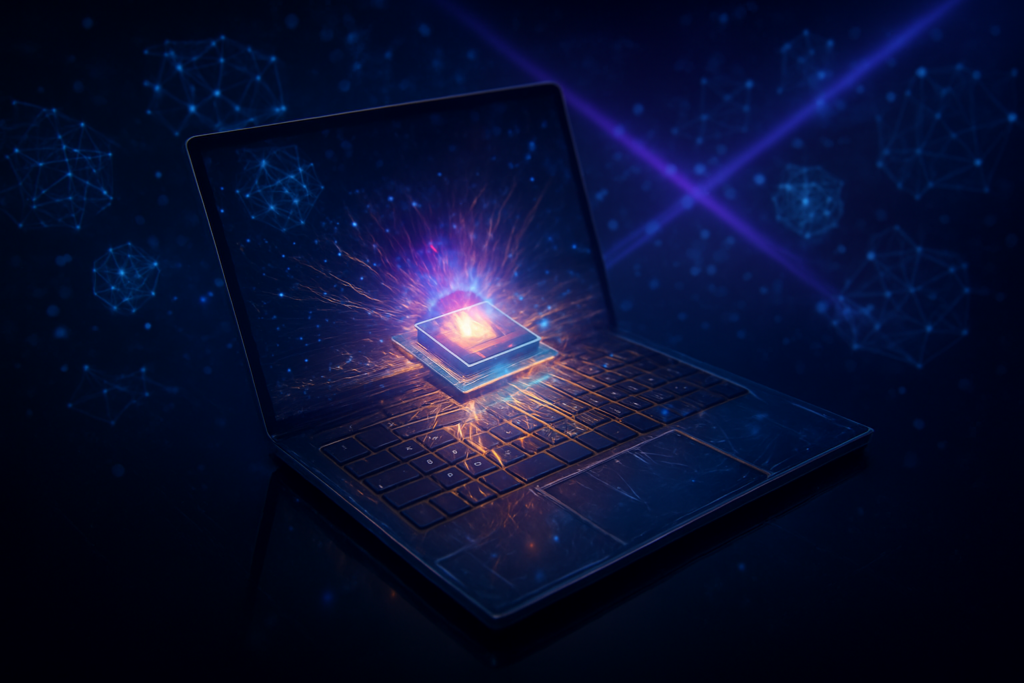
The personal computer is undergoing its most radical transformation since the transition from vacuum tubes to silicon. As of January 2026, the "AI PC" is no longer a futuristic concept or a marketing buzzword; it is the industry standard. This seismic shift was catalyzed by a single, stringent requirement from Microsoft (NASDAQ: MSFT): the 40 TOPS (Trillions of Operations Per Second) threshold for Neural Processing Units (NPUs). This mandate effectively drew a line in the sand, separating legacy hardware from a new generation of machines capable of running advanced artificial intelligence natively.
The immediate significance of this development cannot be overstated. By forcing the hardware industry to integrate high-performance NPUs, the industry has effectively shifted the center of gravity for AI from massive, power-hungry data centers to the local edge. This transition has sparked what analysts are calling the "Great Refresh," a massive hardware upgrade cycle driven by the October 2025 end-of-life for Windows 10 and the rising demand for private, low-latency, "agentic" AI experiences that only these new processors can provide.
The Technical Blueprint: Mastering the 40 TOPS Hurdle
The road to the 40 TOPS standard began in mid-2024 when Microsoft defined the "Copilot+ PC" category. At the time, most integrated NPUs offered fewer than 15 TOPS, barely enough for basic background blurring in video calls. The leap to 40+ TOPS required a fundamental redesign of processor architecture. Leading the charge was Qualcomm (NASDAQ: QCOM), whose Snapdragon X Elite series debuted with a Hexagon NPU capable of 45 TOPS. This Arm-based architecture proved that Windows laptops could finally achieve the power efficiency and "instant-on" capabilities of Apple's (NASDAQ: AAPL) M-series chips, while maintaining high-performance AI throughput.
Intel (NASDAQ: INTC) and AMD (NASDAQ: AMD) quickly followed suit to maintain their x86 dominance. AMD launched the Ryzen AI 300 series, codenamed "Strix Point," which utilized the XDNA 2 architecture to deliver 50 TOPS. Intel’s response, the Core Ultra Series 2 (Lunar Lake), radically redesigned the traditional CPU layout by integrating memory directly onto the package and introducing an NPU 4.0 capable of 48 TOPS. These advancements differ from previous approaches by offloading continuous AI tasks—such as real-time language translation, local image generation, and "Recall" indexing—from the power-hungry GPU and CPU to the highly efficient NPU. This architectural shift allows AI features to remain "always-on" without significantly impacting battery life.
Industry Impact: A High-Stakes Battle for Silicon Supremacy
This hardware pivot has reshaped the competitive landscape for tech giants. AMD has emerged as a primary beneficiary, with its stock price surging throughout 2025 as it captured significant market share from Intel in both the consumer and enterprise laptop segments. By delivering high TOPS counts alongside strong multi-threaded performance, AMD positioned itself as the go-to choice for power users. Meanwhile, Qualcomm has successfully transitioned from a mobile-only player to a legitimate contender in the PC space, dictating the hardware floor with its recently announced Snapdragon X2 Elite, which pushes NPU performance to a staggering 80 TOPS.
Intel, despite facing manufacturing headwinds and a challenging 2025, is betting its future on the "Panther Lake" architecture launched earlier this month at CES 2026. Built on the cutting-edge Intel 18A process, these chips aim to regain the efficiency crown. For software giants like Adobe (NASDAQ: ADBE), the standardization of 40+ TOPS NPUs has allowed for a "local-first" development strategy. Creative Cloud tools now utilize the NPU for compute-heavy tasks like generative fill and video rotoscoping, reducing cloud subscription costs for the company and improving privacy for the user.
The Broader Significance: Privacy, Latency, and the Edge AI Renaissance
The emergence of the AI PC represents a pivotal moment in the broader AI landscape, moving the industry away from "Cloud-Only" AI. The primary driver of this shift is the realization that many AI tasks are too sensitive or latency-dependent for the cloud. With 40+ TOPS of local compute, users can run Small Language Models (SLMs) like Microsoft’s Phi-4 or specialized coding models entirely offline. This ensures that a company’s proprietary data or a user’s personal documents never leave the device, addressing the massive privacy concerns that plagued earlier AI implementations.
Furthermore, this hardware standard has enabled the rise of "Agentic AI"—autonomous software that doesn't just answer questions but performs multi-step tasks. In early 2026, we are seeing the first true AI operating system features that can navigate file systems, manage calendars, and orchestrate workflows across different applications without human intervention. This is a leap beyond the simple chatbots of 2023 and 2024, representing a milestone where the PC becomes a proactive collaborator rather than a reactive tool.
Future Horizons: From 40 to 100 TOPS and Beyond
Looking ahead, the 40 TOPS requirement is only the beginning. Industry experts predict that by 2027, the baseline for a "standard" PC will climb toward 100 TOPS, enabling the concurrent execution of multiple "agent swarms" on a single device. We are already seeing the emergence of "Vibe Coding" and "Natural Language Design," where local NPUs handle continuous, real-time code debugging and UI generation in the background as the user describes their intent. The challenge moving forward will be the "memory wall"—the need for faster, higher-capacity RAM to keep up with the massive data requirements of local AI models.
Near-term developments will likely focus on "Local-Cloud Hybrid" models, where a local NPU handles the initial reasoning and data filtering before passing only the most complex, non-sensitive tasks to a massive cloud-based model like GPT-5. We also expect to see the "NPU-ification" of every peripheral, with webcams, microphones, and even storage drives integrating their own micro-NPUs to process data at the point of entry.
Summary and Final Thoughts
The transformation of the PC industry through dedicated NPUs and the 40 TOPS standard marks the end of the "static computing" era. By January 2026, the AI PC has moved from a luxury niche to the primary engine of global productivity. The collaborative efforts of Intel, AMD, Qualcomm, and Microsoft have successfully navigated the most significant hardware refresh in a decade, providing a foundation for a new era of autonomous, private, and efficient computing.
The key takeaway for 2026 is that the value of a PC is no longer measured solely by its clock speed or core count, but by its "intelligence throughput." As we move into the coming months, the focus will shift from the hardware itself to the innovative "agentic" software that can finally take full advantage of these local AI powerhouses. The AI PC is here, and it has fundamentally changed how we interact with technology.
This content is intended for informational purposes only and represents analysis of current AI developments.
TokenRing AI delivers enterprise-grade solutions for multi-agent AI workflow orchestration, AI-powered development tools, and seamless remote collaboration platforms.
For more information, visit https://www.tokenring.ai/.