
As the craze of earnings season draws to a close, here’s a look back at some of the most exciting (and some less so) results from Q2. Today, we are looking at auto parts retailer stocks, starting with O'Reilly (NASDAQ: ORLY).
Cars are complex machines that need maintenance and occasional repairs, and auto parts retailers cater to the professional mechanic as well as the do-it-yourself (DIY) fixer. Work on cars may entail replacing fluids, parts, or accessories, and these stores have the parts and accessories or these jobs. While e-commerce competition presents a risk, these stores have a leg up due to the combination of broad and deep selection as well as expertise provided by sales associates. Another change on the horizon could be the increasing penetration of electric vehicles.
The 5 auto parts retailer stocks we track reported a mixed Q2. As a group, revenues were in line with analysts’ consensus estimates.
Amidst this news, share prices of the companies have had a rough stretch. On average, they are down 11.4% since the latest earnings results.
O'Reilly (NASDAQ: ORLY)
Serving both the DIY customer and professional mechanic, O’Reilly Automotive (NASDAQ: ORLY) is an auto parts and accessories retailer that sells everything from fuel pumps to car air fresheners to mufflers.
O'Reilly reported revenues of $4.89 billion, up 8.1% year on year. This print exceeded analysts’ expectations by 0.6%. Despite the top-line beat, it was still a mixed quarter for the company with EPS and gross margin in line with analysts’ estimates.
Brad Beckham, O’Reilly’s CEO, commented, “I would like to thank all of Team O’Reilly for their tremendous hard work and unwavering commitment to taking care of our customers each and every day. We are very pleased to report another quarter of strong performance, highlighted by a comparable store sales increase of 6.0% and a 10% increase in diluted earnings per share. Our Team continues to consistently execute our proven dual market strategy at a high level and delivered solid growth in both professional and DIY during the quarter. We remain committed to taking market share by providing unsurpassed levels of service to our customers, supported by best-in-class parts availability.”
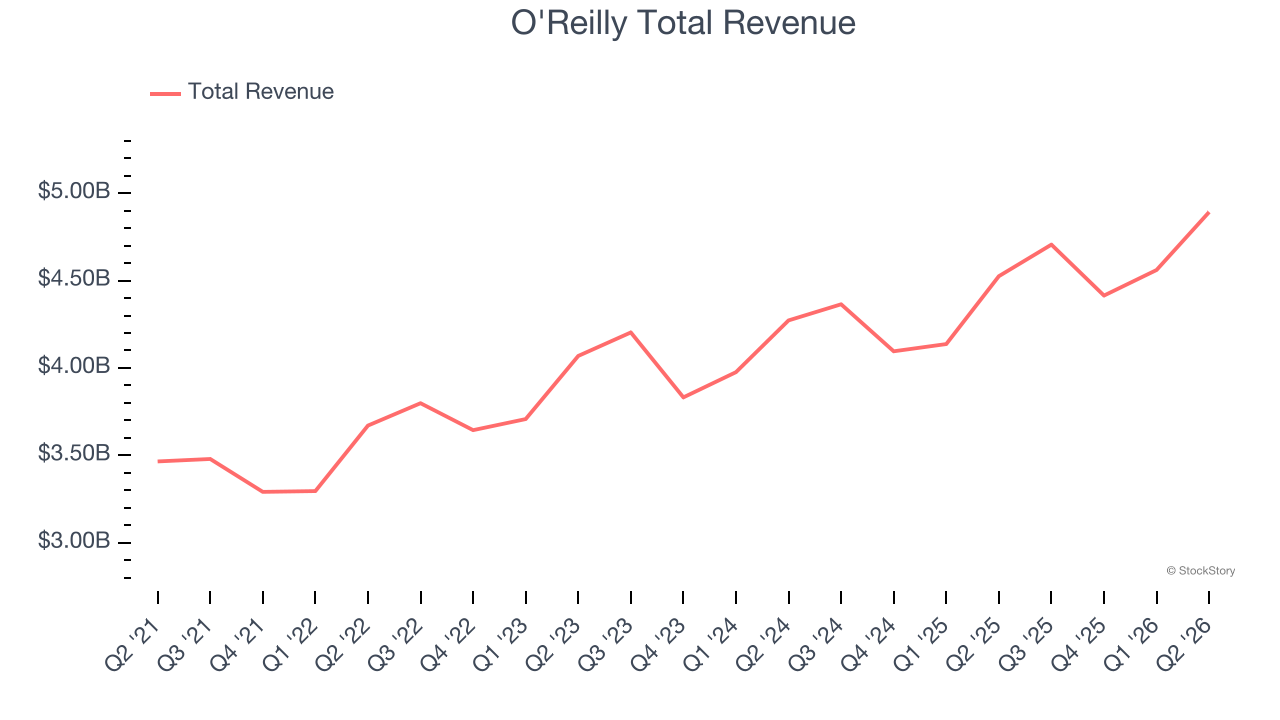
O'Reilly scored the highest full-year guidance raise in the group. Still, the market seems discontent with the results. The stock is down 2.5% since reporting and currently trades at $88.35.
Is now the time to buy O'Reilly? Access our full analysis of the earnings results here, it’s free.
Best Q2: Genuine Parts (NYSE: GPC)
Largely targeting the professional customer, Genuine Parts (NYSE: GPC) sells auto and industrial parts such as batteries, belts, bearings, and machine fluids.
Genuine Parts reported revenues of $6.54 billion, up 6% year on year, outperforming analysts’ expectations by 1.6%. The business had a strong quarter with full-year EPS guidance slightly topping analysts’ expectations and a beat of analysts’ EPS estimates.
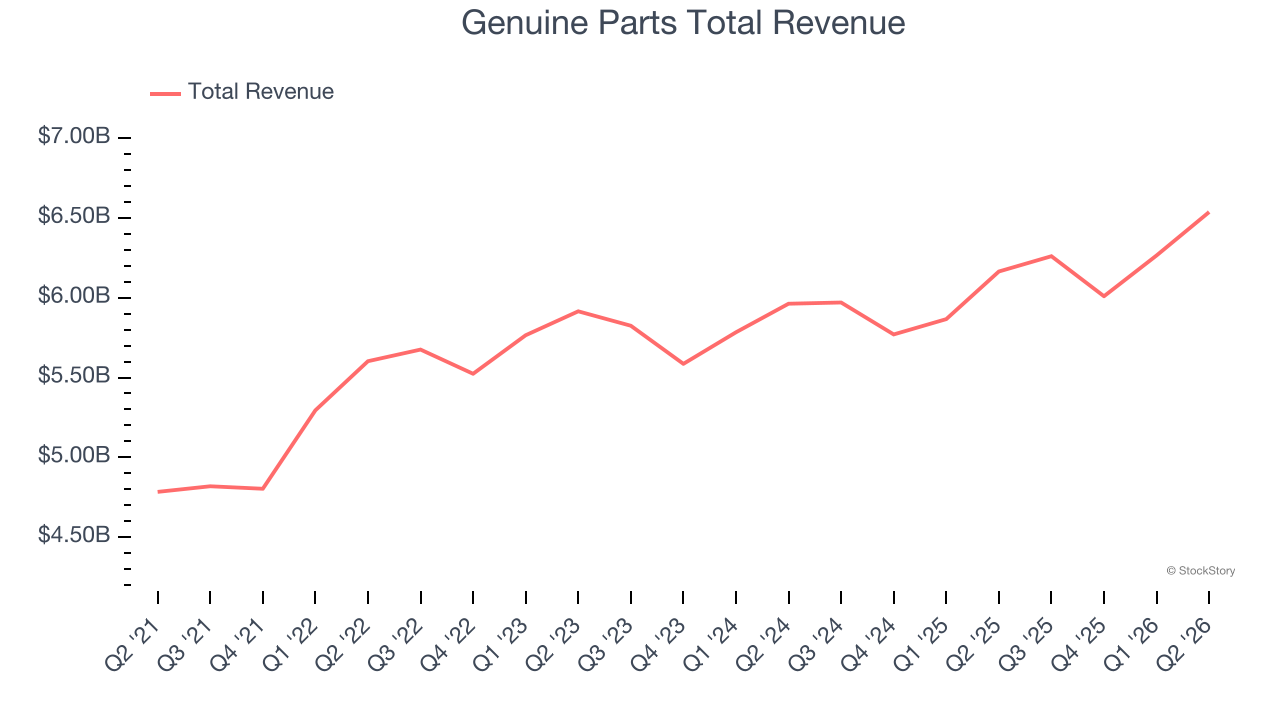
Genuine Parts achieved the biggest analyst estimate beat of the whole group. The market seems happy with the results as the stock is up 10.2% since reporting. It currently trades at $134.86.
Is now the time to buy Genuine Parts? Access our full analysis of the earnings results here, it’s free.
Weakest Q2: Monro (NASDAQ: MNRO)
Started as a single location in Rochester, New York, Monro (NASDAQ: MNRO) provides common auto services such as brake repairs, tire replacements, and oil changes.
Monro reported revenues of $287.1 million, down 4.6% year on year, in line with analysts’ expectations. It was a softer quarter as it posted a significant miss of analysts’ EPS estimates.
Monro delivered the slowest revenue growth among its peers. As expected, the stock is down 27.9% since the results and currently trades at $12.40.
Read our full analysis of Monro’s results here.
Advance Auto Parts (NYSE: AAP)
Founded in Virginia in 1932, Advance Auto Parts (NYSE: AAP) is an auto parts and accessories retailer that sells everything from carburetors to motor oil to car floor mats.
Advance Auto Parts reported revenues of $2 billion, flat year on year. This result came in 1.9% below analysts’ expectations. Aside from that, it was a satisfactory quarter as it also produced a beat of analysts’ EPS estimates but full-year revenue guidance slightly missing analysts’ expectations.
Advance Auto Parts had the weakest performance against analyst estimates and weakest full-year guidance update of the whole group. The stock is down 23.8% since reporting and currently trades at $42.81.
Read our full, actionable report on Advance Auto Parts here, it’s free.
AutoZone (NYSE: AZO)
Aiming to be a one-stop shop for the DIY customer, AutoZone (NYSE: AZO) is an auto parts and accessories retailer that sells everything from car batteries to windshield wiper fluid to brake pads.
AutoZone reported revenues of $4.84 billion, up 8.4% year on year. This number lagged analysts’ expectations by 0.6%. All in all, it was a mixed quarter for the company.
AutoZone scored the fastest revenue growth in the group. The stock is down 13% since reporting and currently trades at $2,962.
Read our full, actionable report on AutoZone here, it’s free.
Market Update
Over the past year, investors have been forced to repeatedly answer the same question: what is the market’s biggest risk? The answer has changed several times, and each shift has reshaped market leadership.
Late in 2025 and early 2026, artificial intelligence became the market’s primary uncertainty. Investors questioned whether AI would erode software pricing power and weaken competitive moats as AI made it easier to replicate once-differentiated products.
By the spring, technology took a back seat to geopolitics. The U.S. conflict with Iran briefly became the market’s dominant narrative, raising concerns about oil prices, inflation, and global growth. But as energy markets remained orderly and fears of a prolonged supply disruption faded, investors quickly turned their focus back to fundamentals.
Want to invest in winners with rock-solid fundamentals? Check out our Top 6 Stocks and add them to your watchlist. These companies are poised for growth regardless of the political or macroeconomic climate.