
Clothing and footwear retailer Boot Barn (NYSE: BOOT) reported revenue ahead of Wall Street’s expectations in Q2 CY2026, with sales up 17.7% year on year to $593.5 million. On the other hand, next quarter’s revenue guidance of $577 million was less impressive, coming in 2.7% below analysts’ estimates. Its GAAP profit of $2.29 per share was 34.6% above analysts’ consensus estimates.
Is now the time to buy Boot Barn? Find out by accessing our full research report, it’s free.
Boot Barn (BOOT) Q2 CY2026 Highlights:
- Revenue: $593.5 million vs analyst estimates of $583.9 million (17.7% year-on-year growth, 1.7% beat)
- EPS (GAAP): $2.29 vs analyst estimates of $1.70 (34.6% beat; "Included in net income per diluted share is an estimated $0.38 per share benefit from tariff refunds")
- The company slightly lifted its revenue guidance for the full year to $2.60 billion at the midpoint from $2.60 billion
- EPS (GAAP) guidance for the full year is $9.02 at the midpoint, beating analyst estimates by 5.6%
- Operating Margin: 15.3%, up from 14% in the same quarter last year
- Free Cash Flow Margin: 5.5%, down from 8.4% in the same quarter last year
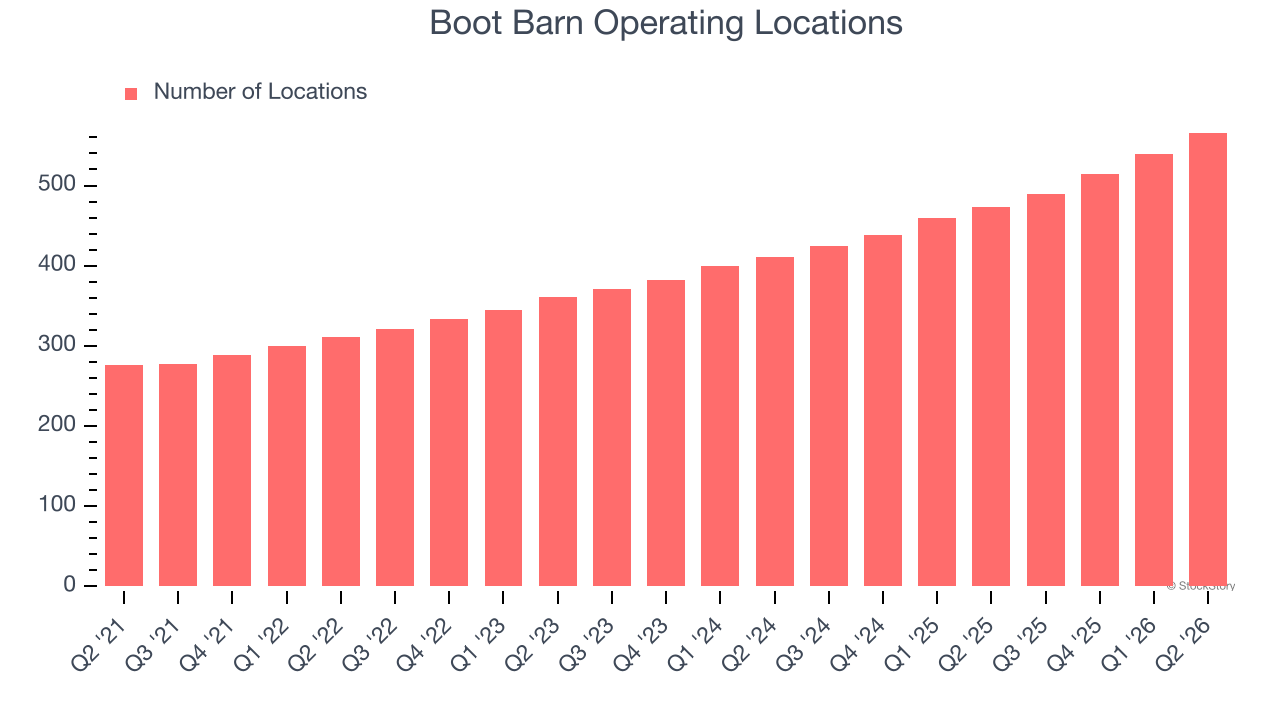
- Locations: 566 at quarter end, up from 473 in the same quarter last year
- Same-Store Sales rose 4.7% year on year (9.4% in the same quarter last year)
- Market Capitalization: $4.81 billion
John Hazen, Chief Executive Officer, commented, “We are pleased with our strong start to fiscal 2027, as first quarter results exceeded our expectations and reflected broad-based strength across the business. Our team continues to execute at a high level, delivering solid same store sales growth, expanding margin, and opening new stores that continue to perform above our expectations.”
Company Overview
With a strong store presence in Texas, California, Florida, and Oklahoma, Boot Barn (NYSE: BOOT) is a western-inspired apparel and footwear retailer.
Revenue Growth
A company’s long-term sales performance can indicate its overall quality. Any business can experience short-term success, but top-performing ones enjoy sustained growth for years.
With $2.34 billion in revenue over the past 12 months, Boot Barn is a small retailer, which sometimes brings disadvantages compared to larger competitors benefiting from economies of scale and negotiating leverage with suppliers. On the bright side, it can grow faster because it has more white space to build new stores.
As you can see below, Boot Barn grew its sales at a decent 11.8% compounded annual growth rate over the last three years as it opened new stores and increased sales at existing, established locations.
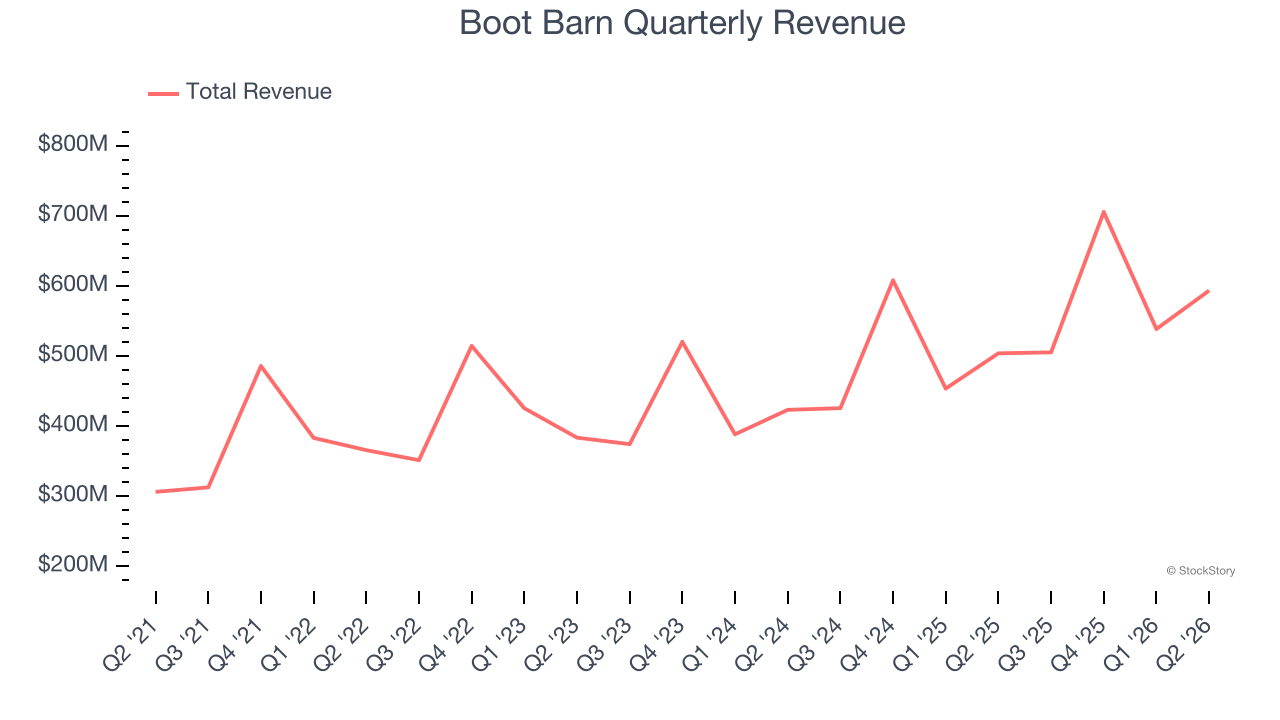
This quarter, Boot Barn reported year-on-year revenue growth of 17.7%, and its $593.5 million of revenue exceeded Wall Street’s estimates by 1.7%. Company management is currently guiding for a 14.2% year-on-year increase in sales next quarter.
Looking further ahead, sell-side analysts expect revenue to grow 14.5% over the next 12 months, an acceleration versus the last three years. This projection is eye-popping and implies its newer products will catalyze better top-line performance.
WHILE YOU’RE HERE: The Next Palantir? One satellite company captures images of every point on Earth. Every single day. The Pentagon wants it. Hedge funds are using it to beat earnings. You’ve probably never heard of it.
This is what the early days of Palantir looked like before it became a giant. Same playbook. Different technology. If you missed Palantir, you need to see this. Claim The Stock Ticker for Free HERE.
Store Performance
Number of Stores
A retailer’s store count often determines how much revenue it can generate.
Boot Barn sported 566 locations in the latest quarter. Over the last two years, it has opened new stores at a rapid clip by averaging 16.1% annual growth, among the fastest in the consumer retail sector. This gives it a chance to scale into a mid-sized business over time.
When a retailer opens new stores, it usually means it’s investing for growth because demand is greater than supply, especially in areas where consumers may not have a store within reasonable driving distance.
Same-Store Sales
The change in a company’s store base only tells one side of the story. The other is the performance of its existing locations and e-commerce sales, which informs management teams whether they should expand or downsize their physical footprints. Same-store sales gives us insight into this topic because it measures organic growth for a retailer’s e-commerce platform and brick-and-mortar shops that have existed for at least a year.
Boot Barn has been one of the most successful retailers over the last two years thanks to skyrocketing demand within its existing locations. On average, the company has posted exceptional year-on-year same-store sales growth of 6.7%. This performance along with its meaningful buildout of new stores suggests it’s playing some aggressive offense.
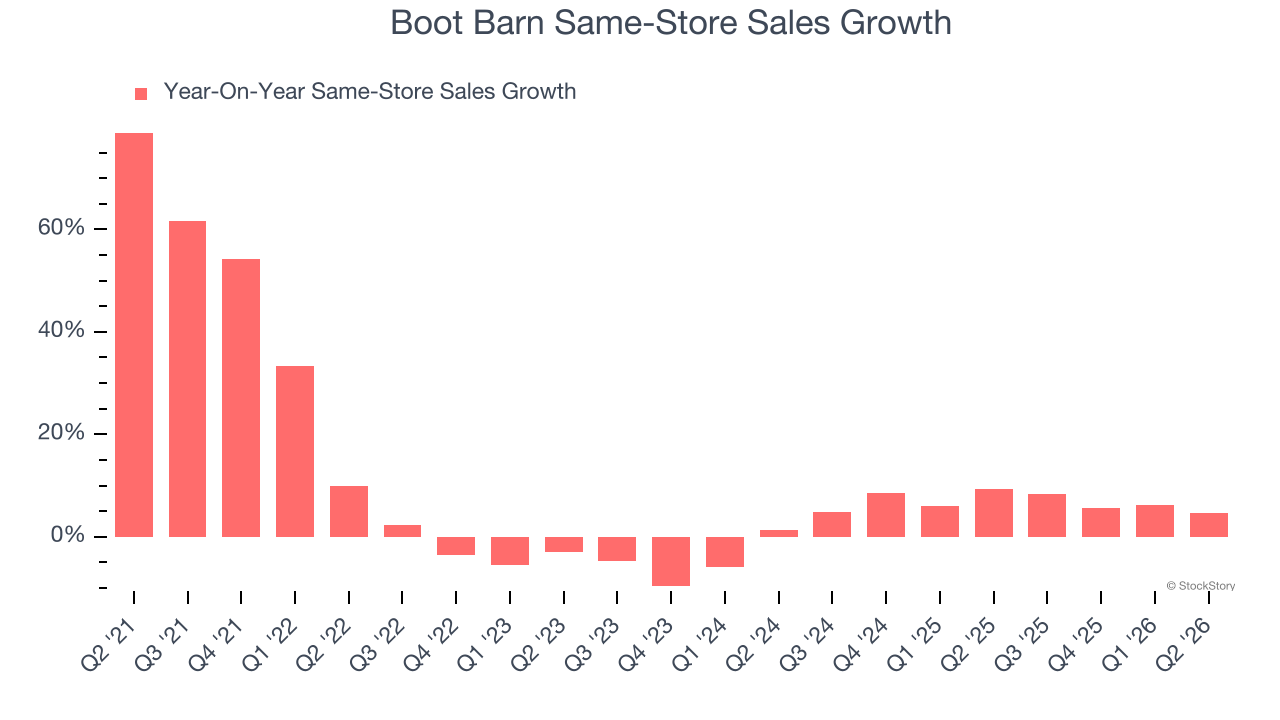
In the latest quarter, Boot Barn’s same-store sales rose 4.7% year on year. This growth was a deceleration from its historical levels, showing the business is still performing well but losing a bit of steam.
Key Takeaways from Boot Barn’s Q2 Results
It was good to see Boot Barn beat analysts’ EPS expectations this quarter. We were also excited its gross margin outperformed Wall Street’s estimates by a wide margin. On the other hand, its EPS guidance for next quarter missed and its revenue guidance for next quarter fell short of Wall Street’s estimates. Overall, this print was mixed. The stock remained flat at $149.43 immediately after reporting.
Is Boot Barn an attractive investment opportunity right now? What happened in the latest quarter matters, but not as much as longer-term business quality and valuation, when deciding whether to invest in this stock. We cover that in our actionable full research report which you can read here (it’s free).