
The end of an earnings season can be a great time to discover new stocks and assess how companies are handling the current business environment. Let’s take a look at how Gulfport Energy (NYSE: GPOR) and the rest of the mixed or offshore upstream e&p stocks fared in Q1.
This category includes smaller or niche E&P companies operating in specialized basins, geographies, or resource types outside major classifications. These firms may target unconventional resources, frontier regions, or specific commodity niches. Tailwinds include potential for outsized returns from successful exploration, acquisition opportunities during industry downturns, and specialized expertise commanding premium valuations. Headwinds include higher operational and geological risks, limited scale reducing negotiating power and cost efficiencies, and constrained capital market access during challenging commodity environments. Regulatory risks and ESG concerns may disproportionately affect smaller operators with fewer resources for compliance.
The 21 mixed or offshore upstream e&p stocks we track reported a strong Q1. As a group, revenues missed analysts’ consensus estimates by 0.8%.
Amidst this news, share prices of the companies have had a rough stretch. On average, they are down 10.4% since the latest earnings results.
Gulfport Energy (NYSE: GPOR)
With drilling operations focused on the Utica Shale in eastern Ohio and the SCOOP play in central Oklahoma, Gulfport Energy (NYSE: GPOR) drills for and produces natural gas from underground shale formations.
Gulfport Energy reported revenues of $437.5 million, up 122% year on year. This print exceeded analysts’ expectations by 6.4%. Despite the top-line beat, it was still a mixed quarter for the company.
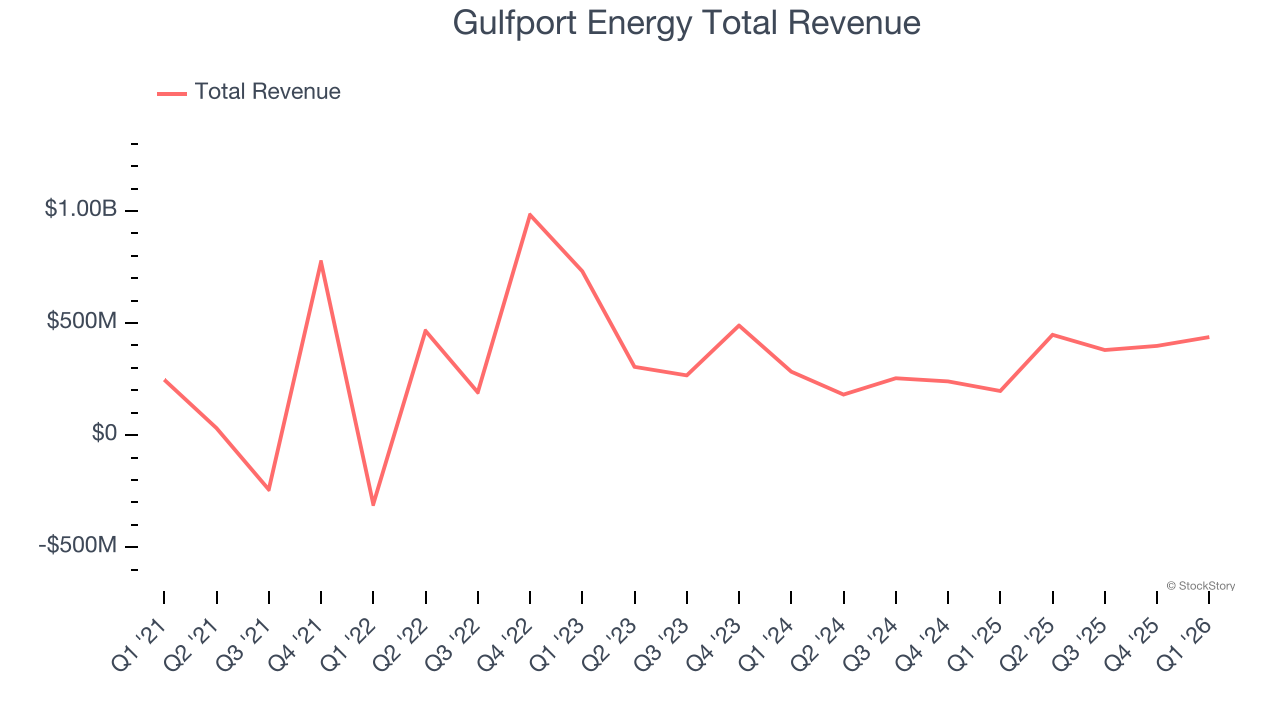
Gulfport Energy pulled off the fastest revenue growth among its peers. Still, the market seems discontent with the results. The stock is down 21.6% since reporting and currently trades at $153.01.
Is now the time to buy Gulfport Energy? Access our full analysis of the earnings results here, it’s free.
Best Q1: SM Energy (NYSE: SM)
Operating across three key regions with over 328,000 net acres under its control, SM Energy (NYSE: SM) explores for, develops, and produces oil, natural gas, and natural gas liquids primarily from shale formations in Texas and Utah.
SM Energy reported revenues of $1.48 billion, up 75.1% year on year, outperforming analysts’ expectations by 5.8%. The business had an incredible quarter with a beat of analysts’ EPS estimates.
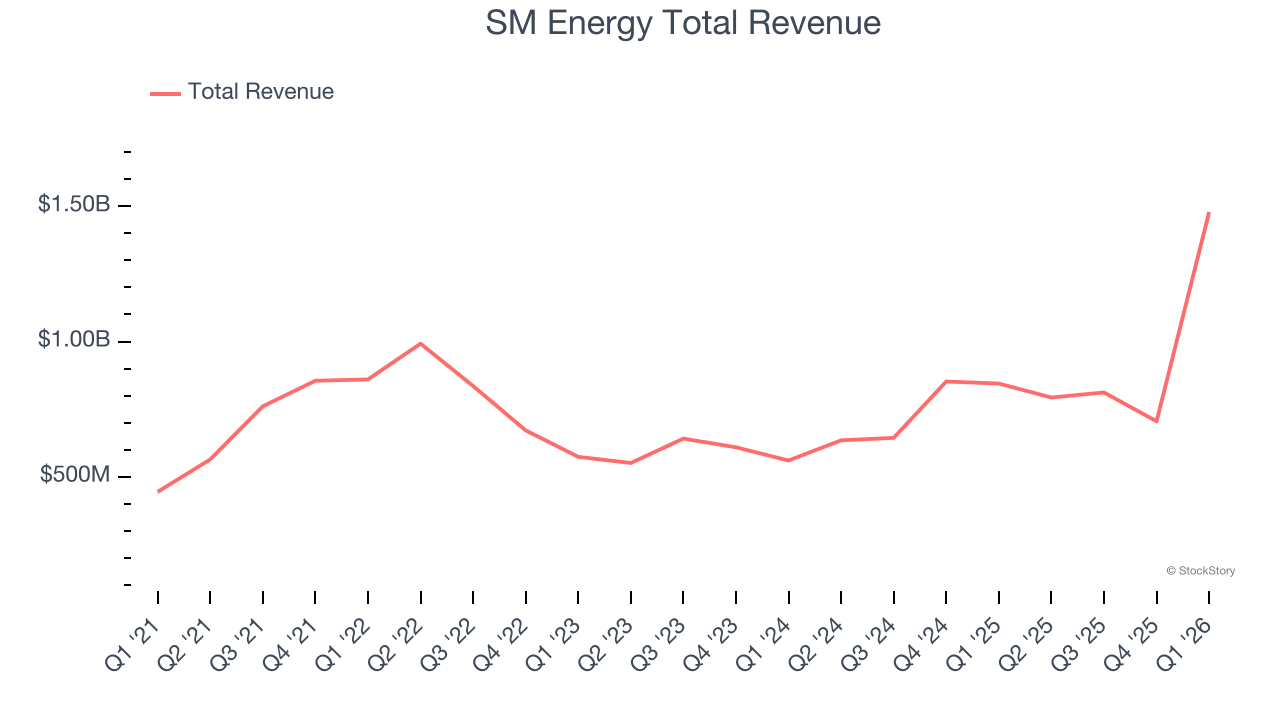
The market seems happy with the results as the stock is up 10.5% since reporting. It currently trades at $31.56.
Is now the time to buy SM Energy? Access our full analysis of the earnings results here, it’s free.
Weakest Q1: Vitesse Energy (NYSE: VTS)
Taking a hands-off approach to energy production, Vitesse Energy (NYSE: VTS) owns non-operated stakes in oil and natural gas wells primarily in North Dakota and Montana's Williston Basin.
Vitesse Energy reported revenues of $67.41 million, up 1.9% year on year, falling short of analysts’ expectations by 6.8%. It was a disappointing quarter as it posted a significant miss of analysts’ EBITDA and EPS estimates.
As expected, the stock is down 16.6% since the results and currently trades at $15.91.
Read our full analysis of Vitesse Energy’s results here.
Green Plains (NASDAQ: GPRE)
Operating one of North America's largest ethanol platforms with capacity to process 310 million bushels of corn annually, Green Plains (NASDAQ: GPRE) operates ten biorefineries that convert corn into ethanol for fuel, distillers grains for animal feed, and renewable corn oil.
Green Plains reported revenues of $445.8 million, down 25.9% year on year. This print lagged analysts’ expectations by 15.8%. Aside from that, it was a very strong quarter as it put up a beat of analysts’ EPS and EBITDA estimates.
Green Plains had the slowest revenue growth in the group. The stock is up 15.6% since reporting and currently trades at $19.61.
Read our full, actionable report on Green Plains here, it’s free.
Peabody Energy (NYSE: BTU)
Beginning with a single wagon hauling coal in Illinois back when Grover Cleveland was president, Peabody Energy (NYSE: BTU) mines coal used by electricity generators and steel manufacturers.
Peabody Energy reported revenues of $973.3 million, up 3.9% year on year. This number surpassed analysts’ expectations by 0.9%. Zooming out, it was a softer quarter as it logged a significant miss of analysts’ EPS estimates.
The stock is down 15.3% since reporting and currently trades at $22.45.
Read our full, actionable report on Peabody Energy here, it’s free.
Market Update
Over the past year, investors have been forced to repeatedly answer the same question: what is the market’s biggest risk? The answer has changed several times, and each shift has reshaped market leadership.
Late in 2025 and early 2026, artificial intelligence became the market’s primary uncertainty. Investors questioned whether AI would erode software pricing power and weaken competitive moats as AI made it easier to replicate once-differentiated products.
By the spring, technology took a back seat to geopolitics. The U.S. conflict with Iran briefly became the market’s dominant narrative, raising concerns about oil prices, inflation, and global growth. But as energy markets remained orderly and fears of a prolonged supply disruption faded, investors quickly turned their focus back to fundamentals.
Want to invest in winners with rock-solid fundamentals? Check out our 9 Best Market-Beating Stocks and add them to your watchlist. These companies are poised for growth regardless of the political or macroeconomic climate.